The sun over the Great Salt Lake doesn't just shine. It punishes. It is a white, searing light that bounces off the salt flats, turning the horizon into a shimmering mirage where the water used to be. For generations, the people of Utah have looked at this receding shoreline with a mixture of reverence and quiet terror. They know that when the water disappears, the arsenic in the lakebed doesn't stay put. It catches the wind. It enters the lungs.
In this brittle environment, every drop of water is a political act. Every acre of land is a legacy. So, when the news broke that a patch of desert twice the size of Manhattan was being earmarked for a single project, the silence in the local diners wasn’t born of awe. It was the silence of a people realizing they might be priced out of their own survival.
The project is a data center. But that phrase feels too small, too sterile. We are talking about a gargantuan digital lung, a sprawling complex designed to house the humming brains of the artificial intelligence revolution. It is a monument to our collective desire for more: more speed, more storage, more instant answers to trivial questions.
But machines don't just think. They sweat.
The Invisible Weight of a Click
When you type a prompt into an AI or stream a high-definition video, a physical chain reaction occurs hundreds of miles away. Somewhere in a dark, chilled room, a server rack begins to churn. It generates heat—immense, concentrated heat. To keep those circuits from melting, thousands of gallons of water must circulate through cooling systems.
This is the hidden tax of the digital age. We think of the "cloud" as something ethereal, a weightless mist floating above our heads. It isn't. The cloud is made of copper, silicon, and billions of gallons of freshwater diverted from the very ground we walk on.
In Utah, the scale of the approved development is almost impossible to visualize. Manhattan is roughly 23 square miles. This new data center footprint will swallow nearly 50 square miles of the West Desert. For the technocrats in Salt Lake City and the investors in Silicon Valley, this is a "megaproject." It represents jobs, tax revenue, and the prestige of being the backbone of the next industrial revolution.
For a farmer in Tooele County, it looks like a predator.
Consider a hypothetical rancher named Elias. He isn't a Luddite. He uses a smartphone to check cattle prices and monitors his irrigation through an app. But Elias understands a math that the developers often overlook. He knows that his wells are deeper than his father’s were. He knows that the snowpack in the Uintas is becoming a fickle friend. When he hears that a data center will require millions of gallons of water daily to keep its processors cool, he doesn't see "innovation." He sees his grandson’s inheritance evaporating into a cooling tower so someone in New York can generate a funny picture of a cat in a spacesuit.
A Geometry of Greed
The sheer physical footprint of this approval is what has local activists sounding the alarm. To grant a single entity the rights to develop an area twice the size of the world’s most famous island is not a standard zoning move. It is a surrender of the commons.
The logic used by the Utah Inland Port Authority and the developers is built on the idea of "productive use." They argue that this land is barren, dusty, and underutilized. In the eyes of a balance sheet, a desert is a zero. It only becomes a "one" when you pave it, wire it, and plug it into the grid.
But the desert is never empty. It is a delicate balance of crust and sagebrush that keeps the dust—and the toxins beneath it—at bay. When you scrape away 50 square miles of that crust to build a concrete fortress for servers, you aren't just building. You are unmaking.
The energy requirements alone are enough to stagger a power grid. A data center of this magnitude doesn't just sip electricity; it gulps it. To power the cooling fans, the lights, and the endless rows of high-performance GPUs, the project will require a dedicated infrastructure that could power hundreds of thousands of homes. In a state that still relies heavily on fossil fuels for its baseline power, the irony is thick. We are using the energy of the past to build a future that might be too hot to inhabit.
The Human Toll of High-Speed Dreams
Why here? Why Utah?
The answer is as cold as the servers. It’s about the climate, the cheap land, and a regulatory environment that has historically been more than welcoming to big tech. It is a business decision made with a spreadsheet, far removed from the sensory reality of a dust storm rolling off the Great Salt Lake.
There is a psychological cost to these developments that rarely makes it into the "Environmental Impact" reports. It is the feeling of being colonized by an invisible force. When a factory moves into a town, you see the smoke, you see the trucks, but you also see the product. You see things being made.
A data center is different. It is a tomb for data. It employs a fraction of the people a traditional factory would, given its size. Most of its inhabitants are machines. It sits there, a windowless monolith, humming with a frequency that vibrates in the teeth of the locals. It is a constant reminder that their resources—their water, their power, their space—are being exported to the digital ether.
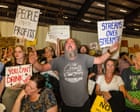
The "backlash" mentioned in the headlines isn't just about zoning laws or tax breaks. It is an emotional outcry against the feeling of being rendered obsolete in one’s own backyard. It is the frustration of being told that "progress" requires you to tighten your belt while the machine next door drinks its fill.
The Mirage of Infinite Growth
We have been conditioned to believe that the internet is infinite. We believe that there is always more room for another email, another video, another AI model. But the physical world is finite. Every bit of data has a weight in carbon and a price in water.
The approval of a Manhattan-sized data center is a symptom of a larger delusion. It is the belief that we can decouple our digital ambitions from our biological realities. We want the AI to solve our problems, but we are feeding it the very resources we need to survive the problems it hasn't solved yet.
Wait.
Listen to the sound of your own life for a moment. The rustle of the wind, the sound of a faucet dripping, the quiet of a room. Now, imagine that sound being replaced by the relentless, industrial drone of a million cooling fans. Imagine looking at a map and seeing a black square where the wilderness used to be—a square that represents the collective storage of every "like," every "share," and every "search" we’ve ever performed.
The real tragedy isn't that we are building these centers. It’s that we are doing it without asking what we are willing to lose. We are trading the tangible for the virtual. We are trading the cold, life-giving water of the mountains for the cold, lifeless circuits of the machine.
The Dust on the Horizon
The residents of the Salt Lake Valley are used to looking at the sky to see what the day will bring. They look for rain clouds. They look for the haze of an inversion. Soon, they will be looking at the horizon of the West Desert, wondering how much of it is left.
The decision has been made. The ink is drying on the permits. The excavators will arrive, and the desert will be carved into a grid of silicon and steel. The Manhattan of the West will rise, not with skyscrapers and jazz and the thrum of human life, but with windowless walls and the sterile glow of LED status lights.
As the sun sets over the Great Salt Lake, the water continues its slow, agonizing retreat. The arsenic waits in the mud. And in the distance, the machines are getting ready to drink.
They are very, very thirsty.