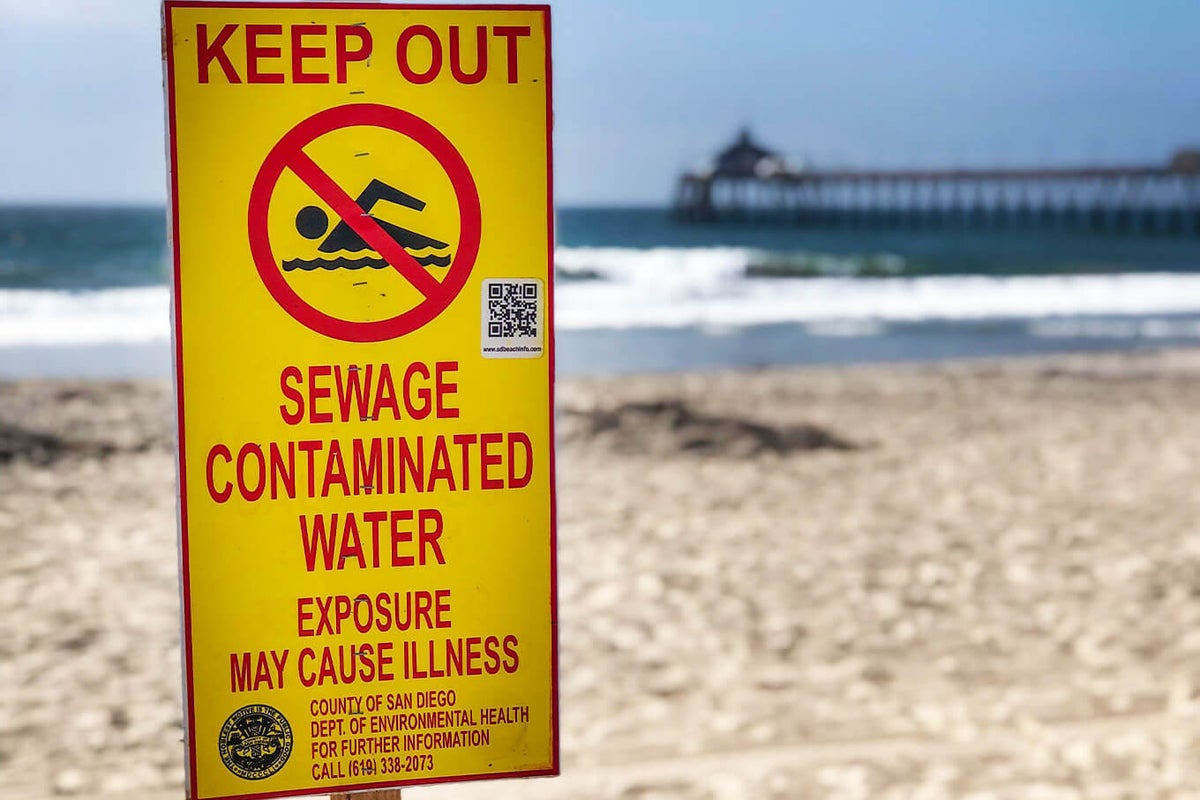
The saltwater used to crust on your skin like a second coat of armor. If you grew up anywhere near Imperial Beach, California, that sting on your lips after a long afternoon in the breaks was just part of the local currency. You paid it gladly. You traded sunburnt shoulders and sand-rimmed pockets for the absolute freedom of the Pacific.
Now, the only thing hitting your nose is the sour, unmistakable stench of rotten eggs and chemical waste.
It wafts over the dunes on the midday breeze. It creeps through the open windows of million-dollar beachfront properties and modest stucco bungalows alike. It settles in the back of your throat. A toxic reminder of a boundary line that nature refuses to recognize.
More than one thousand days.
Think about that number for a second. It is easy to let three digits, now rolling into four, blur into standard bureaucratic background noise. But a thousand days is a toddler growing into a child without ever touching the wet sand of their hometown beach. It is three full summers of empty lifeguard towers. It is hundreds of morning rituals rewritten in frustration, surfboards gathering thick layers of garage dust while the ocean just yards away churns, forbidden and foul.
Imperial Beach holds the grim crown of the longest continuous beach closure in the United States. This is not a temporary setback caused by a passing storm or a minor seasonal runoff. This is an environmental hostage situation.
The Invisible Boundary
The crisis begins just a few miles south, across an international border that exists only on maps.
Every single day, millions of gallons of untreated sewage, heavy metals, and industrial chemicals tear down the Tijuana River channel. The infrastructure in Baja California is buckled, broken, and hopelessly overwhelmed by rapid population growth. When the pumps fail, or when the rains come, the valley becomes a funnel. The destination is always the same.
Gravity does not care about passports.
The geography of the region dictates that everything dumped into the Tijuana River basin flows north-northwest. It spills directly into the Pacific Ocean just below San Diego. From there, the coastal currents take over, pushing a plume of gray, bacteria-laden sludge straight into the surf zones of southern California.
Consider a hypothetical resident named Javier. He is a third-generation resident who used to walk his dogs along the shoreline every morning at dawn. To Javier, the closure is not an abstract news headline about transboundary pollution. It is a physical theft of his lifestyle. He watches the yellow warning signs line the sand like tiny, plastic tombstones. Keep Out. Sewage Contaminated Water. The signs are faded now, bleached by the same sun that used to bring thousands of tourists to the local shops.
The economic pulse of a beach town lives and dies by its relationship with the water. When the water turns toxic, the local economy suffocates. Surf shops quietly close their doors. The taco stands that used to have lines wrapping around the block on a July afternoon sit quiet, their patio tables occupied only by the occasional drifter. The loss is calculated in millions of dollars, but the true cost is measured in the erosion of a community's identity.
A Cocktail of Neglect
What exactly is riding the waves? The reality is far worse than simple wastewater.
Scientists monitoring the water quality have documented a terrifying soup of contaminants. We are talking about astronomical levels of E. coli and enterococcus bacteria, strains that can cause severe gastrointestinal illness, skin infections, and respiratory failure. But the hidden danger lies in what the local maquiladoras—the manufacturing plants lining the border—discharge into the system.
DDT. Hexavalent chromium. Lead. Runoff from unregulated tire dumps and scrap yards.
When you stand on the pier at Imperial Beach, you are looking at a chemical catalog of modern industrialization, diluted by the sea but still potent enough to trigger emergency declarations. The air itself has become a vector. Recent studies by oceanographers have revealed that the crashing waves aerosolize these toxins. The bacteria and chemical compounds are kicked up into the sea spray, blowing inland and entering the lungs of people who have never even dipped a toe into the water.
It breaks your heart to watch the ocean on a perfect afternoon. The sets roll in beautifully, clean and glassy, catching the golden light of the setting sun. From a distance, it looks like paradise. It looks like the postcard California that people sell in movies.
Step closer.
The illusion shatters against the reality of the smell. It is a visceral, oily odor that clings to your clothes. It feels like a betrayal. The ocean is supposed to be the great equalizer, the public space that belongs to everyone. Instead, it has been transformed into a liquid fence.
The Friction of Two Nations
Fixing a crisis like this requires a level of diplomatic and bureaucratic coordination that seems almost impossible in the modern political climate. The International Boundary and Water Commission manages the treatment facilities, but funding has traditionally been a drop in a bucket that has a massive hole in the bottom.
The South Bay International Wastewater Treatment Plant is supposed to act as the shield. Built on the U.S. side of the border, its job is to catch and treat the incoming filth from Mexico. But the plant is old, neglected, and chronically underfunded. It was designed to handle 25 million gallons a day. During peak flows or infrastructure collapses in Tijuana, the volume can surge past 100 million gallons.
The system simply chokes.
The untreated excess pours out of the outfall pipes, raw and alive with pathogens, into the ocean currents. It is a loop of failure that repeats with agonizing predictability. Promises are made during election cycles. Federal funds are secured, celebrated in press conferences, and then swallowed up by the sheer scale of the repairs needed just to bring the current facilities up to baseline standards.
Meanwhile, the days tick upward. 1,001. 1,002. 1,003.
The community is tired of being patient. They are tired of hearing about task forces, bilateral agreements, and long-term environmental impact reports. When your eyes water just from standing on your front porch, five-year plans feel like an insult.
The Weight of the Wait
There is a quiet anger that settles into a town when its defining feature becomes dangerous. You see it in the eyes of the parents who have to drag their children away from the water's edge, explaining for the twentieth time why they cannot build a sandcastle near the foam. You see it in the local surfers who risk chronic illness, skin rashes, and neurological symptoms just to catch a wave, playing Russian roulette with a petri dish because the addiction to the ocean is too strong to quit.
The true tragedy of Imperial Beach is the normalization of the disaster.
People adjust. They drive thirty minutes north to Coronado or Mission Beach, fleeing their own coast to find clean water. They learn to live with the yellow signs. They stop looking at the horizon. The loss becomes a permanent fixture of life, a collective scar that everyone acknowledges but no one knows how to heal.
But you cannot truly walk away from the sea when it sits right at your doorstep. It is always there, murmuring in the dark, a massive, compromised lung breathing toxic mist into the coastal night. The surf keeps breaking, empty and beautiful, waiting for a day when the water runs clear again, and the long, silent exile finally ends.