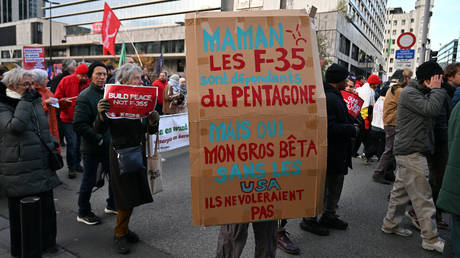
Tens of thousands of protesters flooded the streets of Brussels with a blunt message for European leaders. They want peace budgets, not fighter jets.
Specifically, they're furious about the F-35 Lightning II.
If you've been following European politics lately, you know defense spending has skyrocketed since Russia invaded Ukraine in 2022. Governments across the continent are scrambling to modernize their militaries, and Lockheed Martin's fifth-generation stealth fighter sits right at the center of that shopping spree. Belgium alone committed to buying 34 of these jets back in 2018, with deliveries rolling out through the mid-2020s.
Protesters aren't buying the official justification. During the massive demonstrations in the Belgian capital—home to both the European Union and NATO headquarters—activists, trade unionists, and everyday citizens marched under banners reading "Build peace, not F-35s." They argue that pouring billions of euros into American-made warplanes drains money directly from healthcare, climate action, and public infrastructure while escalating global tensions.
What Sparked the Brussels Anti-War Protests
You can't understand the Brussels march without looking at the numbers hitting European taxpayers right now. Inflation squeezed household budgets across Belgium and neighboring countries over the past few years, making massive military contracts a tough sell on the street.
The protest wasn't just a spontaneous gathering of pacifists. It was organized by a broad coalition of peace organizations, labor unions, and social movements—including groups like Vrede vzw and CNAPD—who routinely mobilize around NATO summits and European Council meetings. Their core argument is simple. Every euro spent on offensive military hardware is a euro stolen from social welfare and diplomatic conflict resolution.
People are angry. Honestly, it's easy to see why when you look at the price tag.
When Belgium first selected the F-35 over European alternatives like the Eurofighter Typhoon and the Dassault Rafale, the initial purchase price was estimated around €4 billion. Factor in decades of maintenance, pilot training, software updates, and specialized infrastructure at bases like Florennes and Kleine-Brogel, and the total lifecycle cost climbs past €15 billion. For a country of roughly 11.7 million people, that's a staggering commitment.
The Nuclear Question Nobody Wants to Answer
There's another layer to the F-35 controversy in Belgium that rarely makes the front page of mainstream news outlets. It's the nuclear mission.
Under NATO's nuclear sharing arrangement, Belgium hosts U.S. B61 tactical nuclear bombs at Kleine-Brogel Air Base in Limburg. While the Belgian government has historically maintained a policy of "neither confirm nor deny" regarding the weapons' presence, NATO documents and parliamentary debates have made it an open secret for decades.
The F-35A is specifically certified to carry the upgraded B61-12 guided nuclear bomb. Protesters in Brussels pointed out that buying the F-35 effectively locks Belgium—and by extension, Europe—into nuclear deterrence strategy for the next forty years without a genuine public referendum. For peace activists, that's not defensive posturing. It's a dangerous escalation.
Why European Governments Keep Buying the F-35 Anyway
If the public backlash is so loud, why are European defense ministries lining up to buy this jet?
Ask any military planner in Brussels, Berlin, or Warsaw, and you'll hear the same answer. Interoperability.
When you're running a 32-nation alliance like NATO, having air forces that can share sensor data, target tracking, and communications in real time changes everything on a battlefield. The F-35 isn't just a plane; it's essentially a flying supercomputer that talks to other F-35s, naval vessels, and ground radar systems automatically.
Look at the adoption rate across the continent:
- Belgium ordered 34 jets to replace its aging fleet of F-16 Fighting Falcons.
- Germany broke decades of post-World War II military restraint by ordering 35 F-35s, largely to maintain its own NATO nuclear-sharing role.
- Poland signed a $4.6 billion deal for 32 jets to deter Russian aggression on NATO's eastern flank.
- Finland committed to 64 jets—the largest military procurement in the country's history—right before joining NATO.
- The Netherlands, Norway, Denmark, Italy, and the UK are already flying them.
From a purely tactical standpoint, European defense ministers argue they don't have a choice. European-made jets like the French Rafale or the Swedish Gripen are capable aircraft, sure. Neither offers true fifth-generation stealth capabilities today, and Europe's own next-generation fighter programs—FCAS and GCAP—won't be operational until at least the late 2030s or 2040s.
The Hidden Friction Inside European Defense
Here's where things get messy, and where the protesters in Brussels actually have an unlikely ally in some European industrial circles.
Buying American jets undercuts European strategic autonomy. French President Emmanuel Macron has spent years warning that Europe relies too heavily on Washington for its security. When Belgium picked the American F-35 over the French Rafale in 2018, Paris was furious. French officials argued that European tax dollars should fund European aerospace jobs, not Lockheed Martin's assembly lines in Fort Worth, Texas.
Even though European companies build certain components for the F-35 supply chain, the intellectual property, source code, and primary economic benefits stay firmly in the United States.
Protesters marching through Brussels tapped directly into this frustration. Why are European citizens paying for a military buildup that enriches American defense contractors while domestic social services face austerity cuts? It's a question that bridges the gap between anti-war activists and economic nationalists.
What Critics Get Wrong About Military Spending
To be fair, the anti-F-35 movement sometimes oversimplifies a brutal geopolitical reality.
Peace slogans sound great on cardboard signs in front of the European Parliament. They don't stop ballistic missiles. Following Russia's full-scale invasion of Ukraine, Eastern European nations made it painfully clear that weak deterrence invites aggression. Countries like Poland and the Baltic states view heavy military investment not as warmongering, but as basic survival insurance.
When protesters demand an immediate halt to weapons procurement without offering a concrete security alternative for countries bordering Russia, they lose credibility with mainstream voters. You can't wish away authoritarian expansionism with diplomacy alone when the other side only respects hard power.
At the same time, defense hawks routinely ignore the opportunity cost of endless militarization. NATO's benchmark of spending 2% of GDP on defense—a floor that many alliance members are now pushing to raise toward 3% or higher—requires massive fiscal trade-offs. Governments rarely raise taxes on corporations to pay for fighter jets. Instead, they quietly trim budgets for green energy transitions, public transit, education, and healthcare.
What Happens Next for Belgium and NATO Budgets
The marches in Brussels won't cancel Belgium's F-35 contract. The first Belgian F-35s have already rolled off the production line, with pilot training underway at Luke Air Force Base in Arizona and aircraft arriving on Belgian soil. Walking away now would trigger massive financial penalties and leave the Belgian Air Component without functional fighter jets as its old F-16s are phased out and donated to Ukraine.
That doesn't mean the protests are pointless. Far from it.
Public pressure forces transparency around defense budgets that governments would rather pass quietly behind closed doors. Right now, European leaders are negotiating how to finance the next decade of rearmament—debating everything from joint EU defense bonds to relaxing strict debt rules for military spending.
If you want to understand where your tax money is going, don't just watch the press conferences from NATO headquarters. Look at national parliamentary budget debates in Brussels, Berlin, and The Hague over the coming months. Track whether governments fund defense increases through fair taxation or by gutting public services, and support independent watchdogs like the Stockholm International Peace Research Institute (SIPRI) and PAX that audit arms contracts and nuclear deployments. Keeping governments accountable requires watching the balance sheets just as closely as the streets.