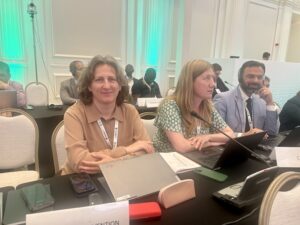
The air inside the Washington, D.C. conference center always tastes the same. It is a mix of recycled oxygen, expensive wool suits, and the faint, bitter scent of over-brewed coffee. Outside, a late-spring downpour slicked the streets, but inside, under the harsh glare of the fluorescent lights, a group of people held the fate of several billion lives in their hands. They were the Global Environment Facility (GEF) Council, an assembly tasked with distributing billions of dollars to keep the planet from fraying at the edges.
To the casual observer, the meeting was a masterclass in bureaucratic density. Acronyms floated through the room like heavy smoke. Documents hundreds of pages long were flipped through with practiced indifference.
But if you looked closer—if you looked past the bad ties and the diplomat badges—you could see the quiet panic in their eyes.
For decades, the world has treated its environmental crises like a man trying to fix a house by dealing with one room at a time. The plumber comes to fix the sink in the kitchen. The roofer patches the ceiling in the bedroom. The electrician rewires the basement. They never speak to each other. They don't know that the leaky roof is rotting the kitchen ceiling, or that the faulty wiring is about to spark a fire that renders the plumbing entirely irrelevant.
We have built a global apparatus that operates exactly like this broken house.
We have three distinct, massive international agreements—the UN Conventions on Climate Change, Biodiversity, and Desertification. In the dry language of international diplomacy, they are known as the Rio Conventions. For thirty years, they have operated in their own silos, hosting their own massive summits, known as COPs. They have their own budgets, their own languages, and their own armies of specialists.
Now, for the first time in history, the calendars have aligned. All three of these massive summits are set to take place within a single, breathless window at the end of the year.
The three clocks are about to strike midnight at the exact same time.
The Man with the Shovel
To understand why this bureaucratic alignment matters, you have to leave Washington and travel to a small patch of earth just outside of Niamey, Niger.
Let us call him Ibrahim. He is not a diplomat. He does not wear a badge, and he has never tasted conference-room coffee. Ibrahim is forty-two years old, but his hands look sixty. They are mapped with deep, dirt-caked lines, the result of three decades of trying to coax life out of a landscape that is turning into dust.
Ibrahim does not think about "biodiversity loss" when he wakes up. He thinks about the fact that the birds that used to eat the pests on his crops haven't returned this spring. He does not read reports on "climate change dynamics"; he simply watches the horizon, waiting for a rain that arrives two months late and falls with such violent fury that it washes away his topsoil instead of nourishing it. He does not study "desertification trends." He just measures the distance between his mud-brick home and the creeping edge of the Sahara with his footsteps.
To Ibrahim, these are not three separate crises. They are a single, suffocating python wrapping itself tighter around his throat every morning.
If the climate team gives Ibrahim a drought-resistant seed that requires chemical fertilizers that kill the remaining local insects, the biodiversity team loses. If the biodiversity team convinces a government to cordoning off a forest for protection, driving Ibrahim to clear scrubland elsewhere to feed his family, the desertification team loses.
When we isolate these problems in distant conference halls, Ibrahim is the one who pays the price for our neat, orderly categorization.
The GEF Council members know this. Or, at least, they are finally beginning to admit it out loud. Carlos Manuel Rodríguez, the CEO of the GEF, sat at the head of the table in Washington and looked out at the delegates. His voice lacked the usual polished neutrality of a seasoned official. He spoke with the urgency of someone who sees the structural failure of the building he is standing in.
The world, he signaled, can no longer afford the luxury of treating the earth as a collection of fragmented parts.
The Cost of the Split Screen
Consider the sheer absurdity of how we currently spend money to save ourselves.
Imagine a massive emergency fund. A country applies for a grant to plant millions of trees to absorb carbon dioxide. It sounds like a victory. The climate metrics go up; the spreadsheets look green and healthy. But because the project was funded purely through a climate lens, the planners select a single, fast-growing, non-native species of eucalyptus.
Within five years, those trees suck the local water table dry, exacerbating a drought that drives the surrounding grassland into complete desertification. The native birds flee. The local rodents overmultiply. The ecosystem collapses.
We spent millions of dollars to fix the kitchen sink, and we blew up the basement in the process.
This is not a hypothetical failure. It is a recurring tragedy enacted across millions of hectares of land in sub-Saharan Africa, Central Asia, and the Amazon basin. We are trapped in a cycle of competing cures, where the medicine for one ailment behaves like a poison for the next.
The upcoming convergence of the three COPs—Climate in Azerbaijan, Biodiversity in Colombia, and Desertification in Saudi Arabia—is either the ultimate logistical nightmare or the final opportunity to synchronize our defenses.
The delegates in Washington spent hours debating the "financial architecture" required to handle this moment. It is a term designed to make your eyes glaze over. But what it actually means is simple: Who gets the money, and how hard do we make them work to prove they aren't accidentally ruining everything else?
Currently, a developing nation looking to protect its coastal mangroves must fill out thousands of pages of distinct applications. One set for the carbon storage value. One set for the fish nurseries. One set for the coastal erosion prevention. The process takes years. It requires expensive consultants, usually flown in from Western capitals, who eat up a significant portion of the grant before a single seed is planted.
By the time the paperwork is approved, the mangrove forest has often already been cleared for a shrimp farm.
The Resistance of the Machine
Why has it taken thirty years to realize that the dirt, the air, and the animals are connected?
The answer lies in human nature and the terrifying power of institutional inertia. Bureaucracies are built to self-perpetuate. When you create an agency dedicated to a specific problem, that agency develops its own culture, its own heroes, and its own survival instincts. It views cooperation not as an opportunity, but as a threat to its funding.
During the council sessions, several delegates from smaller island nations spoke with an edge of quiet desperation that cracked through the decorum. For them, this isn't an academic debate about institutional synergy. It is a race against the tide.
A representative from a low-lying Pacific state described the reality of trying to manage these disjointed funds while their roads are actively collapsing into the sea. They do not have the staff to run three separate ministerial offices dedicated to three separate UN treaties. They have a handful of exhausted civil servants working out of a building that loses power when the storm surges hit.
The demand from the GEF floor was clear: the funding must become unified. The artificial walls must come down.
But saying it is easy. Implementing it means forcing powerful people to give up their territory. It means rewriting the rules of how international aid is tracked and evaluated. It requires a level of humility that is rare in international politics—the willingness to admit that our highly specialized, hyper-focused expertise has occasionally made us blind to the larger horizon.
The Threshold
We are living in an era of compounding feedback loops.
When the permafrost melts in Siberia due to rising temperatures, it releases vast plumes of methane. That methane accelerates global warming. The warming intensifies the droughts in the Canadian boreal forests. The forests burn, releasing decades of stored carbon back into the atmosphere while destroying the habitats of hundreds of species. The ash settles on Greenland's ice sheets, darkening the surface, causing them to absorb more sunlight and melt even faster.
The planet does not care about our committee structures. It does not recognize the boundaries between our treaties. It operates as a single, massive, breathing thermodynamic system.
The GEF Council’s call for unified action is an acknowledgment that our governance models must finally mirror the complexity of the ecosystem they are trying to protect. If the three COPs later this year remain separate exercises in national branding and isolated negotiations, we will have missed the last clear chance to pivot.
The rain outside the Washington conference center eventually stopped, leaving the streets damp and reflective under the streetlights. Inside, the delegates packed up their laptops, slid their badges into their briefcases, and headed toward the elevators. The papers they left on the tables were filled with track changes, bracketed text, and carefully negotiated compromises.
Thousands of miles away, Ibrahim walked out into his field. The air was hot, still, and heavy with the promise of a storm that might or might not come. He bent down, picked up a handful of the pale, dry soil, and let it sift through his calloused fingers. It drifted away on the light wind, disappearing into the twilight.
He does not know what was decided in that carpeted room in Washington. He only knows that the ground beneath his feet is slipping away, day by day, grain by grain, while the world decides which box it belongs in.