The radiator in Olena’s apartment in Kharkiv makes a sound like a dying kettle before it gives up entirely for the night. She does not get up to check it. In the fourth year of a war that has reshaped the borders of Europe and the grocery bills of families from Nairobi to Nebraska, you learn which noises mean danger and which ones merely mean cold. You pull a second wool blanket over your coat, stare at the pale blue glow of a phone screen running on a portable battery pack, and read a dispatch from half a world away.
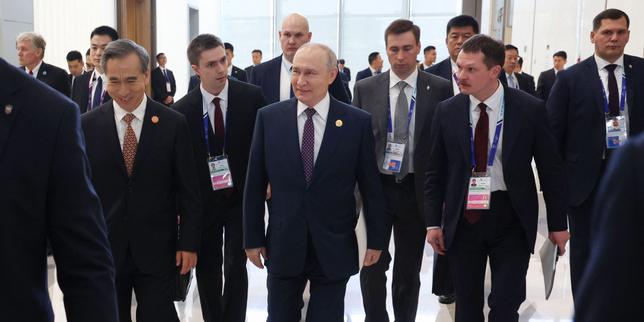
Russian President Vladimir Putin expects a summit with U.S. President Donald Trump and Chinese President Xi Jinping in China to be, in his words, "of great utility."
Read that phrase again. Of great utility.
It sounds like a municipal memo about sewer repairs or a quarterly earnings call for a mid-sized logistics firm. It is sanitized, clinical, and stripped of mud, blood, and diesel smoke. Yet behind those three bureaucratic words sits the most consequential diplomatic gamble of the twenty-first century—a high-stakes convergence of Washington, Moscow, and Beijing that could determine whether Olena’s radiator stays on next winter, whether Ukraine remains a sovereign state with defensible borders, and whether the post-1945 global order survives its severest test.
The Architecture of a Three-Way Gamble
To understand why a potential trilateral meeting on Chinese soil carries such seismic weight, you have to strip away the ceremonial handshakes and look at the cold arithmetic driving each leader to the table.
For years, diplomacy surrounding the Russia-Ukraine war operated on parallel, non-intersecting tracks. Western capitals coordinated sanctions and weapons deliveries through NATO and the European Union, insisting on the principle that borders cannot be redrawn by force and that nothing about Ukraine should be decided without Ukraine. Moscow, meanwhile, pivoted east, deepening its economic and energy dependence on Beijing while grinding forward in an attritional war across the Donbas. China walked a careful tightrope—professing neutrality, calling for peace talks, yet throwing Russia an economic lifeline through dual-use goods and discounted oil purchases that blunted the impact of Western sanctions.
Now, those tracks are colliding.
According to diplomatic reporting and public remarks from the Kremlin, Putin has signaled readiness and high expectations for a summit hosted by Xi Jinping that would bring Donald Trump into the same room. In Moscow’s framing, such a gathering is not merely a photo opportunity; it is an acknowledgment that the war in Ukraine cannot be resolved through European capitals alone, and that real power resides in a triangular negotiation among the world’s three dominant military and geopolitical heavyweights.
Think of it like three landlords sitting in a private dining room in Beijing, sketching property lines on a napkin while the family actually living in the house waits outside in the snow. That is a metaphor, of course, and diplomacy is rarely quite so neat. Yet for millions of Ukrainians—and for nervous officials in Warsaw, Tallinn, Berlin, and Brussels—the metaphor feels uncomfortably close to the truth.
What Each Leader Wants From the Room
Nobody travels across continents for a summit unless they believe the math favors them. Each of the three men contemplating this table enters with a distinct set of pressures, ambitions, and vulnerabilities.
Vladimir Putin wants legitimacy, relief, and codification. After years of diplomatic isolation from the West, standing beside both the American and Chinese presidents in Beijing signals to his domestic audience—and to the Global South—that Russia cannot be ostracized or defeated. More practically, the Russian economy, while resilient through massive state defense spending, faces mounting structural strain: labor shortages, persistent inflation, high interest rates, and degraded infrastructure. A settlement negotiated at the top tier offers Moscow a chance to freeze territorial gains on the ground, block Ukraine’s path into NATO, and secure the gradual dismantling of Western financial restrictions. When Putin calls the prospect of such a summit "of great utility," he is speaking the language of a leader who sees an opening to convert battlefield attrition into permanent political reality.
Donald Trump has long framed the conflict in Ukraine through the lens of transactional dealmaking and American burden-sharing. Throughout his return to the White House, he has argued that the war is a costly, destabilizing drain on U.S. resources that should be ended rapidly through direct, top-level negotiation. For Trump, a high-profile summit in China offers the prospect of dramatic, personal diplomacy—the kind of historic breakthrough that bypasses years of incremental multilateral gridlock. Yet it also carries acute strategic risk. Any agreement perceived as rewarding Russian aggression or sidelining European allies could fracture NATO cohesion and embolden adversaries elsewhere, particularly in the Indo-Pacific.
Xi Jinping holds the venue, the optics, and a decisive share of the leverage. By hosting a trilateral summit on Chinese soil, Beijing casts itself as the indispensable broker of global stability—the adult in the room capable of bringing Washington and Moscow together when European diplomacy has stalled. For Xi, the war in Ukraine has always been a double-edged sword. On one hand, it has tied down American attention and military stockpiles in Europe while turning Russia into a compliant junior partner dependent on Chinese markets. On the other hand, prolonged instability disrupts global trade, alienates European economies China still needs, and threatens to harden Western alliances. Facilitating a settlement allows Xi to claim the mantle of peacemaker while simultaneously negotiating bilateral trade, tariff, and technology tensions directly with Trump.
The Ghost at the Table
Notice who is missing from the headline.
Kyiv.
Whenever great powers gather to discuss the fate of a smaller nation, history leaves a trail of cautionary footnotes. In 1938, leaders met in Munich to settle the Sudetenland crisis without Czechoslovakia in the room, convinced they were securing "peace for our time." In 1945, at Yalta, the Allied powers redrew spheres of influence across Eastern Europe in ways that locked tens of millions of people behind the Iron Curtain for more than four decades.
Historical analogies are never exact replicas; 2026 is not 1938, and modern Ukraine is neither defenseless nor passive. Over four years of full-scale war, Ukrainian forces have defied every initial prediction of rapid collapse, retaking swaths of territory, neutralizing much of Russia’s Black Sea Fleet, and building one of the most innovative drone-warfare ecosystems on earth. European nations, too, have dramatically ramped up defense spending and industrial production, recognizing that their own security architecture is tethered to Ukraine’s survival.
Still, the anxiety rippling through Kyiv and European capitals is real, visceral, and entirely rational.
Consider a hypothetical scenario—one that defense planners in Brussels have war-gamed behind closed doors for months. Suppose a trilateral summit in Beijing produces the outline of a ceasefire: a freeze along existing front lines, a moratorium on Ukrainian NATO membership, and a phased easing of sanctions in exchange for a halt to Russian offensive operations. On paper, the shooting stops. Headlines around the world proclaim peace.
Now walk down to street level and watch what happens next.
Without ironclad, enforceable security guarantees—backed by credible military force rather than paper promises—a frozen conflict is simply an intermission. We have already seen how this movie plays out. In 2014 and 2015, the Minsk agreements were hailed as diplomatic off-ramps after Russia’s seizure of Crimea and incursion into eastern Ukraine. Instead of durable peace, those agreements gave Moscow seven years to fortify its positions, build parallel institutions, and prepare the full-scale invasion of February 2022.
Ask any soldier rotating out of the trenches near Pokrovsk or Kupiansk what a ceasefire without real deterrence means. It means giving an adversary time to replenish artillery shells, train fresh conscripts, and choose the exact morning to resume the assault.
The Hidden Price Tag Everyone Pays
It is tempting, if you live five thousand miles from the Dnipro River, to treat a summit in Beijing as distant geopolitical theater—fascinating to watch on evening news broadcasts, irrelevant to your daily routine.
That illusion never survives contact with reality.
Every major shift in the Ukraine conflict sends shockwaves directly into household budgets and national economies worldwide. Ukraine and Russia together account for massive shares of global wheat, barley, corn, sunflower oil, and fertilizer exports. When Black Sea shipping lanes are threatened or infrastructure is bombed, food prices spike in Cairo, Lagos, and Jakarta. When European energy markets scramble to replace Russian pipeline gas with liquefied natural gas shipments, industrial costs rise in Germany and utility bills climb across the continent.
Beyond commodities lies an even deeper stakes-raiser: the precedent set for global rules.
Think of international norms like the traffic signals at a busy four-way intersection. They do not physically stop a reckless driver; a red light is just colored glass and electricity. What keeps the intersection from collapsing into daily carnage is the shared expectation that running the light carries swift, certain consequences. If the three largest vehicles on the road pull into the center of the intersection and decide among themselves that red lights are optional for heavy trucks, every smaller car on the street suddenly has to buy armor plating.
In Taipei, Tokyo, Seoul, and Manila, policymakers will dissect every syllable emerging from a Beijing summit. If the lesson of the Ukraine war is that a nuclear-armed power can invade a neighbor, absorb years of sanctions, and eventually ratify its territorial conquest at a summit table with Washington and Beijing, the nuclear non-proliferation regime weakens overnight. Nations that spent decades trusting security umbrellas will quietly ask whether they need their own nuclear deterrents to survive.
The Fog of High-Stakes Diplomacy
Here is the uncomfortable truth that pundits rarely admit on television: nobody knows how this ends, and anyone claiming absolute certainty is selling you a story rather than insight.
Diplomacy at this altitude is notoriously volatile. Public statements about a summit "of great utility" are themselves instruments of leverage—carefully calibrated signals designed to test resolve, sow doubt among allies, or shape domestic narratives before a single negotiator boards a plane. Putin’s optimism could be genuine confidence that he holds strong cards, or it could be theater aimed at driving a wedge between Washington and Europe while buying time on the battlefield. Trump’s willingness to engage could yield an unexpected framework that compels real concessions from Moscow, or it could collide with the stubborn reality that neither Kyiv nor Moscow is prepared to accept the other’s core demands. Xi’s readiness to host could reflect a sincere desire to stabilize global markets, or a calculated move to extract American concessions on Taiwan and trade in exchange for leanings on Moscow that never fully materialize.
We are watching three leaders play three-dimensional chess on a board where the rules are being rewritten mid-game.
For Olena in Kharkiv, though, the game is not abstract. When morning finally breaks and the grey winter light filters through the plastic sheeting taped over her blown-out window frame, she will boil water on a camping stove, check the local Telegram channels for air-raid alerts, and walk to the hospital where she works as a nurse. She does not care about the choreography of motorcades in Beijing or the adjectives used in Kremlin readouts. She cares about one simple, stubborn question: whether the men deciding the future of her country will remember that a map is not made of ink and paper, but of homes, graveyards, and people who refuse to disappear.



