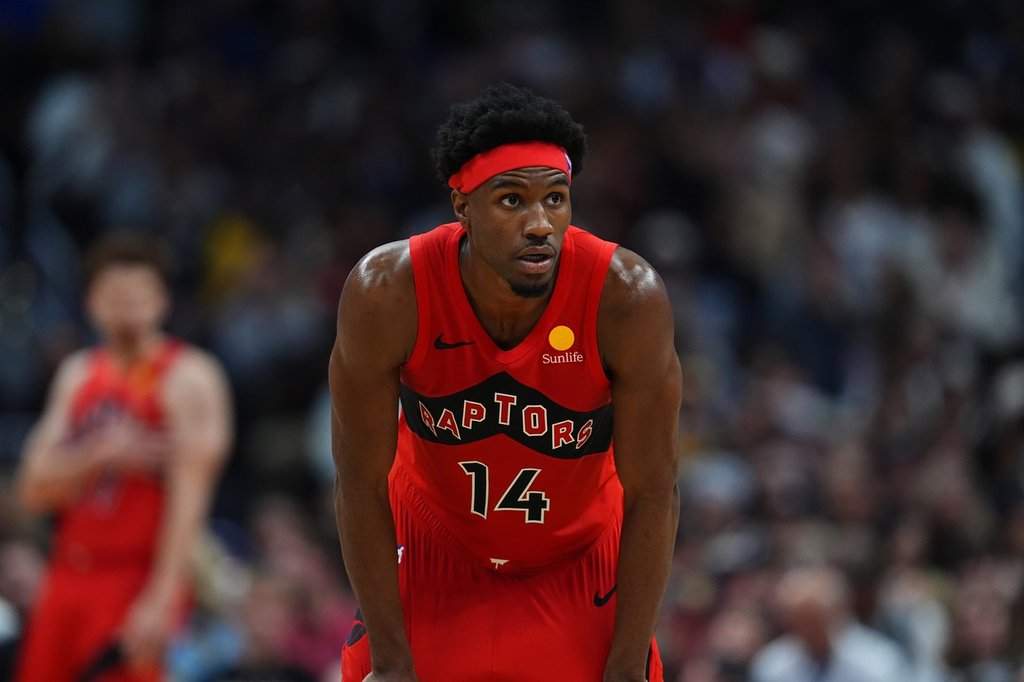
The Toronto Raptors do not merely rely on the three-point shot; their entire offensive ecosystem functions as an asymmetric risk engine where expected value is subordinated to shot volume and spatial geometry. When an NBA franchise constructs a roster around length, switchability, and transitional pace rather than elite half-court isolation scoring, the three-point line ceases to be a supplementary weapon and becomes a structural load-bearing wall. If that wall holds, Toronto overwhelms opponents through mathematical surplus and defensive disruption. If it fractures under the weight of shooting variance, the entire tactical architecture collapses into stagnant, low-efficiency possessions.
To understand why the Raptors exhibit such extreme game-to-game volatility, we must strip away the conventional sports cliché of "living and dying by the three" and replace it with an operational framework. In modern basketball analytics, offensive output is governed by three primary inputs: shot quality, shot volume, and shooter conversion rate. Toronto’s system is deliberately engineered to maximize the first two variables while accepting extreme volatility in the third. You might also find this related coverage insightful: Why Roberto Clemente’s Sons Losing at the Supreme Court Actually Protects Every Athlete’s Legacy.
The Three Pillars of Toronto's Perimeter Architecture
Every possession in Toronto’s half-court and transition offense is designed to solve a specific spatial problem. Without a perennial top-five half-court creator capable of breaking down a set defense off the dribble at will, the coaching staff relies on systemic ball movement and defensive pressure to manufacture open looks.
1. Drive-and-Kick Compression
The primary half-court initiator attacks the paint not exclusively to score at the rim, but to trigger defensive help rotations. When a ball-handler penetrates the midline or baseline, the opposing weak-side defender must choose between conceding a layup or tagging the roller, thereby abandoning their assignment on the perimeter. Toronto’s offense operates on a strict trigger-and-release mechanism: penetration forces collapse, and the immediate pass out to the strong-side or weak-side corner exploits the recovery time of the rotating defender. The mathematical objective is to generate uncontested catch-and-shoot opportunities, which historically yield significantly higher expected points per possession than off-the-dribble perimeter attempts. As discussed in latest reports by ESPN, the implications are widespread.
2. Transitional Pitch-Ahead Mechanics
Toronto’s defensive identity—built on long wingspans, aggressive passing-lane deflections, and switch-heavy schemes—serves as the primary fuel for its perimeter offense. Live-ball turnovers and long rebounds immediately initiate a sprint-to-the-corners protocol. Rather than attacking a scrambled defense solely at the rim, trailing bigs and secondary wings flare to the above-the-break arcs. This forces retreating defenders to sprint past the three-point line to contest shooters, opening up secondary driving lanes if the closeout is overly aggressive. Here, the three-point shot acts as a spatial wedge that prevents opponents from packing the paint in transition.
3. Offensive Rebounding as Variance Insurance
High-volume perimeter shooting inherently produces long rebounds, as missed three-pointers bounce further from the basket than missed mid-range or paint shots. Toronto systematically converts this physical byproduct into a second-chance possession engine. By crashing the glass with athletic wings from the weak side, the Raptors attempt to offset low initial conversion percentages through sheer possession volume. If a team shoots a suboptimal percentage from deep, securing an extra ten to twelve offensive rebounds per game artificially inflates their total points per possession, masking underlying shooting inefficiency.
The Cost Function of Shooting Variance
While the strategic logic behind high-volume perimeter shooting is sound over an 82-game sample size, individual games and short playoff series are governed by standard deviation. Understanding Toronto's volatility requires examining the Cost Function of Shooting Variance—the cascading operational failures that occur when the team’s three-point percentage drops below its break-even threshold.
In basketball economics, a 33.3% conversion rate from three-point range yields 1.00 point per shot, the exact mathematical equivalent of shooting 50% from two-point range. When Toronto’s perimeter shooters collectively fall into a slump, shooting below 30% for a half or a full game, three immediate structural breakdowns occur:
- Spatial Contraction: Opposing defenses stop honoring the catch-and-shoot threat on the weak side. Defenders sink into the paint with both feet inside the lane, effectively building a wall against Toronto's primary drivers. Without credible shooting gravity, the drive-and-kick engine stalls because the defense no longer needs to rotate to cover the perimeter.
- Defensive Transition Erosion: Missed three-pointers are the single greatest catalyst for opponent fast breaks. Unlike a made basket, which allows Toronto to set its full-court or half-court defensive shell, a missed three generates a long rebound directly into the hands of opposing guards already leaking out. Cold shooting nights directly degrade Toronto’s defensive rating, creating a negative feedback loop where offensive misses fuel opponent layups.
- Shot-Clock Compression: When initial drive-and-kick actions fail to produce an open look because defenders refuse to close out, the offense is forced to reset with fewer than eight seconds remaining on the shot clock. This forces non-elite isolation scorers into contested, late-clock mid-range attempts or step-back threes—the lowest-efficiency shots in the sport.
Fact Versus Hypothesis in Roster Construction
Evaluating the sustainability of this offensive model requires separating established statistical realities from unproven strategic hypotheses regarding player development and roster balance.
Established Operational Facts:
- Gravity is Binary: Defenses react to historical shooting reputation, not theoretical potential. A player shooting below league average on open catch-and-shoot attempts will be systematically ignored in high-leverage minutes, regardless of how quickly they release the ball.
- Corner Efficiency Outperforms Above-the-Break: Across the league, corner three-pointers are shorter in distance and yield higher conversion rates than above-the-break attempts. However, corner shots are dependent on ball movement and cross-court skip passes, making them the first shots to disappear against disciplined, lengthy defensive schemes.
- Free-Throw Rate Inverse Correlation: Teams that rely heavily on perimeter jump shots naturally draw fewer shooting fouls than teams that attack the rim relentlessly. On nights when the three-point shot is not falling, Toronto lacks the free-throw safety net that stabilizes the offenses of teams anchored by dominant interior scorers.
Strategic Hypotheses:
- The Two-Way Wing Ceiling: The prevailing front-office hypothesis in Toronto has long been that teaching long, defensive-minded athletes to shoot at a league-average clip is easier than teaching elite shooters how to defend multiple positions. While sound in theory, this hypothesis runs into diminishing returns when multiple non-shooters share the floor simultaneously, as the lack of spacing prevents any single player from operating in rhythm.
- Volume Over Accuracy: Another core assumption is that taking 38 to 42 three-pointers per game will eventually yield positive regression to the mean. While valid over a six-month regular season, this hypothesis fails in single-elimination environments or seven-game series where a four-game cold streak results in immediate elimination before mathematical regression can occur.
Tactical Counter-Measures Against Defensive Packing
When an opponent intentionally concedes the perimeter to choke off the paint, continuing to fire contested or hesitant three-pointers plays directly into the defensive game plan. To break this equilibrium without overhauling the entire roster mid-season, a coaching staff must deploy specific tactical adjustments that punish defenders for sagging off the arc.
- Early-Clock Pitch and Re-Screen Actions: Instead of holding the ball on the perimeter when a defender sags into the paint, the ignored shooter must immediately sprint into a dribble handoff (DHO) or set a flare screen for the primary ball-handler. Because the defender is positioned ten feet away in the lane, they cannot fight over the screen in time, gifting the ball-handler an uncontested three-pointer or a downhill runway with a full head of steam.
- 45-Degree Cut Exploitation: When a weak-side defender turns their head to watch the ball in the paint, the perimeter player must abandon the three-point line and execute a sharp 45-degree cut toward the rim. This punishes ball-watching, forces the help defender to recover backward, and creates high-percentage layup opportunities that restore offensive rhythm without requiring a single jump shot.
- Short-Roll Playmaking: When opponents trap or blitz the pick-and-roll to force the ball out of the primary creator’s hands, the screener must slip into the free-throw line area—the short roll—rather than popping to the arc. From the middle of the floor, a competent passer faces a four-on-three advantage where simple, short-range bounce passes to baseline cutters bypass the perimeter entirely.
- Inverted Pick-and-Rolls: Using a primary wing initiator as the screener for a smaller, faster guard forces the opponent's best perimeter defenders into switches or miscommunications. Even if the wing is not an elite shooter, their size advantage on a smaller guard allows them to seal deep in the post, drawing double teams from a completely different angle on the floor.
The Structural Limits of the Perimeter-Heavy Model
No tactical adjustment completely eliminates the inherent fragility of a perimeter-dependent offense. The fundamental limitation of Toronto’s system is its reliance on external variables—specifically, the shooting accuracy of role players—to unlock the primary skills of its best players. In championship-level basketball, the hierarchy is reversed: the superstars' gravitational pull creates open shots for the role players, not the other way around.
Furthermore, physical fatigue over a compressed schedule disproportionately affects jump shooting. Leg fatigue alters release mechanics, reduces arc, and results in flat, front-rim misses. A team built around defensive intensity, full-court pressure, and relentless offensive rebounding expends massive amounts of anaerobic energy on every possession. Asking those same players to maintain elite shooting precision in the fourth quarter of a back-to-back game introduces an internal physiological contradiction: the exact effort required to generate extra possessions depletes the fine motor control needed to convert them.
The Strategic Imperative for Roster Evolution
To transition from a high-variance regular-season threat into a resilient playoff contender, the Raptors must recalibrate the balance between spatial creation and interior pressure. Relying on collective shooting luck is a losing proposition against elite defenses that shrink the floor in April and May.
The immediate operational mandate is twofold: acquire at least one high-volume, off-the-dribble perimeter threat who commands automatic double teams above the break, and aggressively stagger lineups so that no more than one below-average shooter occupies the floor at any moment. Until Toronto pairs its defensive length with genuine, self-created perimeter gravity, every game will remain an exercise in statistical roulette—dictated not by tactical superiority, but by whether the ball happens to drop from twenty-four feet away.