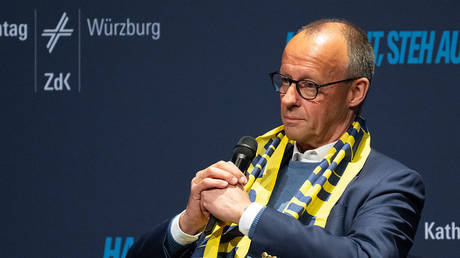
German Chancellor Friedrich Merz recently sparked a wave of debate by advising young Germans against migrating to the United States. While critics dismissed the rhetoric as standard political posturing, the statement uncovers a deeper, structural shift in transatlantic economics. Germany is facing a severe skilled labor shortage, and the traditional path of sending top-tier talent to Silicon Valley or Wall Street is no longer a sustainable option for Berlin. Merz's warning is not merely cultural commentary. It is a desperate economic defense mechanism disguised as parental advice.
For decades, the trajectory for Germany's brightest minds in engineering, software development, and medicine was clear. They left. They sought the higher salaries, venture capital wealth, and deregulation of the American market. Expanding on this topic, you can find more in: The Bangkok Rail Crossing Crisis We Keep Ignoring.
Now, the math is changing. As Europe attempts to build its own technological sovereignty, losing another generation of researchers and engineers to American corporations presents a direct threat to the continent's industrial survival.
The Economic Anxiety Behind the Rhetoric
To understand the timing of this warning, look at the German demographic ledger. The country requires hundreds of thousands of skilled immigrants annually just to maintain its current industrial output. When domestic talent leaves, the gap widens dangerously. Experts at Reuters have provided expertise on this matter.
Berlin is currently pouring billions into domestic semiconductor plants, green energy infrastructure, and artificial intelligence research. These investments are useless without the human capital required to run them. Every software engineer who packs a bag for San Francisco represents a lost return on a massive public investment. German taxpayers fund highly efficient, tuition-free university education, only for the economic rewards of that education to be harvested by American tech giants.
This is the real friction point. The German state can no longer afford to act as a free talent incubator for foreign competitors. The warning issued to youth isn't about the perils of American life; it is about the preservation of German industrial capability.
A Changing American Reality
The American dream looks different from the outside than it does from the boardroom of a European industrial hub. Merz's commentary touches on a reality that many young migrants ignore until they land at JFK or LAX.
Consider the financial equation. A salary of $150,000 in Munich or Stuttgart allows for an exceptional quality of life, backed by comprehensive social safety nets, mandatory paid vacation, and robust employee protections. That same salary in San Francisco or New York is quickly consumed by exorbitant housing costs, private healthcare premiums, and the high cost of basic services.
Transatlantic Talent Trade-Off
+-----------------------+-----------------------+-----------------------+
| Metric                | German Urban Hubs     | US Tech/Finance Hubs  |
+-----------------------+-----------------------+-----------------------+
| Base Salary Potential | Moderate (Regulated)  | High (Variable)       |
| Health/Social Safety  | Universal Coverage    | Employer-Dependent    |
| Employment Security   | High Legal Protection | At-Will Employment    |
| Cost of Living Index  | Moderate-High         | Extreme               |
+-----------------------+-----------------------+-----------------------+
The structural fragility of working in the US has become glaringly obvious over the past few years. The wave of sudden mass layoffs in the tech sector left thousands of foreign workers on H-1B visas with a ticking clock to find a new employer or face deportation. For a young German professional accustomed to strict labor laws and lengthy notice periods, the American "at-will" employment system can be a brutal wake-up call.
The Sovereignty Gamble
Berlin is trying to position itself as a viable alternative to the American ecosystem, but it is fighting an uphill battle. The European Union's regulatory environment, while protective of citizens, often moves too slowly for rapid commercial scaling.
Young innovators frequently complain about the bureaucratic hurdles of starting a business in Germany. Raising capital remains significantly harder in Frankfurt than it is in Boston. While the US relies on market forces to dictate growth, Germany utilizes a more coordinated market economy. This approach provides stability, but it rarely produces the astronomical financial returns that attract ambitious twenty-somethings.
Merz is gambling that a appeal to stability, combined with growing domestic opportunities in specialized high-tech sectors, will outweigh the allure of American corporate culture. It is a high-stakes strategy. If the government fails to reduce the domestic bureaucratic burden, the warning will fall on deaf ears.
The Hidden Subsidies of Domestic Talent
There is a fiscal argument that rarely makes the front pages. When a German citizen migrates, they take their future tax contributions with them. The German social security system relies on a steady influx of young, high-earning contributors to support an aging population.
When the top decile of university graduates leaves the country, the system weakens. The state loses the income tax, the pension contributions, and the consumption taxes that these individuals would generate over a forty-year career.
By framing the United States as a risky destination, political leaders are attempting to shift the cultural narrative. They want to make staying in Europe look like the smarter, safer, and ultimately more lucrative long-term bet.
The Migration of the Middle Matrix
The discussion usually centers on high-profile tech founders, but the more damaging loss occurs in the middle matrix of the workforce. These are the mid-level mechanical engineers, corporate data analysts, and specialized laboratory technicians. They are the backbone of Germany's Mittelstand, the medium-sized enterprises that drive the national economy.
American companies have grown increasingly adept at recruiting these specific workers. Remote work options initially allowed these professionals to stay in Europe while earning American wages, but many eventually cross the Atlantic to climb the corporate ladder.
The Mittelstand cannot compete with the sheer financial scale of American multinationals. To counter this, the German strategy must rely on non-monetary incentives. Quality of life, parental leave, urban infrastructure, and long-term stability are the selling points.
The Cultural Friction
Beyond the economic balance sheet, there is a widening cultural gap between European and American work environments. The hyper-individualistic, high-output expectations of American corporate culture are increasingly out of sync with the values of younger European workers who prioritize work-life balance and environmental sustainability.
Politicians recognize this shift. By highlighting the social deficits of the American model, from the lack of federal paid leave to the broader political polarization, they are tapping into the specific anxieties of the current generation.
It is a calculated messaging campaign. The goal is to redefine success. Instead of measuring career achievement purely by net worth or corporate title, the narrative pushes for a broader definition that favors the European social model.
Rebuilding the European Appeal
If Germany wants to keep its talent, words will not suffice. The country must fundamentally reform how it treats young professionals and entrepreneurs.
This means streamlining the process for commercializing academic research. It means creating tax incentives for early-stage investments. It means modernizing the public sector so that dealing with the state does not feel like stepping back into the nineties.
The warning from the Chancellery is an admission of vulnerability. It acknowledges that the traditional pull factors of the United States are still powerful enough to warp the domestic labor market. The response cannot just be a critique of the American system; it must be a radical improvement of the European one.
The flow of talent has always driven geopolitical dominance. For the past century, the Westward flow across the Atlantic was taken for granted. If Europe intends to chart its own course in the coming decades, that flow must stop. The political rhetoric we are seeing now is the first visible crack in a long-standing economic consensus, signaling a more protective, competitive era of global talent acquisition.