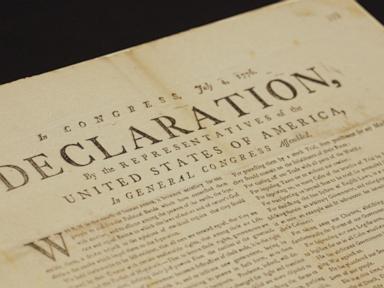
The Atlantic Ocean in the late eighteenth century was not a highway. It was a desert of grey water, terrifyingly vast and indifferent to the fragile wooden shells that dared to cross it. Inside those ships, men lived on the edge of oblivion, teeth loosening from scurvy, hands calloused by coarse hemp ropes, hearts heavy with the knowledge that a single rogue wave or a flash of cannon fire could erase them forever.
In the middle of the American War of Independence, a small American merchant vessel creaked through these hostile waters. Its hull carried the standard survival gear of colonial commerce, but its most dangerous cargo was silent. It was tucked away in a captain's leather sea chest, buried beneath logbooks, navigation charts, and personal letters. For a deeper dive into this area, we suggest: this related article.
It was a single sheet of paper.
To the British Empire, that paper was a death warrant. To the men on board, it was an entirely new way of looking at the world. When a British Royal Navy frigate loomed over the horizon, its massive canvas sails blotting out the sun, the destiny of that ship was sealed. The guns boomed. The American vessel surrendered. British sailors swarmed over the decks, their boots heavy against the wood, their eyes searching for contraband. They tore through the cabins, throwing aside blankets and overturning chests. For further context on this development, comprehensive reporting can also be found at Associated Press.
They were looking for gold, gunpowder, or military intelligence. Instead, they pulled out a freshly printed copy of the Declaration of Independence.
Imagine the colonial printer who pressed that ink onto the page. His fingers would have been permanently stained black, working by the flickering light of a tallow candle in a cramped Philadelphia alley. The air in his shop smelled of linseed oil and damp rag paper. Every pull of the heavy iron press was a physical defiance of the King. If the British army marched into his city, that press would be smashed, and he would swing from a gallows. Yet, he worked through the night, running off copies to be scattered across the colonies and smuggled across the ocean.
One of those copies ended up in the dark, damp hold of a blockade runner.
When the British officers found it among the captured ship's papers, they did not burn it. They did not throw it overboard. They logged it. They bundled it up with the ship's mundane receipts for rum and molasses, tied it with coarse twine, and sent it back to London. It was treated as evidence of a crime, a strange artifact of a wild rebellion brewing across the sea.
For centuries, that piece of paper lay forgotten. It sat in a dark archive, buried under millions of other bureaucratic documents generated by the sprawling machinery of the British Empire. Generations lived and died. The British Empire expanded and dissolved. The United States grew from a fragile experiment into a global superpower. And all the while, the captured document slept in the dark, its ink fading slightly, its edges fraying, a forgotten casualty of an old war.
The discovery of this document centuries later changes how we view the spread of ideas. History books often treat the American Revolution as an intellectual argument between wealthy men in clean suits, debating philosophy in well-lit rooms. We read the polished words of Thomas Jefferson or Benjamin Franklin and forget the terrifying physical reality of spreading those words.
Ideas do not fly across oceans on their own. They must be carried through the mud, hidden in pockets, and smuggled past enemy lines by ordinary people who have everything to lose.
Consider the captain of that captured ship. We do not know if he was a true believer in the cause of liberty or simply a merchant trying to make a living in a world torn apart by war. But by carrying that document, he became part of something massive. He was a vector for an idea that the British Crown desperately wanted to quarantine. The moment those words were printed, they became contagious. You could capture the ship, you could imprison the crew, and you could lock the paper in a vault in London, but you could not stop the infection from spreading.
When modern researchers finally untied that bundle of captured papers and smoothed out the folds of the document, the effect was electric. It was like touching a live wire connecting the present day directly to the terror and excitement of 1776. The paper was still crisp. The typography still screamed its defiance.
The real power of this find is not its financial value. It is the reminder of how fragile our certainty really is. We look back at history and assume the outcome was inevitable. We know how the story ends. The Americans win, the British lose, and the world moves on. But the men on that ship did not know that. As they watched the British frigate close the distance, their hearts hammering against their ribs, they probably thought they were going to die in a rotting prison hulk off the coast of New York or England. They had no idea that their misfortune would preserve a piece of history for centuries.
The captured Declaration of Independence is a monument to failure that became a triumph of preservation. By capturing the ship, the British Royal Navy inadvertently acted as a time capsule, shielding a rare piece of revolutionary media from the fires, floods, and carelessness that destroyed so many copies back home.
The paper survived precisely because it was stolen.
Next time you look at a historic document behind thick glass in a museum, look past the elegant handwriting and the famous signatures. Think about the grease on the printer's hands. Think about the salt spray soaking into the wood of the cargo hold. Think about the unknown captain watching his ship being boarded, wondering if that single piece of paper in his trunk would be the thing that hanged him.
The grand narratives of human freedom are built on these small, terrified moments. The ideas we take for granted today were once raw, dangerous, and hidden in the dark, waiting for the world to catch up.