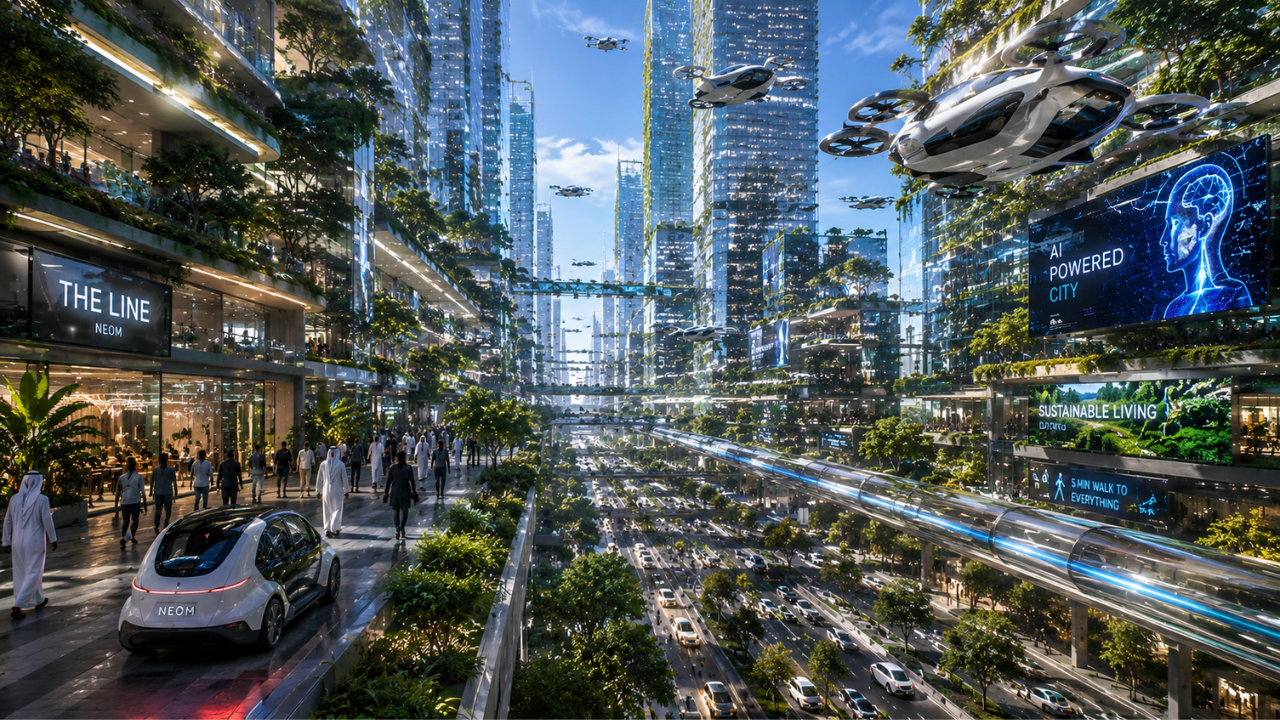
Saudi Arabia is quietly shrinking its ambitions for Neom and its flagship 170-kilometer mirrored metropolis, The Line. While early promotional materials promised a thriving home for 1.5 million residents by 2030, officials have drastically revised those expectations downward, now aiming for fewer than 300,000 people. Financial realities, supply chain bottlenecks, and the sheer physics of building a hyper-dense skyscraper in the desert have forced the kingdom to dial back its timeline. The mega-city is not being canceled, but the gap between marketing hype and industrial execution has finally closed.
This retreat exposes the structural limits of oil wealth when deployed against unprecedented engineering challenges.
The Arithmetic of an Empty Treasury
For years, the public narrative around Neom treated the Saudi Public Investment Fund (PIF) as an bottomless well of capital. It is not.
Managing a multi-trillion-dollar development portfolio requires a constant balancing act. The kingdom is simultaneously funding Neom, the Red Sea Project, Qiddiya, a massive expansion of Riyadh, and the upcoming Expo 2030. When oil prices dip below the level needed to balance the national budget, the government faces a stark choice: burn through cash reserves, borrow heavily on international markets, or prioritize projects.
The math caught up with the dream. Sovereign wealth funds look massive on paper, but much of that wealth is tied up in illiquid assets, global equities, and domestic corporations like Saudi Aramco. Pulling hundreds of billions of dollars out of these revenue-generating investments to fund an experimental city that will not turn a profit for decades is bad financial strategy. International foreign direct investment into Neom has also lagged far behind initial projections. Global investors remain skeptical of the project's long-term viability, leaving the Saudi state to shoulder nearly the entire financial burden alone.
Engineering Confronts the Laws of Physics
Building a continuous structure that is 500 meters tall, 200 meters wide, and meant to stretch across mountains and deserts introduces unprecedented structural vulnerabilities.
The Line was designed to eliminate cars, relying instead on a high-speed underground rail system to transport residents from one end to the other in 20 minutes. To cover 170 kilometers in that timeframe, a train must travel at speeds exceeding 500 kilometers per hour. That requires specialized maglev technology, perfectly straight tracks, and immense amounts of energy.
When the projected length of the city shrunk to just 2.4 kilometers for its first phase, the entire transit logic collapsed. You cannot accelerate a train to hyper-speed over a distance of two kilometers without injuring the passengers.
Microclimate management inside a giant glass trench presents another massive hurdle. The mirrored facade reflects the brutal desert sun outward, altering the local thermal profile. Inside the structure, the lack of natural cross-ventilation creates a stagnant heat-island effect. Cooling a 500-meter-tall canyon requires a continuous supply of electricity, powered by a green hydrogen and solar grid that does not yet exist at this scale. Contractors quickly realized that building the infrastructure to support the city was costing more than the city itself.
The Talent Exodus and Corporate Friction
Behind the glossy architectural renders lies a corporate culture strained by impossible deadlines and shifting mandates.
Neom has historically paid premium salaries to attract top international executives from the fields of tech, logistics, and architecture. However, the retention rate tells a different story. Dozens of senior managers have left the project over the past three years.
Estimated Project Adjustments (By 2030)
+-------------------+--------------------+--------------------+
| Metric            | Original Target    | Revised Target     |
+-------------------+--------------------+--------------------+
| Population        | 1.5 Million        | < 300,000          |
| Completed Length  | 170 Kilometers     | 2.4 Kilometers     |
| Main Focus        | The Line Skyscraper| Industrial Port/Oil|
+-------------------+--------------------+--------------------+
The friction stems from a fundamental mismatch in expectations. Western executives accustomed to data-driven timelines and iterative construction milestones found themselves reporting to a political leadership that demanded instant, groundbreaking results. When engineering consultants pointed out that certain design elements violated basic safety codes or supply chain realities, they were often sidelined or replaced. The resulting atmosphere of caution slowed decision-making to a crawl, stalling progress on the ground while millions of dollars leaked away in consulting fees.
Shifting Priorities to Tangible Wins
With the World Cup coming to Saudi Arabia in 2034 and the Asian Winter Games scheduled for 2029 at Neom’s mountain resort of Trojena, the kingdom has to build things that work, and build them quickly.
Trojena requires artificial snow-making infrastructure in an increasingly volatile climate. Oxagon, the planned floating industrial city, requires actual deep-water port operations to attract manufacturing giants. These projects offer clear, measurable economic utility. The Line, by contrast, is a speculative real estate play.
By scaling back the skyscraper and refocusing resources onto the industrial port and sports tourism infrastructure, Saudi planners are trying to secure tangible wins before the global spotlight intensifies. They are quietly shifting from a utopian narrative to an industrial one. The mirrors are shrinking, but the factories and concrete foundations are staying.
The scaling down of Neom shows that even the most ambitious visionaries must eventually bow to the realities of capital markets, logistics, and physics. The kingdom's grand experiment is transitioning from a sci-fi manifesto into a standard, albeit massive, regional infrastructure project, proving that you can buy a lot of things with oil money, but you cannot buy an escape from economic gravity.