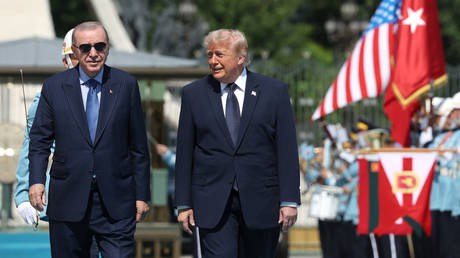
Donald Trump likes strongmen, and he really likes deals. Right now, at the NATO summit in Ankara, those two traits are merging in a way that sends shivers down the spine of the Israeli defense establishment. The reality is simple. Trump flirting with Turkey is making Israel uneasy because it threatens the exclusive strategic monopoly Jerusalem enjoyed in Washington during his first term. When Trump stands next to Turkish President Recep Tayyip Erdogan and calls him terrific, it isn't just standard political theater. It is a signal that the regional hierarchy in the Middle East is shifting, and Israel might have to share center stage with an adversary that openly backs Hamas.
The immediate flashpoint is the F-35 fighter jet. Turkey wants them back. Trump says he will certainly consider it. For Prime Minister Benjamin Netanyahu, this is an absolute nightmare scenario. He took to American television networks to argue that giving advanced jets to Ankara would shatter the regional balance of power. It's a massive shift from the days when the White House viewed the Middle East entirely through an Israeli lens.
Why Trump Flirting With Turkey Shifts the Balance of Power
Israel has always relied on its Qualitative Military Edge. That's the formal doctrine ensuring Washington only sells weapons to regional actors that won't compromise Israel's military dominance. For years, this doctrine kept Turkey out of the F-35 loop after Erdogan bought Russian S-400 missile systems.
Trump is changing the conversation entirely. He doesn't look at Turkey through the lens of ideological purity. He looks at it as a transactional partner with a massive army.
Trump argues that Turkey has been loyal. He points out that Ankara stayed out of the recent US-Israeli conflict with Iran. In Trump's mind, Erdogan didn't join the fight because of their personal relationship. It's classic Trump logic. He believes personal chemistry overrides deep structural animosities.
Jerusalem sees things differently. Erdogan has called Israel a burden that humanity can no longer bear. His government actively harbors Hamas leadership. Giving fifth-generation stealth fighters to a country with that posture isn't just a diplomatic slight. It is a direct security threat to the Israeli Air Force, which uses those exact same jets to maintain dominance over regional skies.
The Blue Homeland Threat Below the Radar
Israeli planners aren't just looking at the sky. They are looking at the sea. Turkey has been pushing a doctrine called the Blue Homeland. It's an aggressive maritime strategy designed to expand Ankara’s control over the Eastern Mediterranean.
This brings Turkey into direct conflict with Greece and Cyprus, two countries Israel has spent the last decade building tight energy and security alliances with. If Trump welcomes Erdogan back into the American hardware fold, it boosts Turkish confidence. An emboldened Turkey means more pressure on the natural gas fields and shipping lanes that Israel considers vital to its economic survival.
The Syria and Iran Friction Points That Changed Everything
The rivalry isn't hypothetical anymore. It played out behind the scenes during the tail end of the recent Iran hostilities. Reports indicate that a planned joint US-Israeli ground offensive meant to destabilize the Iranian regime was abandoned at the last minute.
Why did it fall apart? Erdogan reportedly phoned Trump and put on immense pressure to halt the operation, coordinating closely with Syrian leadership.
Israel wanted to keep regional authority fragmented to preserve its total freedom of action. Turkey wanted a stabilized Syrian state to prevent Kurdish uprisings and massive refugee flows. Trump listened to Erdogan. This tells us everything we need to know about where the leverage lies right now.
- The Syrian Arena: Turkey successfully pushed for the recognition of the new dynamics in Damascus, running counter to Israel's goals.
- The Mediation Game: Turkey positioned itself as the key backchannel during the hostage release deals, proving its utility to Trump's team.
- The Russian Factor: Washington believes keeping Ankara close prevents it from falling entirely into Moscow's orbit.
How Israel is Trying to Force a Course Correction
Netanyahu is playing a delicate diplomatic game. He can't attack Trump directly. Trump is still wildly popular among the Israeli public and has a history of holding grudges against foreign leaders who cross him. Instead, the Israeli strategy focuses entirely on demonizing Erdogan while praising the American president.
Netanyahu conducts his media campaigns on Fox News because he knows Trump watches it. He praises their personal coordination while painting Turkey as an unstable, radical state that occupies half of Cyprus and threatens its neighbors.
It's a tough sell. Trump's current foreign policy team, including Vice President JD Vance, views the world through a hard-nosed realist framework. They look at the map and see a Turkish military with millions of soldiers controlling the vital passage between the Black Sea and the Mediterranean. To them, that is an asset you don't push away, regardless of what Erdogan says about Israel in public speeches.
The New Reality Jerusalem Has to Accept
The old rules are dead. For a long time, Israel operated under the assumption that its security interests were the absolute starting point for any American policy in the Middle East. That era is fading. Trump's willingness to sell advanced weapons to Turkey shows that Washington is balancing its priorities differently now.
If you want to understand where this goes next, stop looking at the rhetoric and watch the US Congress. The administration has already notified lawmakers of its intent to sell hundreds of millions of dollars in jet engines to Turkey. That's the real test. If that deal slides through without major institutional resistance, the F-35s won't be far behind.
Israel needs to pivot its strategy immediately. Relying solely on public relations blitzes on American television isn't going to stop a transactional superpower from making deals that suit its global ledger. Jerusalem must find ways to make its own utility undeniable to Washington, or accept that the skies over the Mediterranean are about to get a lot more crowded.