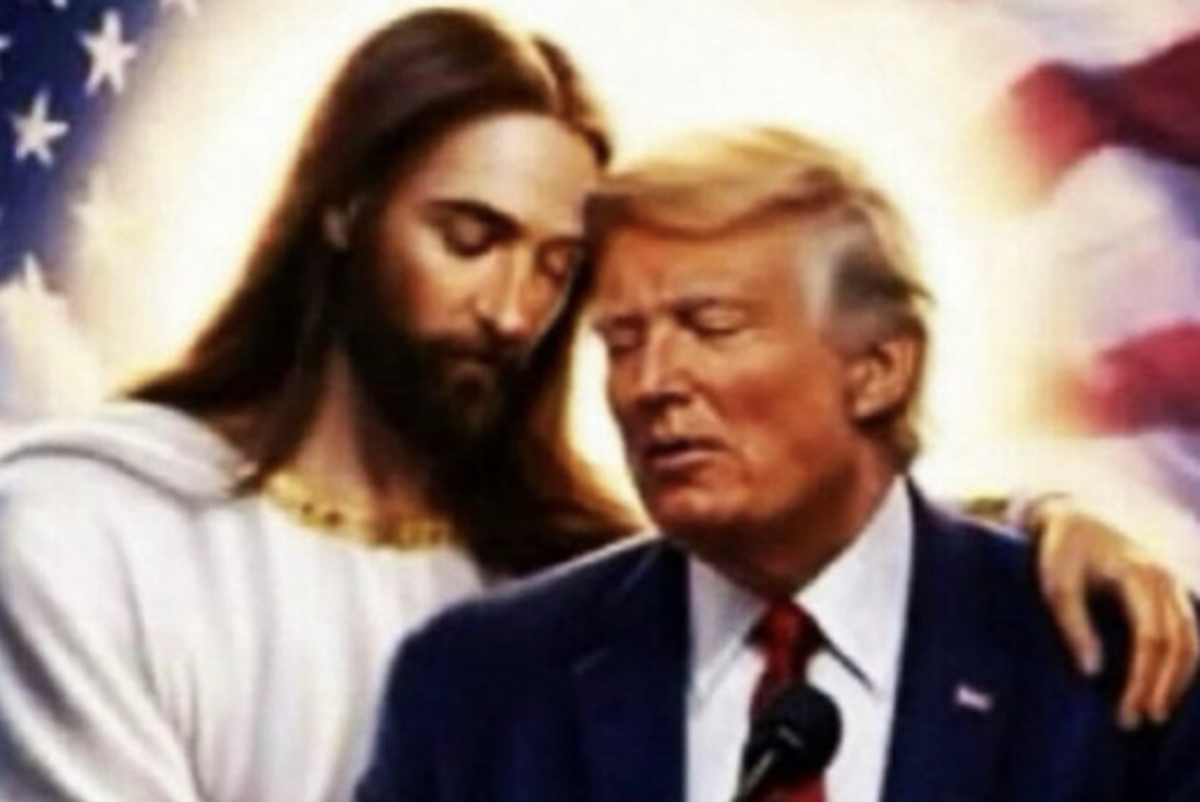
Donald Trump doesn’t back down when he’s cornered. He leans in. On Wednesday morning, the world saw this play out again on Truth Social. Just days after a massive wave of criticism—including from his most loyal evangelical base—forced him to delete an AI-generated image of himself as a Christ-like deity, he posted another one. This time, it’s a picture of Jesus hugging him.
It’s a classic move from the Trump playbook. If you get caught going too far, don’t apologize. Just pivot to something slightly less "sacrilegious" but equally provocative. For a man who’s currently feuding with Pope Leo XIV over the war in Iran, these images aren't just social media filler. They’re a direct message to his followers about where he thinks his authority comes from.
The image that broke the MAGA internet
The controversy started Sunday night. Trump shared an AI-generated masterpiece that crossed a line even for some of his staunchest supporters. In the image, Trump wore flowing white robes and a red cloak. He held a glowing orb in one hand while the other rested on the forehead of a sick man in a hospital bed. Beams of light shot from his fingers. It wasn't just a "patriotic" photo; it was a full-on messianic depiction.
The background was a chaotic blend of American symbolism—bald eagles, the Statue of Liberty, fighter jets, and fireworks. It looked like something ripped from a fever dream of a digital artist. But for many Christians, it looked like blasphemy.
Prominent conservative voices didn't hold back. Riley Gaines, a frequent guest at Trump’s White House, took to X to voice her confusion. "God shall not be mocked," she wrote, suggesting a bit of humility would serve him well. Megan Basham, a well-known columnist for the Daily Wire, called it "OUTRAGEOUS blasphemy." Even the most loyal segments of the religious right started to recoil. By Monday morning, the post was gone.
The doctor defense that nobody bought
When reporters asked him about the deleted post on Monday, Trump did what he always does. He redefined reality. He claimed he didn't even realize it was supposed to be Jesus.
"I thought it was me as a doctor," he told reporters. He tried to tie it to the Red Cross, saying it was about "making people better." Honestly, it’s a tough sell. The image featured 1st-century robes and divine light, not a stethoscope or a lab coat. But by Tuesday, he’d already moved on to his next target: the Pope.
Trump’s recent attacks on Pope Leo XIV have added fuel to this fire. He called the pontiff "WEAK on crime" and "terrible for foreign policy" because the Pope criticized the U.S. involvement in Iran. By posting images of himself being embraced by Jesus, Trump is effectively trying to bypass the institutional church. He’s telling his base that he has a direct line to the divine, even if the "liberal" Pope disagrees.
Why the Jesus hug is a strategic pivot
Wednesday's post—the one of Jesus hugging Trump—is a calculated step back from the "AI-Deity" status. It’s "safer." In this version, he isn't the savior; he’s the one being saved or comforted. It’s a subtle shift that aims to quiet the blasphemy charges while still keeping the religious imagery front and center.
But why keep doing it? Because it works. Despite the vocal critics, Truth Social remains flooded with this kind of content. His supporters often share images of him surrounded by lions, angels, or biblical figures. It reinforces a narrative of "divine protection" that has only grown stronger since he survived an assassination attempt in 2024.
The risk of alienating the base
Trump won Catholic voters by a significant margin in 2024—56% to 42%. He can't afford to lose that group. While many of his supporters see these images as harmless expressions of faith, the "blasphemy" tag is a dangerous one. When you have people like Michael Knowles and Isabel Brown calling your posts "disgusting" and "unacceptable," you've hit a nerve.
The real danger for Trump isn't the "Radical Left" he complains about. They were never going to vote for him anyway. The danger is the evangelical mom in Iowa or the Catholic worker in Pennsylvania who starts to feel that their faith is being used as a cheap political prop.
You’re seeing a new kind of digital theology emerging. It’s messy, it’s AI-generated, and it’s deeply polarizing. Trump isn't just running a campaign; he’s maintaining a persona that demands total devotion. If the Pope won’t give him the stamp of approval, he’ll just generate it himself with a prompt and an algorithm.
If you’re following this, keep a close eye on the reaction from local church leaders, not just the big influencers. That’s where the real impact will show up. Don't expect an apology anytime soon—that’s just not how he operates. Instead, look for more of these "comforting" images to appear every time his foreign policy or personal conduct gets questioned by religious authorities.
Check your news feeds for the next round of AI art. It’s becoming the primary language of the MAGA movement, and it’s not going away.