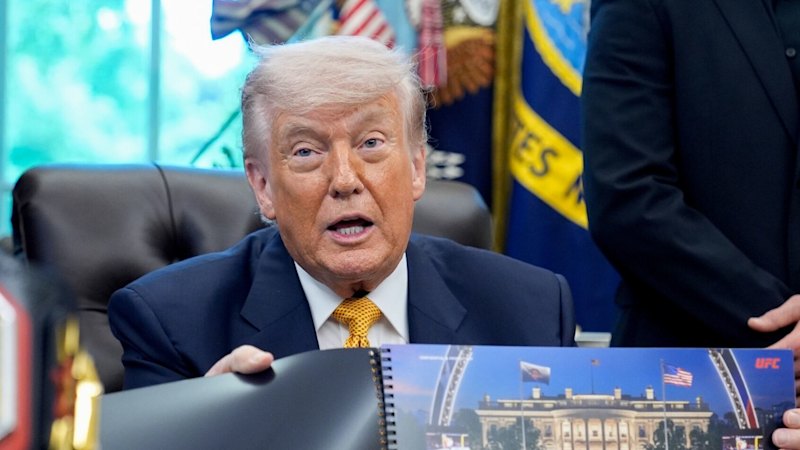
Cranes are dominating the Washington skyline, lifting massive metal arches directly onto the South Lawn. The White House, historically the backdrop for tense diplomatic negotiations and stately press conferences, is transforming into a full-blown sports arena. Donald Trump is celebrating his 80th birthday on June 14, 2026, by hosting an official Ultimate Fighting Championship event right outside the Oval Office.
If you think this sounds like a fever dream or a satirical headline, you aren't paying attention. The event, officially dubbed UFC Freedom 250, aligns with Flag Day and kickstarts celebrations for the United States' 250th anniversary. It is the ultimate manifestation of Trump's brand: loud, disruptive, and deeply intertwined with sports entertainment.
Whether you love the idea or find it completely unpresidential, the cage is going up. Here is what is actually happening on the lawn, how the logistics work, and why this event is a masterclass in modern attention economics.
The Logistics of a South Lawn Octagon
Building a professional fight venue on historic, protected grounds is a logistical nightmare. Crews are working around the clock to construct a temporary 4,500-seat arena right outside the executive mansion.
The centerpiece is the famous eight-sided wire-mesh cage, ringed by a vibrant red, white, and blue stage. Overhead, a towering custom arch flown in from Europe—dubbed "the claw"—will hold the lighting rig. Dana White, the UFC Chief Executive Officer, explicitly stated that the design ensures the historic facade of the White House remains perfectly visible as the background for every single frame of the broadcast.
Because 4,500 seats on the lawn won't satisfy global demand, the event is taking over neighboring federal land. Huge screens are going up at the Ellipse park just south of the grounds. Organizers plan to broadcast the action live to an additional 75,000 to 100,000 spectators for free.
Who is Footing the 60 Million Dollar Bill
An event of this scale does not come cheap. Corporate disclosures from UFC's parent company, TKO Group Holdings, estimate the production costs will exceed $60 million. For context, that is significantly more than the $21 million spent on the highly praised UFC 306 production inside Las Vegas's high-tech Sphere.
Critics immediately raised concerns about government waste, but the administration insists that taxpayers are completely off the hook. UFC is covering the entire tab. This includes an estimated $700,000 specifically earmarked to entirely restore and re-turf the South Lawn grass after the heavy equipment and thousands of stamping feet leave the property.
To recoup that cash, TKO Group Holdings is selling ultra-premium sponsorship packages. Corporate executives and high-net-worth individuals are shelling out up to $1.5 million for ringside seats.
The remaining ticket distribution is incredibly exclusive. There are no public tickets for sale. Instead, the entry list is broken down into highly curated blocks:
- Donald Trump: 1,000 personal invitations.
- Dana White: 200 VIP tickets.
- Ari Emanuel (TKO CEO): 200 VIP tickets.
- U.S. Military: The entire remaining block of roughly 3,000 seats is reserved for active service members.
The Fight Card Built for the White House
The actual sporting lineup has drawn mixed reactions from hardcore mixed martial arts fans online, but it features heavy hitters. It is a six-fight card topped by two massive championship bouts.
In the main event, Spanish-Georgian sensation Ilia Topuria faces off against interim lightweight champion Justin Gaethje. Gaethje is one of only two Americans currently holding a piece of a UFC world title, making his inclusion on Flag Day highly intentional.
The co-main event features a massive heavyweight clash. Brazil's striking specialist Alex Pereira will face France's Ciryl Gane for the interim UFC heavyweight championship.
The day before the fights, the National Mall will host a massive fan festival. The weigh-ins are scheduled to take place right on the steps of the Lincoln Memorial, capped off by a performance by the Zac Brown Band, interactive fan zones, and a massive fireworks display.
Security Challenges in an Open Air Arena
Staging a massive, highly publicized sporting event on the open-air lawn of the president's residence introduces unprecedented security vulnerabilities. The Secret Service is already on high alert following multiple high-profile security scares involving Trump earlier this year.
Just months ago, a gunman was neutralized near the perimeter of the mansion, and an alleged assassination attempt occurred during the White House Correspondents' Dinner. Adding thousands of civilian guests, corporate sponsors, and a live rock band into a temporary stadium setting complicates the security perimeter exponentially.
To manage the athletic integrity of the event, the Association of Boxing Commissions is stepping in. Because Washington D.C.'s local athletic commission rarely handles combat sports events of this magnitude, independent sanctioning bodies are handling the selection of judges, referees, and medical personnel to ensure the bouts are heavily regulated.
The Cultural Pivot From Statecraft to Pop Culture
Historically, the South Lawn has been preserved for somber, nation-defining history. This is the exact turf where Richard Nixon gave his final double-victory salute before boarding Army One after resigning in 1974. It is where Bill Clinton stood as Yitzhak Rabin and Yasser Arafat shook hands over the Oslo Accords in 1993.
Now, it features cage fighting.
The geopolitical timing is undeniably strange. The event comes as global energy markets fracture and economic tensions remain high. Even prominent media figures in Trump's orbit, like podcaster Joe Rogan, have noted that holding a massive, extravagant sports celebration at the executive mansion feels distinctively weird given current global events.
But Dana White rejects the idea that the event is a political tool. To him, it is a commercial opportunity to celebrate an American milestone on a stage that has never been utilized this way before. It is also the culmination of a decades-long friendship. When the mainstream corporate world refused to host early UFC events in the late 1990s and early 2000s, Trump hosted them at his Atlantic City properties, helping keep the young promotion alive.
What This Means for Future Events
This is not a standalone stunt; it is the centerpiece of an ongoing trend where the lines between governance, entertainment, and personal branding are entirely erased. Trump is fundamentally altering the physical space of the executive mansion to match his vision, joining his other aggressive projects like the massive new $400 million ballroom on the grounds.
If you are trying to catch the action, do not look for a traditional pay-per-view link. The event will stream live on Paramount+, with select preliminary matches airing on CBS.
The next step for residents and workers in the capital is navigating the massive traffic gridlock. Major cultural events, like the Scripps National Spelling Bee, have already been forced to alter their traditional walking routes and venues to accommodate the heavy machinery tearing up the Ellipse. If you live or commute anywhere near downtown Washington D.C. over the next three weeks, prepare for massive detours, heavy security checkpoints, and a city center that looks a lot less like a political capital and a lot more like the Las Vegas strip.