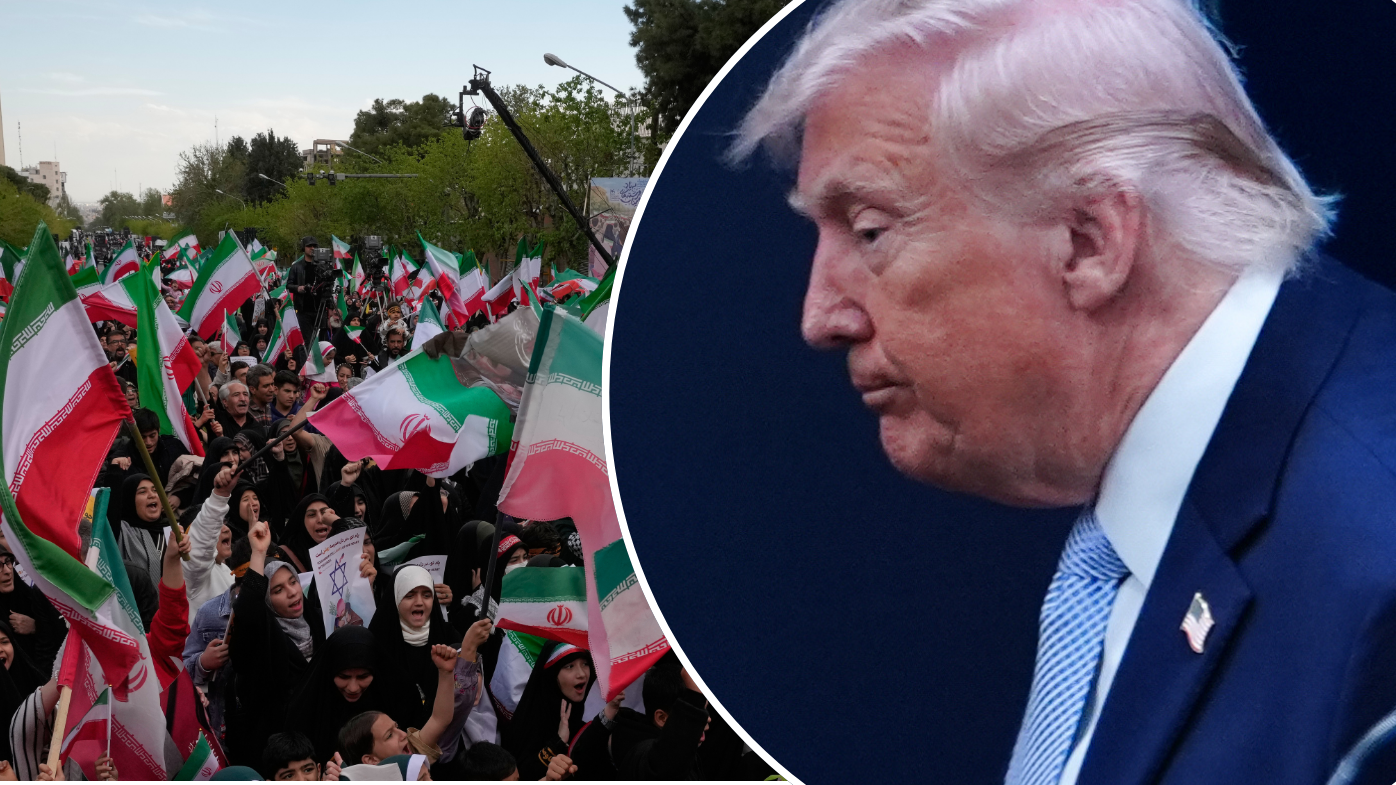
The foreign policy establishment is currently hyperventilating over a phantom. They call it a "terrible deal" that the President "may be forced to accept." This narrative assumes two things that are categorically false: that Iran is a rational actor seeking a return to the global economy, and that the United States is currently holding a weak hand.
I have spent decades watching diplomats trade long-term security for short-term "stability" metrics that look good on a quarterly report but fail in the field. This isn't about a bad deal versus a good deal. It is about the fundamental misunderstanding of what a deal with Tehran actually represents. To suggest the U.S. is "forced" into anything ignores the sheer economic gravity of the dollar and the crumbling domestic reality inside the Islamic Republic.
The Myth of Iranian Leverage
The standard "expert" take suggests that because Iran has accelerated its enrichment to $60%$ purity, they have the upper hand. This is a linear, one-dimensional view of power. Enrichment is a technical milestone, yes, but it is also a desperate cry for relevance from a regime that is cannibalizing its own economy to keep the centrifuges spinning.
In 2015, the Joint Comprehensive Plan of Action (JCPOA) was sold as a way to "integrate" Iran. It failed because you cannot integrate a revolutionary entity that views the international order as an obstacle to its existence. When people talk about Trump being "forced" to accept a deal, they are really saying they want to return to the era of bribing a fire to stop burning.
Real leverage isn't found in a IAEA report; it’s found in the fact that Iran's inflation rate is a permanent fever and its currency, the Rial, has become a collector's item for people who like worthless paper. The U.S. doesn't need to sign a paper to "contain" Iran. The U.S. just needs to stay out of the way while the regime’s own contradictions finish the job.
The "Maximum Pressure" Post-Mortem
Critics love to say Maximum Pressure failed because Iran didn't come to the table and beg. That is a mid-level manager’s view of success. Success isn't a signed document; success is the degradation of the adversary's ability to fund proxies.
During the height of the sanctions, Hezbollah was forced to place donation boxes in grocery stores. Hamas was complaining about late payments. That is a win. A "deal" that releases billions in frozen assets—under the naive hope that Tehran will spend it on hospitals instead of hypersonic missiles—is the actual "terrible" outcome.
Imagine a scenario where a bank lends money to a known arsonist on the condition that he promises not to buy matches. The bank then pats itself on the back for "engaging" the arsonist. That is the current state of Western diplomacy regarding Iran.
Why Enrichment Percentages are a Distraction
The media fixates on whether Iran is "weeks" or "days" away from a breakout. Let’s talk about the math they ignore.
$$t = \frac{W}{P}$$
Where $t$ is the time to produce a significant quantity, $W$ is the amount of work required, and $P$ is the production capacity. The "experts" focus on $P$ (the centrifuges) while ignoring the fact that a nuclear weapon requires a delivery vehicle and a warhead that doesn't melt upon re-entry. Iran has the fuel, but they don't have the finished product.
More importantly, the moment they cross the $90%$ threshold, the strategic landscape shifts instantly. They lose their "threshold state" protection. They become a target for every regional power with a functional air force. Tehran knows this. They use enrichment as a psychological tool to extract concessions from nervous Western bureaucrats who are more afraid of a headline than a hostile nuclear state.
The Fallacy of the "Regional War" Scare
The most common argument for a "terrible deal" is that without one, we face an inevitable regional war. This is a false binary. It ignores the Third Option: Structural Attrition.
We aren't in 2003 anymore. The Middle East has shifted. The Abraham Accords weren't just a photo op; they were a hard-nosed realization by Gulf states that Iran is a shared existential threat. The U.S. doesn't need to lead a "coalition of the willing" into a ground war. It just needs to provide the intelligence and the hardware to the locals who are already motivated to keep the IRGC in a box.
If Trump accepts a deal, it shouldn't be because he’s "forced" to. It should only be if the deal includes a total cessation of ballistic missile development and a permanent end to proxy funding. Anything less isn't a deal—it’s a subsidy for regional chaos.
Stop Asking "How Do We Fix the JCPOA?"
This is the wrong question. It’s like asking how to fix a car that has no engine and four flat tires. The JCPOA was built on the "sunset clause" logic—the idea that if we just wait ten years, Iran will suddenly become a peaceful Switzerland of the Middle East.
Instead, we should be asking: "How do we manage the collapse of the revolutionary state?"
The internal unrest in Iran isn't a phase. It is the result of a generational divide that cannot be bridged. The regime is an 80-year-old theocracy trying to govern a 20-year-old population that wants high-speed internet and global brands. By signing a new deal, the U.S. would effectively be handing a lifeline to a drowning oppressor.
The Real Risk of Re-Entry
If the U.S. re-enters a weak agreement, it signals to every other middle-tier power that nuclear blackmail works.
- Proliferation: If Iran gets a pass, why shouldn't Saudi Arabia or Turkey pursue the same path?
- Economic Credibility: Sanctions only work if they are perceived as permanent until behavior changes. Flipping them on and off every four years based on who is in the White House turns the U.S. Treasury into a joke.
- Moral Hazard: We tell the Iranian people we support their freedom, then we sign a check to the guys who are arresting them.
The downside to my approach—the "no deal" approach—is that it requires stomach. It requires the U.S. to sit through the screeching of European allies who want to sell Peugeots in Tehran. It requires ignoring the "breakout clock" which is designed to induce panic.
The Strategic Patience Play
The move isn't to negotiate. The move is to wait.
The regime is brittle. Their oil infrastructure is aging. Their water crisis is catastrophic. Their leadership is a geriatric ward. We have the luxury of time; they do not. Every month that passes without a deal is a month where the IRGC has to choose between paying a soldier in Syria or keeping the lights on in Isfahan.
Forcing a deal now is the equivalent of a chess player with a dominating position offering a draw because they’re bored. It’s not just a bad deal; it’s a strategic failure of the highest order.
The establishment wants a signature so they can go back to their cocktail parties and say they "solved" the Iran problem for another eighteen months. Trump’s strength—if he uses it—is the ability to say "No" and walk away from the table entirely.
Let the regime stare at their piles of $60%$ enriched uranium. They can’t eat it, they can’t spend it, and the moment they try to use it, they cease to exist. That isn't a "terrible deal" for the U.S. It's the ultimate stalemate, and in a stalemate, the side with the bigger bank account always wins.
Don't fix the deal. Break the board.