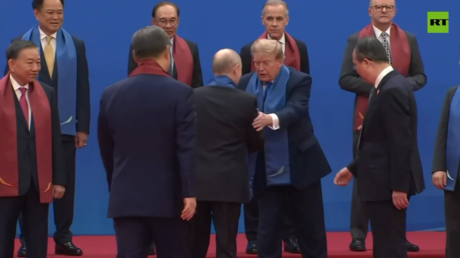
Mainstream commentary treats a handshake between Donald Trump, Xi Jinping, and Vladimir Putin at the 33rd APEC Economic Leaders' Meeting as a seismic shift in global power. Analysts frame this trilateral gathering as either the dawn of a new grand bargain or the final collapse of the Western-led order.
Both interpretations miss the actual mechanics of international trade and statecraft.
Summits of this scale rarely produce structural policy changes. Instead, they serve as high-stakes theater designed to manage domestic audiences while masking deep, unresolved economic friction. Having watched decades of trade negotiations fail behind closed doors while leaders smiled for the cameras, the pattern is unmistakable: the louder the diplomatic spectacle, the thinner the underlying agreement.
The Myth of the Grand Bargain
Commentators frequently assume that when the leaders of the United States, China, and Russia sit in the same room, they hold the unilateral authority to redraw trade routes, end regional conflicts, and stabilize supply chains overnight.
This view misunderstands how modern political economies operate.
- Structural Entrenchment: Trade deficits, industrial subsidies, and tariff regimes are baked into domestic legislation and corporate supply chains. A single afternoon of bilateral or trilateral talks cannot unwind decades of industrial policy.
- Institutional Friction: Even when executives reach verbal understandings, implementation stalls across layers of trade ministries, regulatory agencies, and legislative bodies.
- Divergent Incentives: Washington, Beijing, and Moscow enter these rooms with fundamentally incompatible domestic mandates.
According to analyses from the Council on Foreign Relations and the Peterson Institute for International Economics, high-level summits between major powers historically function as pressure-release valves rather than binding treaty engines. They prevent immediate miscalculation, yet they seldom reverse long-term strategic competition.
What APEC Actually Measures
To understand what happens at the 33rd APEC Economic Leaders' Meeting, it helps to separate the forum's actual mandate from the media's obsession with geopolitical drama.
Asia-Pacific Economic Cooperation (APEC) is a consensus-based economic forum, not a binding trade organization like the World Trade Organization. Its resolutions are non-binding. Its primary value lies in regulatory harmonization, customs facilitation, and technical standards across 21 member economies.
When coverage reduces an APEC meeting to a three-way showdown between Trump, Xi, and Putin, it ignores the 18 other economies in the room—nations like Japan, South Korea, Australia, and Vietnam—that are actively reshaping regional supply chains regardless of what happens in a trilateral pull-aside.
The Real Lever of Power
While cameras focus on bilateral body language, the actual shifts in global commerce happen in quieter venues:
- Supply Chain Diversification: Multinational corporations have spent years executing "China Plus One" strategies, moving manufacturing capacity to Southeast Asia and Mexico regardless of summit communiqués.
- Sanctions Enforcement and Evasion: Russia's economic integration with China relies on alternative payment rails and bilateral energy contracts that operate outside Western financial architecture, unaffected by summit rhetoric.
- Tariff Autarky: Industrial policy in Washington and Beijing increasingly prioritizes domestic resilience over pure efficiency, a trend supported across multiple administrations and party plenums.
Dismantling the Common Questions
When major leaders converge, public commentary fixates on a predictable set of questions. Most of them rest on flawed premises.
Will this meeting end the trade war or ease sanctions?
No. Tariffs and sanctions are no longer temporary bargaining chips; they have become permanent instruments of national security policy. Dismantling them requires reciprocal structural concessions—such as verifiable intellectual property protections, subsidy reductions, or territorial withdrawals—that none of the three leaders can politically afford to make at a multilateral economic forum.
Does a trilateral meeting signal a new multipolar world order?
A multipolar order is already visible in global GDP distribution, energy flows, and regional security pacts. A meeting does not create multipolarity; it merely acknowledges an existing reality where Washington, Beijing, and Moscow each exercise regional vetoes while struggling to dictate global rules.
Who "wins" a summit like this?
In diplomacy, declaring a winner based on optics is a category error. If a leader trades tangible economic leverage—such as export controls on critical technologies—for vague promises of future dialogue, the optics look positive while the strategic position weakens. Conversely, walking away without a joint statement often signals a refusal to accept unfavorable terms.
The Limits of Contrarian Skepticism
Dismissing summit diplomacy entirely carries its own blind spot. Even when a trilateral meeting yields zero binding agreements, the absence of communication carries severe risks.
Direct leader-to-leader contact establishes crisis communication channels. During periods of heightened military tension in the Taiwan Strait, the South China Sea, or Eastern Europe, personal familiarity between heads of state can prevent tactical incidents from escalating into broader conflicts. The danger is not that leaders meet; the danger is mistaking a crisis-management conversation for a strategic breakthrough.
How to Read the Post-Summit Fallout
Ignore the joint statements, the carefully choreographed handshakes, and the breathless cable news panels dissecting body language. Watch the concrete indicators that follow over the next two quarters:
- Tariff Schedules and Licensing: Check whether the U.S. Department of Commerce or China's Ministry of Commerce actually modifies export control entity lists. Until the regulatory text changes, policy remains identical.
- Currency and Commodity Flows: Watch bilateral trade settlement volumes in yuan and rubles, alongside shifts in Liquefied Natural Gas (LNG) and critical mineral contracts. Markets price real concessions immediately; they ignore diplomatic platitudes.
- Third-Party Alignment: Observe how middle powers in the Indo-Pacific respond. If ASEAN nations and U.S. treaty allies continue accelerating independent defense and trade agreements, they are signaling that the trilateral meeting changed nothing on the ground.
Diplomatic theater sells headlines, but balance sheets and regulatory registries tell the truth. Until a single tariff line is revoked or a single export ban is lifted in writing, the 33rd APEC meeting remains exactly what it looks like: three leaders managing their domestic narratives while the underlying fault lines stay firmly locked in place.