Twenty-eight years.
Say those two words out loud, and they sound like a prison sentence, a geological epoch, or the slow growth of an oak tree in an English churchyard. Now, try to measure them in footsteps. Measure them in worn-out rubber soles, in borders crossed on dusty dirt tracks, in the quiet agony of sleeping alone under foreign stars while the people you love grow gray three thousand miles away.
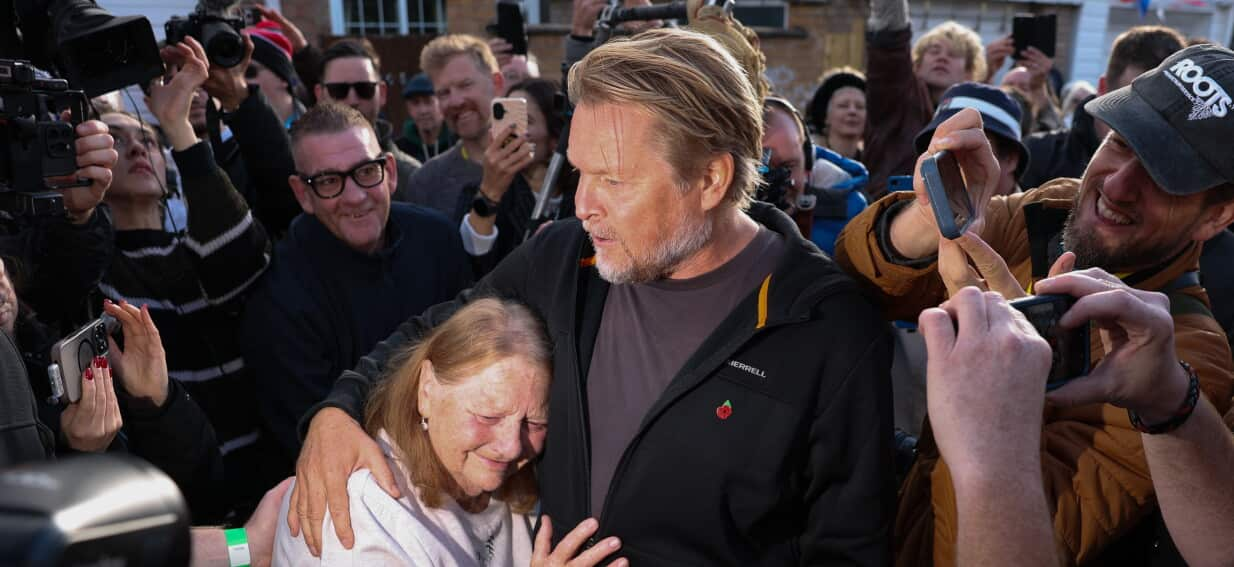
When Karl Bushby finally stepped back onto British soil and wrapped his arms around his mother, Angela, the cameras caught a tearful, cinematic embrace. It looked like a triumphant movie ending. Headlines immediately reduced nearly three decades of sheer human endurance into a neat, clickable summary about a British adventurer completing a historic trek around the world.
They missed the real story.
Because a walk that lasts twenty-eight years is no longer an expedition. It becomes a lifetime. And when you spend your entire adult life moving forward without ever taking a flight, a bus, or a boat to shortcut the distance, the hardest part of the journey isn't the frozen Bering Strait or the bureaucratic nightmares of border crossings. It is the invisible weight of what you left behind—and the terrifying realization that the home you are walking back to might no longer exist when you arrive.
The Anatomy of an Unbroken Line
To understand why a man would give up his twenties, thirties, and forties to walk around the planet, you have to understand the rules he set for himself in 1998.
Karl Bushby was a former British paratrooper from Hull, a port city in northern England known more for its resilience and industrial grit than its romanticism. He was twenty-nine years old when he stood at the southern tip of South America, in Punta Arenas, Chile, with a crazy, uncompromising idea. He would walk all the way home.
No motorized transport. Ever.
If he reached an ocean, he had to find a way to cross it on foot—meaning walking across the frozen sea ice between Alaska and Russia—or swim it. And if geopolitical red tape, visa rejections, or wars forced him to leave the path and fly home temporarily, he was bound by his own ironclad code to return to the exact spot where he had stopped before taking another step forward.
Think about that for a second. Imagine you are walking to the grocery store, and halfway there, a neighbor stops you and says you have to go back to your house, wait six months, and then resume your walk from the exact crack in the sidewalk where you paused. Now scale that up to thirty-six thousand miles across four continents.
Most of us struggle to keep a New Year’s resolution until February. We abandon diet plans when it rains and quit learning languages when the grammar gets tricky. Bushby’s Goliath Expedition wasn't fueled by adrenaline; adrenaline burns out in a week. It was fueled by a quiet, terrifyingly stubborn refusal to break a promise he made to himself when Bill Clinton was still in the White House and the internet made a screeching dial-up noise.
The Invisible Cost of Motion
There is a romance we attach to the lone wanderer. We picture freedom. We picture open horizons, campfire smoke, and the thrill of the unknown.
I remember the first time I tried a long-distance solo trek—nothing remotely close to Bushby’s scale, just a few weeks across mountain passes with everything I owned strapped to my back. By day ten, the romance had evaporated. What remained was a strange, hollow ache. Your body becomes a machine obsessed only with calories, water, and the next flat patch of ground. Meanwhile, your mind drifts backward. You start doing mental math about birthdays you are missing, conversations happening around kitchen tables without you, and the slow, silent drift of friendships that require physical presence to survive.
Now multiply that isolation by a thousand.
For Karl Bushby, the world changed while he walked through it. When he left Chile in 1998, smartphones didn't exist. He navigated with paper maps, a compass, and handwritten notes. By the time he was slogging through the swamps of Siberia or navigating the vast steppes of Central Asia, the world had gone digital. Strangers were suddenly pulling glass rectangles from their pockets to take selfies with him.
Yet while technology made the planet feel smaller for everyone else, Bushby’s self-imposed rule kept it brutally, stubbornly huge.
Consider what happens when you refuse to fly. You feel every single mile of the Earth's curvature in your knees and your lower back. You experience the agonizing slowness of geography. A mountain range isn't a twenty-minute turbulence bump while you watch an in-flight movie; it is six weeks of freezing wind, blistered feet, and rationing dried oats.
And while you are fighting the terrain, time is quietly attacking your roots.
The Woman Waiting in Hull
Every great odyssey has someone waiting on the shore, and in this story, the quietest heroism belonged to Angela.
While Karl was dodging polar bears on the shifting ice of the Bering Strait—a feat he and French adventurer Dimitri Kieffer accomplished in 2006, becoming the first Britons to walk across the frozen gap between America and Russia—his mother was living a different kind of endurance test.
We rarely talk about the courage it takes to love someone whose dream requires them to disappear. As a parent, your instinct is to protect, to keep your child within reach, to know they are warm and safe. Angela had to surrender that instinct for nearly three decades. Every phone call from a satellite line in the middle of nowhere was a relief; every stretch of silence was a quiet prayer.
Think of the milestones that passed in that ordinary house in Hull. Twenty-eight Christmases. Twenty-eight birthdays. Seasons turning from damp English springs to gray winters, year after year, while her son was a moving dot on a map, delayed for years at a time by Russian visa bans, financial collapses, and global pandemics.
At one point, Russian authorities banned him from the country for five years over a technicality—crossing the border at an unmarked point after nearly drowning in the freezing slush of the Bering Sea. Five years. Imagine having your life’s work paused for half a decade because a bureaucrat stamped the wrong box. Bushby didn't quit. He fought the ban, waited it out, and eventually returned to the exact coordinates in Chukotka to keep walking.
When you look at the photographs of their reunion, look past the adventure gear and the media microphones. Look at Angela’s hands gripping her son. Those aren't just the hands of a proud mother celebrating a world record. Those are the hands of a woman who held her breath for twenty-eight years and finally, mercifully, got to exhale.
Why We Obsess Over Extremes
Why does a story like this stop us in our tracks while we are scrolling through bad news and petty arguments on our phones?
Because modern life has engineered friction out of almost everything. If we are hungry, food arrives at our door in thirty minutes. If we want to see someone across the ocean, we tap a screen and their face appears in high definition. We have optimized for speed, comfort, and instant gratification.
And yet, somewhere deep in our wiring, we suspect we have lost something vital in the trade.
When we watch someone willingly choose the hardest, slowest possible path—and stick to it across three decades—it acts like a mirror. It forces us to ask uncomfortable questions about our own lives. What have we given up on because it took too long? Where did we take the shortcut when the long road was the only one that actually mattered?
It is easy to dismiss extreme endurance as madness. To a degree, it is. No rational cost-benefit analysis would ever greenlight a twenty-eight-year walk around the Earth. There is no massive corporate payout waiting at the finish line. There is no practical utility in walking across deserts when commercial airlines exist.
Let's be honest: the line between inspiring grit and destructive obsession is razor-thin. Spending nearly thirty years away from family, risking hypothermia, arrest, and exhaustion to fulfill a rule you invented in your twenties—that isn't a lifestyle blueprint anyone should copy. It carries a real, heavy human price. Relationships fray. Ordinary life passes you by. You wake up in your late fifties having spent almost your entire youth on the margins of civilization.
Yet that exact tension is what makes the story ache with truth. Great human achievements rarely come from balanced, reasonable people making safe choices. They come from people who care about one single thing so fiercely that they are willing to let the rest of the world burn away until it is done.
The Final Miles Are Always the Heaviest
Anyone who has ever run a marathon, finished a difficult degree, or nursed a loved one through a long illness knows a strange psychological trap: the closer you get to the end, the harder it becomes.
In the middle of a long ordeal, your mind goes numb. You just put one foot in front of the other. You don't think about the finish line because it is too far away to be real.
The danger comes when the finish line enters your field of vision. Suddenly, the numbness wears off. Every ache you have been ignoring for years announces itself at once. Doubt creeps in. You realize that finishing means losing the very identity that kept you alive for so long.
For Karl Bushby, the final stretch across Europe and back toward the English Channel meant confronting a terrifying transition. For twenty-eight years, his answer to "What do you do?" was simple: I am walking home.
What happens the morning after you arrive?
When your entire existence has been defined by forward motion, standing still feels like falling. You have to learn how to live in a house again. You have to learn how to have conversations that aren't about border permits, boot tread, or winter survival. You have to reconnect with a mother who is nearly thirty years older than the woman who waved goodbye to you in 1998, and introduce yourself to a version of home that has moved on without you.
What Remains When the Walking Stops
The media will eventually move on from the Goliath Expedition. Within a few days, the algorithms will serve up the next viral sensation, the next outrage, the next fleeting distraction.
Karl Bushby’s footsteps, however, are etched into the dirt of four continents. From the windswept plains of Patagonia to the dense jungles of the Darién Gap, across the frozen expanse of the Bering Strait, through the endless birch forests of Siberia, and across the heart of Europe, he drew an unbroken human line around the globe.
Not with a pen. With his own two feet.
Still, if you strip away the geography, the statistics, and the world records, the entire twenty-eight-year saga boils down to a single image that has nothing to do with exploration and everything to do with being human.
It is a son, weathered by sun and wind, standing on the threshold of home, and a mother closing the last few inches of a thirty-six-thousand-mile gap with a hug. No compass could measure that distance. No map could show the way. It took twenty-eight years of walking just to get back to where love had been waiting the entire time.