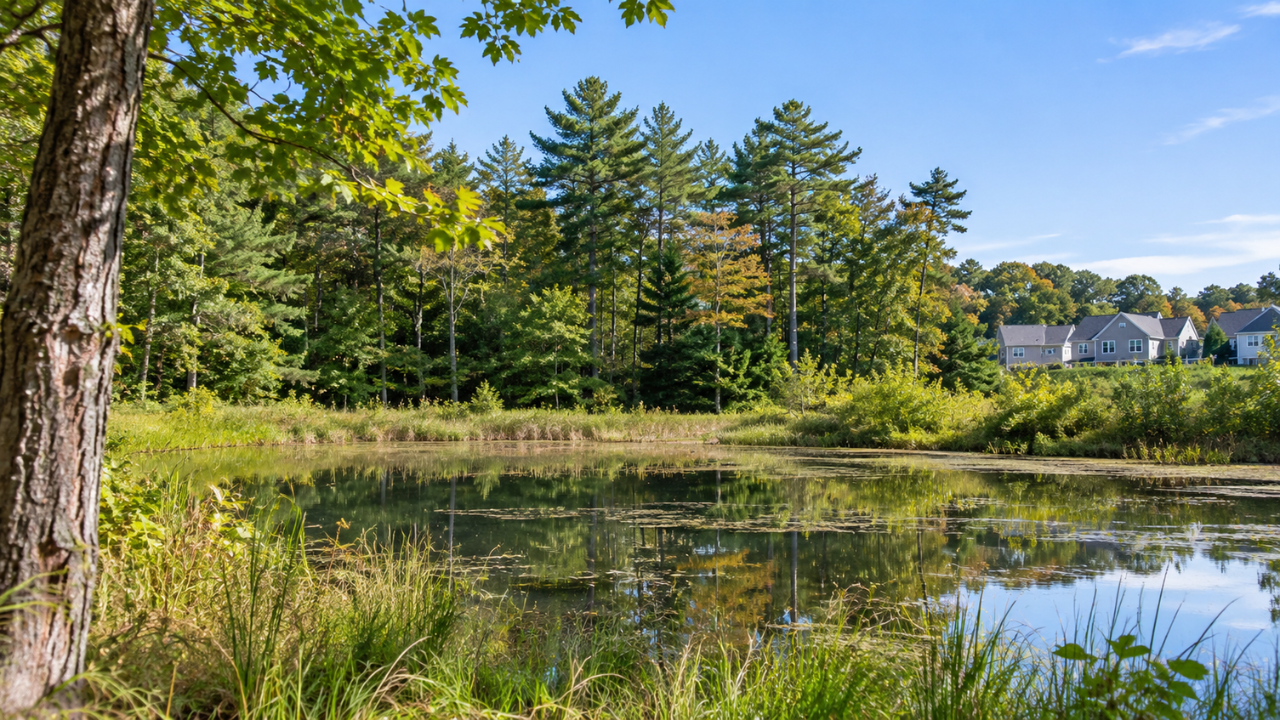
Walk into a New England forest at six in the morning in late November, and the silence has weight.
It is not an empty silence. Beneath the crunch of frost-stiffened oak leaves under your boots, thousands of tiny systems are working at a slow, deliberate pulse. Vernal pools—those shallow, seasonal depressions in the dirt that look like muddy puddles to an impatient eye—are already banked with eggs and dormant larvae waiting for the spring thaw. White-tailed deer step without sound through the mountain laurel. A barred owl shifts its weight on a hemlock limb, watching you pass.
Now, picture the sound of a diesel engine turning over at seven.
In Massachusetts, ninety-four acres of that exact kind of quiet woods sat on the brink of becoming something else entirely. Twenty-six luxury homes. Paved cul-de-sacs. Septic fields, manicured lawns, and the steady hum of central air conditioning units where granite outcroppings and old timber had stood since before the American Revolution. The permits were signed. The plans were approved. By every standard measure of municipal paperwork, the forest was already gone.
Then came a counteroffer worth two million dollars—and a race against the clock to turn an approved housing development into a permanent wildlife conservation area.
The Anatomy of a Done Deal
To understand why this single parcel of land matters so much, you have to understand how land disappears in the Northeast. It rarely vanishes in one dramatic sweep. Instead, it dies by a thousand subdivisions.
Consider a hypothetical town official—let’s call her Sarah—sitting at a folding table in a fluorescent-lit town hall basement on a Tuesday night. Across from her sits a developer with rolled-up blueprints and a team of civil engineers. The developer owns ninety-four acres of zoned residential land. Under Massachusetts law, if a subdivision plan meets local zoning bylaws, environmental wetlands regulations, and road-width requirements, a planning board cannot simply vote no because they like looking at trees. Property rights are real, and the law protects them.
So the board approves the twenty-six homes. Everyone shakes hands. Nobody is a villain in this room. Families need places to live, towns need property tax revenue, and builders build houses.
Yet the morning after that vote, something irreversible begins. When you carve twenty-six house lots out of ninety-four contiguous acres, you do not just lose the footprint of the foundations and driveways. You fracture the interior. Ecologists call this edge effect, though it is easier to picture it as tearing a warm wool blanket into twenty-six separate rags. The total amount of wool might look similar on paper, but it can no longer keep anyone warm.
Interior forest species—wood thrushes, spotted salamanders, scarlet tanagers, and wide-ranging mammals like bobcats and fishers—cannot survive in backyard buffer strips. They need unbroken deep woods to breed, hunt, and shelter from predators like raccoons and outdoor house cats that thrive along suburban edges. Once a cul-de-sac punches through the heart of a ninety-four-acre block, the ecological value of the entire tract collapses.
Why Two Million Dollars Is Actually a Bargain
When the price tag of two million dollars hits a local warrant or a fundraising thermometer, people naturally flinch. It sounds like an enormous sum of money for empty dirt.
Let’s do the math that towns usually ignore until it is too late.
If you break two million dollars down across ninety-four acres, you are looking at roughly twenty-one thousand dollars per acre. In eastern and central Massachusetts, where a single quarter-acre building lot can easily command two hundred thousand dollars before a single shovel hits the ground, twenty-one thousand dollars an acre is practically a rounding error.
More importantly, look at what happens to a town’s budget when those twenty-six homes actually get built. A common myth in local politics is that new residential subdivisions pay for themselves through property taxes. Decades of municipal fiscal impact studies across New England tell the exact opposite story. A new four-bedroom home brings new families, and new families bring children into the public school system, new demands on police and fire departments, new miles of asphalt that the Department of Public Works has to plow at three in the morning during a February nor'easter, and new strain on municipal water supplies.
On average, for every dollar a residential property generates in local tax revenue, it costs the municipality roughly a dollar and sixteen cents in public services. Open space, by contrast, requires zero school buses, zero snowplows, and zero sewer hookups. Its cost-to-revenue ratio sits near thirty cents on the dollar. Buying the land for two million dollars isn't charity for squirrels. It is one of the smartest financial hedges a community can make.
The Invisible Plumbing Under the Leaves
There is another reason those ninety-four acres carry weight far beyond their property lines, and you can only see it when it rains.
Think of an intact forest floor as a massive, living sponge laid over bedrock. Centuries of fallen leaves, decaying logs, and tangled tree roots create a spongy duff layer several feet thick. When a three-inch rainstorm sweeps across Massachusetts—a type of intense weather event that has grown noticeably more frequent over the last twenty years—that forest floor absorbs millions of gallons of water. It slows the runoff down, filters out pollutants through soil microbes, and trickles clean, cold water slowly into underground aquifers and nearby streams.
Replace those trees with twenty-six roofs, twenty-six paved driveways, and a wide asphalt road, and you have just installed an expressway for stormwater. Water hits the shingles, shoots down gutters, picks up motor oil and lawn fertilizer from the pavement, and dumps straight into local brooks at high speed. Downstream basements flood. Trout streams warm up and silt over. Wells run drier during August droughts because the rainwater never had time to soak back into the ground.
I remember walking a similar parcel in Middlesex County a few years ago, right after a heavy autumn storm. On the wooded side of a stone wall, the ground felt like walking on a thick mattress—damp, springy, holding the rain in thousands of tiny pockets around mossy boulders. Ten feet away, on the newly graded gravel of an adjacent cul-de-sac, brown water was carving gullies straight down the hill toward a culvert. Same rain. Same hill. Completely different outcome.
How a Conservation Deal Actually Happens
People often wonder how land that is already approved for twenty-six homes suddenly pivots toward conservation. Does the town just seize it?
No. In almost every successful Massachusetts land save, the process looks far more like a high-stakes relay race than a courtroom battle.
First, a local land trust or a municipal conservation commission steps in to negotiate with the landowner or developer. Often, the builder realizes that putting in roads, blasting ledge, and navigating years of construction financing carries massive financial risk. If a conservation group can assemble a fair purchase price—in this case, two million dollars—the developer gets a clean, guaranteed exit without ever firing up an excavator.
Then comes the scramble to assemble the money before the purchase-and-sale option expires. That two million dollars rarely comes from a single checkbook. Instead, it gets stitched together from multiple sources:
- State Grants: Programs like the Massachusetts Local Acquisitions for Natural Diversity (LAND) grant reimburse municipalities for a substantial percentage of conservation purchases, provided the land will remain open to the public forever.
- Community Preservation Act Funds: Over two hundred Massachusetts cities and towns have adopted the CPA, creating a dedicated local fund through a small property tax surcharge matched by the state, specifically designed to buy open space before developers do.
- Private Philanthropy and Neighbors: Local residents chip in everything from twenty-five-dollar checks to five-figure matching gifts, driven by the sudden realization that the woods they have walked for twenty years are genuinely on the chopping block.
It is messy, stressful, and constantly teetering on the edge of falling apart. Appraisals have to match state standards. Title searches uncover forgotten right-of-ways from the 1890s. Town meeting voters have to show up in a high school gymnasium on a rainy Monday night and raise their hands for a two-thirds majority.
The Weight of Forever
If the deal closes, something remarkable happens to the legal deed of those ninety-four acres. It gets stamped with a Conservation Restriction—a permanent legal covenant held by a third party, ensuring that no future town board, no future mayor, and no future developer can ever come back in fifty years and try again.
In an era where almost every decision feels temporary, reversible, or subject to the next election cycle, land conservation is stubbornly permanent.
Imagine a hypothetical ten-year-old boy—let’s name him Leo—living a mile down the road from this parcel. Right now, Leo probably cares more about video games or soccer practice than he does about municipal zoning laws or two-million-dollar appraisals. He doesn't know what a vernal pool is, and he certainly doesn't know how close his neighborhood came to gaining twenty-six new houses.
But three years from now, Leo might walk down a newly blazed trail into those ninety-four acres. He might turn over a rotting log and find a red-backed salamander curled underneath. He might learn how to read deer tracks in February snow, or sit on a granite boulder in October just to get away from the noise of his phone. Forty years from now, he might bring his own kids down that same trail, pointing out the same old hemlock trees.
Every single park, town forest, and wildlife sanctuary you have ever loved exists only because a group of ordinary, slightly overwhelmed people once decided that two million dollars—or fifty thousand, or ten million—was worth paying to leave the dirt alone.
The bulldozers were ready. The permits were signed. Now, the frost settles quietly over ninety-four acres of oak and pine, waiting for spring.