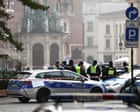
Two junior patrol officers—24-year-old Senior Constable Jakub Kulik and 27-year-old Senior Constable Artur Morański—stopped the November 7, 2026 mass shooting in Kraków. Chasing a heavily armed gunman through the historic center in a standard squad car, they cornered him at the intersection of Stradomska and Dietla streets, absorbed multiple rifle rounds, and neutralized him before he could empty his 500-round stockpile. Poland awarded them state honors and hailed them as national heroes. That official celebration obscures a harsher reality: two young beat cops carrying standard sidearms were the only barrier between a legally armed civilian with semi-automatic rifles and a crowded tourist square.
Heroism makes for clean headlines. It allows politicians to pin medals on hospital gowns while avoiding uncomfortable questions about how a 24-year-old lathe operator with zero criminal record legally assembled an arsenal. To understand what really happened in Kraków, you have to look past the ceremony and examine the mechanics of the firefight, the regulatory blind spots that enabled it, and the bizarre legal aftermath now targeting the very officers who saved dozens of lives.
Three Minutes of Chaos at Stradomska and Dietla
At roughly 3:00 p.m. on a Saturday, 24-year-old Michał Oksiński drove a black Subaru onto Kraków’s Main Market Square. The square was packed. Locals, tourists, and demonstrators attending an anti-government protest filled the cobblestones. Oksiński opened fire through the car window with a semi-automatic rifle, striking pedestrians at random and shattering the windshield of a passing tram. Six people—four women and two men—died. Fifteen others suffered gunshot and shrapnel wounds.
Kulik and Morański were on routine patrol in Kraków’s First Police Commissariat. Neither man was part of a specialized counter-terrorism unit. Kulik had joined the police force in 2025 after serving in the 18th Bielsko Airborne Battalion and volunteering as a firefighter in Leszczyny. Morański, originally from Powroźnik in the Muszyna municipality, had three years on the job.
They did not wait for tactical backup. When Oksiński accelerated away from the square, Kulik and Morański pursued him through narrow medieval streets while the gunman continued firing from his moving vehicle. The chase ended minutes later when Oksiński crashed into a stationary vehicle at the junction of Stradomska and Dietla streets.
What followed was an asymmetric gunfight. Oksiński stepped out of the wreckage wearing a tactical vest, a helmet, and a face covering. He carried a Diamondback DB-15 semi-automatic rifle, a second AR-15-style carbine, a Walther P99 pistol, a Glock pistol, and roughly 500 rounds of ammunition. Kulik and Morański exited their patrol car armed with standard-issue service pistols.
CCTV stills and bystander footage from the intersection show the gunman advancing and firing bursts toward the officers. Kulik took three bullets. Morański was hit twice, taking severe wounds to his lung and arm. Despite the shock and blood loss, the two constables held their ground, returned fire, and struck Oksiński. The gunman collapsed beside his rifle. He died in a Kraków hospital two days later without regaining consciousness to face interrogation.
When Morański woke up after a twelve-hour emergency surgery at Gabriel Narutowicz Municipal Specialist Hospital, he did not ask about his own arm or lung. According to Prime Minister Donald Tusk and Muszyna Mayor Jan Golba, his first three words were, "Is Kuba alive?"
The Legal Arsenal in Ostrowiec Świętokrzyski
Public commentary in the immediate aftermath treated the attack as an inexplicable bolt from the blue—a sudden fracture in Poland’s reputation as one of Europe’s safest countries. That framing ignores the paper trail. The weapons used in Kraków were not smuggled across the eastern border from Ukraine or bought on the dark web. They were registered, licensed, and stored legally in a family apartment 190 kilometers away in Ostrowiec Świętokrzyski.
Investigators reconstructing Oksiński’s movements discovered that the rampage began hours before he reached Kraków. Inside the family apartment in Ostrowiec Świętokrzyski, police found the bodies of his 53-year-old father Janusz, his 52-year-old mother Renata, and his 21-year-old sister Magdalena, a student at Kraków’s Academy of Fine Arts. All three were in their sleepwear, each shot twice in the head. Oksiński had also shot the family’s two cats. Neighbors heard nothing; police recovered a suppressor from Oksiński’s vehicle three days after the shooting.
Both Michał and his father were active members of a local shooting club. Poland’s gun laws are often described as strict, yet sports shooting permits have created a rapidly expanding legal firearms market. Police statistics show that more than 50,000 new firearm permits were issued in Poland in 2025 alone, pushing the national total to 411,000.
Oksiński joined his shooting club in 2022. Early in 2026, he cleared the administrative and psychological hurdles to obtain his own permit for two firearms—a rifle and a pistol. His father held permits for nine more. Under Polish regulations governing sports shooters, semi-automatic AR-15 platforms are routinely approved for sporting and collection purposes. Once a shooter passes the initial screening, ongoing psychological monitoring is virtually nonexistent.
"The Interior Ministry has announced a review of firearm licensing conditions, specifically targeting the lack of periodic medical updates for permit holders," noted official briefings following the attack.
💡 You might also like: The National Security Threat Inside the White House Combat Sports Gambit
Warning signs existed outside the licensing office, though none triggered a formal intervention. Former technical school classmates told reporters that Oksiński was socially withdrawn and frequently sketched scenes of school shootings in his notebooks. At his workplace, the Ostrowiec Refractory Materials Plant, agents from the Internal Security Agency later found the initials "GGER" scratched inside his locker—a reference to "Good Game Elliot Rodger," the perpetrator of the 2014 Isla Vista killings. Investigators also found a Gadsden flag at his home and browser histories linked to Norwegian mass murderer Anders Breivik.
Yet National Prosecutor’s Office spokesman Przemysław Nowak cautioned against rushing to label the attack purely ideological. While Justice Minister Waldemar Żurek pointed to far-right fascination, prosecutors noted the absence of any manifesto or explicit political symbols. What remains indisputable is the failure of the vetting apparatus. A young man fixated on mass killers passed every statutory check required to buy an AR-15 and hundreds of rounds of ammunition.
The Disinformation Machine and the Bureaucratic Backlash
The gunsmoke had barely cleared on Stradomska Street before a second front opened online. Within hours of the first emergency calls, coordinated social media accounts flooded Polish X and Facebook with fabricated claims about the shooter’s identity. Fact-checkers at Demagog.pl documented waves of posts falsely claiming the gunman was a Ukrainian national, a Muslim refugee, or an operative tied to rival domestic political parties.
The timing magnified the chaos. Because an anti-government demonstration was already underway near the Main Square, television crews from the conservative broadcaster Republika were on scene immediately, capturing raw footage of the black Subaru fleeing while police gave chase. Opposition politicians seized on the footage to blame Prime Minister Tusk’s government for alleged police staffing shortages, linking the tragedy to an ongoing constitutional crisis over judicial reforms. Meanwhile, Defense Minister Władysław Kosiniak-Kamysz was forced to issue an emergency denial after viral rumors falsely identified Oksiński as an active-duty Polish soldier.
Then came an even stranger development. While President Karol Nawrocki awarded Kulik and Morański the Officer’s Cross of the Order of Polonia Restituta—one of Poland’s highest state decorations—and Kraków officials moved to grant them honorary citizenship, private citizens began filing criminal complaints against the officers.
Prosecutor Eryk Stasielak of the Kraków Regional Prosecutor’s Office confirmed that multiple formal notifications had been submitted questioning Jakub Kulik’s use of lethal force during the shootout. Under Polish criminal procedure, prosecutors cannot simply toss a formal citizen complaint into the trash; every filing must be logged and reviewed, even when investigators find zero grounds to open an official inquiry.
The contrast is jarring. On November 23, Kulik was finally discharged from the John Paul II Specialist Hospital in Kraków and transferred to a pulmonary rehabilitation facility in Jaroszowiec. Still recovering from three gunshot wounds, he released an open letter begging journalists to leave his family alone so he could focus on his recovery and on Morański, who remains at the 5th Military Clinical Hospital facing further reconstructive hand surgeries. At the exact moment Kulik was asking for quiet, prosecutors were forced to publicly defend his split-second decision to shoot a man firing an AR-15 into a city intersection.
What Patrol Policing Actually Looks Like Under Fire
Tactical analysts who study active-shooter events point to a persistent myth in public safety: the idea that specialized SWAT teams stop mass shootings. They rarely do. Specialized units take twenty to forty minutes to muster, gear up, and breach a perimeter. Active-shooter incidents are almost always decided in the first three to five minutes by whichever patrol unit happens to be closest to the sound of gunfire.
In Kraków, that meant two constables in their twenties driving a standard sedan.
Look closely at the tactical disadvantages Kulik and Morański faced at Stradomska and Dietla:
- Ballistic asymmetry. Standard police soft body armor is rated to stop handgun rounds (9mm or .40 caliber). High-velocity 5.56mm rounds fired from an AR-15-style rifle like Oksiński’s Diamondback DB-15 punch straight through standard patrol vests.
- Range and capacity. Oksiński carried two rifles, two handguns, and 500 rounds, wearing a helmet and tactical carrier. Patrol officers carry limited pistol magazines designed for close-quarters self-defense, not prolonged street engagements against rifle fire.
- Environmental risk. Firing back at a junction in central Kraków meant accounting for pedestrians, trams, and parked cars behind the target. Missing low or wide risked hitting the very civilians they were trying to protect.
Kulik’s military background in the 6th Airborne Brigade—including border deployment along Belarus in 2023—almost certainly shaped his composure under fire. Training alone, however, cannot manufacture cover where none exists. Both officers closed the distance knowing they were outgunned, drawing Oksiński’s fire onto themselves and away from the crowded sidewalks leading off the Main Square.
The Questions Medals Cannot Answer
Poland has spent the weeks since November 7 oscillating between grief and self-congratulation. Thousands marched silently through Kraków’s Old Town carrying candles. State television replayed clips of the officers’ decorations. Local councils drafted resolutions praising the courage of the Małopolska police force.
Yet none of those gestures fix the structural vulnerabilities exposed on that Saturday afternoon.
First, Poland’s firearms registry operates on a static snapshot of mental health. Once a citizen joins a sports club and passes a single psychiatric evaluation, the state assumes their stability is permanent. Until the Interior Ministry mandates recurring psychological assessments and cross-checks club memberships against local behavioral reports, the gap between legal ownership and lethal intent remains wide open.
Second, frontline patrol units across Central Europe are still equipped for twentieth-century policing. Expecting beat officers in standard soft vests and 9mm pistols to confront armored riflemen without patrol carbines or rifle-rated plates in their trunk kits relies entirely on personal sacrifice rather than institutional preparedness.
Third, the speed with which disinformation hijacked the Kraków shooting—turning a domestic familicide and mass murder into a partisan cudgel before the wounded even reached operating rooms—shows how fragile public trust becomes during a crisis. When politicians speculate prematurely about ideology and fringe actors weaponize tragedy to harass wounded officers with nuisance complaints, the civic solidarity displayed at candlelight vigils begins to look dangerously thin.
Artur Morański is still in a military hospital bed in Kraków, waiting for surgeons to rebuild his shattered hand. Jakub Kulik is learning to breathe properly again in a rehabilitation clinic in Jaroszowiec. They did their jobs under conditions no patrol officer should ever have to face alone. The state gave them medals; it has yet to prove it deserves their sacrifice.