Sunlight hits red sandstone in Delhi differently than it does anywhere else on earth. At four in the afternoon, the heat loses its sharp, punishing edge and turns into something thick, amber, and almost forgiving.
Now picture two people standing in that light.
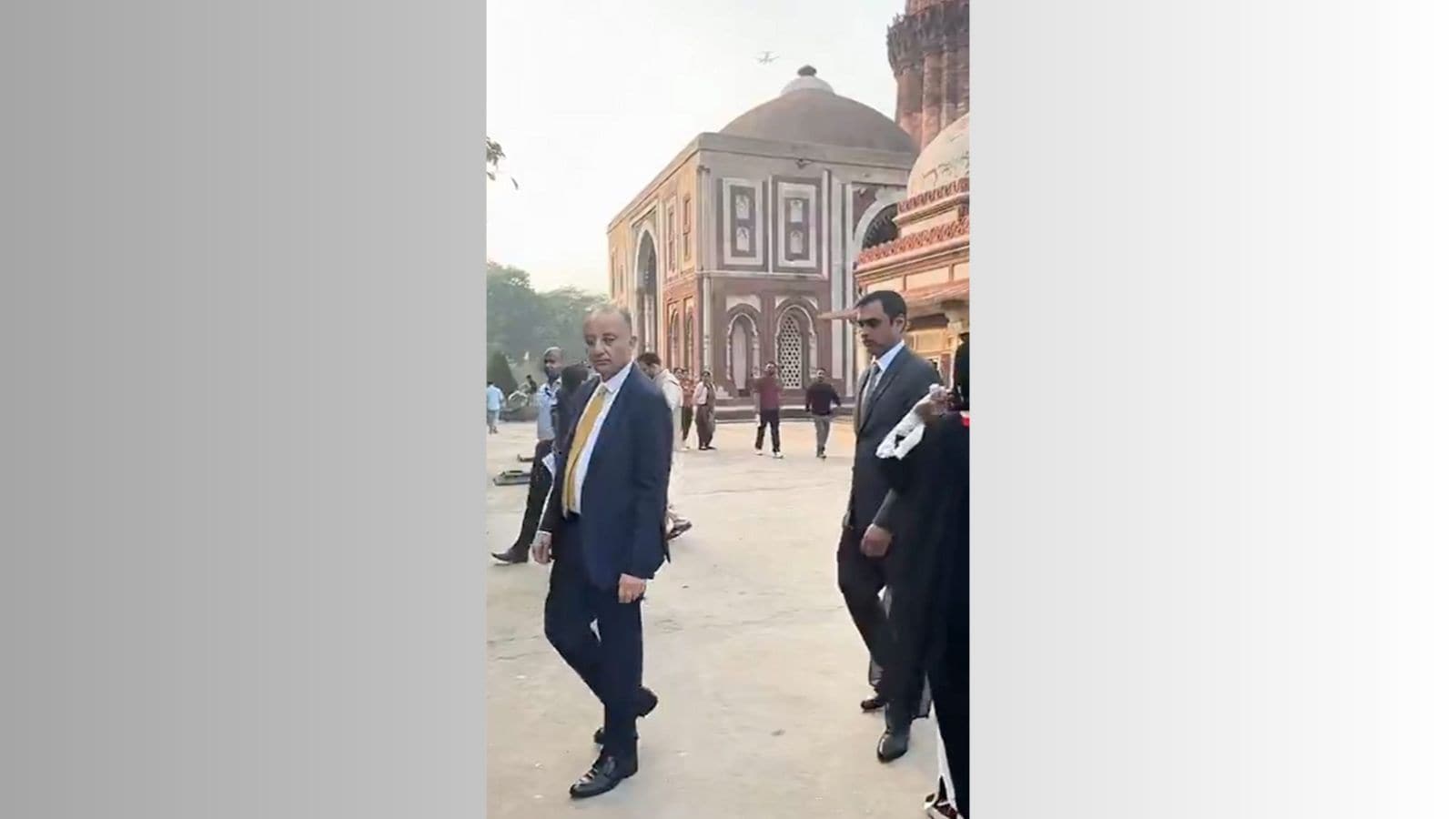
They are not wearing bulletproof vests. They are not shouting across a podium in Geneva or trading barbs through a split-screen television broadcast in Islamabad and New Delhi. Instead, a Pakistani federal minister and his wife are simply walking. Their shoes crunch over the gravel paths of the Qutub Minar complex. They tilt their heads back to stare up seventy-two and a half meters of fluted red sandstone and marble, squinting against the glare, behaving for all the world like two ordinary tourists trying to take in a monument that refuses to fit inside a single camera frame.
To the wire services, this is a three-line filler item. Pak minister Malik, wife explore Delhi; visit Qutub Minar. Click. Scroll. Forget.
That dismissal is a mistake.
When you strip away the diplomatic jargon and the endless, exhausting loop of border tensions, a quiet afternoon walk in South Delhi becomes something far heavier than a sightseeing detour. It becomes an accidental stress test for how two nuclear-armed neighbors actually remember who they are when the microphones are turned off.
The Weight of a Simple Stroll
I have spent years watching diplomats move through South Asia, and if there is one thing you learn quickly, it is that nothing a high-ranking official does across the Radcliffe Line is ever truly casual. Every handshake is weighed on a jeweler's scale. Every unscheduled stop is dissected by security detail commanders who haven't slept properly since the flight manifest was filed.
Consider Rehman Malik—a man whose public life in Pakistan was defined by the rigid, high-stakes machinery of internal security, counter-terrorism briefings, and sharp political rhetoric. In the popular imagination, a Pakistani Interior Minister visiting India arrives wrapped in suspicion, escorted by armored motorcades from the tarmac straight to heavily guarded conference rooms in Chanakyapuri, and whisked back out before the dust settles.
Yet here he was, alongside his wife, stepping out into the open air of Mehrauli.
Think about the invisible logistics required just to make that hour possible. Before a single photograph could be taken near the Iron Pillar, intelligence officers from both sides had to map sightlines, clear vendors, and quietly blend plainclothes operatives into the crowds of schoolkids and weekend families. The air around a visiting Pakistani minister in Delhi is always thick with unspoken tension, even when the sky is cloudless.
And still, they walked.
Why does that matter? Because South Asian politics suffers from a chronic addiction to abstraction. We talk about "bilateral relations," "track-two diplomacy," and "confidence-building measures"—cold, sterile phrases that sound like plumbing specifications rather than the messy, emotional reality of 1.7 billion people who share the same rivers, the same monsoon winds, and the same grandmother's recipes. When a Pakistani minister and his wife leave the sanitized bubble of a five-star hotel to stand beneath an eighth-century-old tower in Delhi, they briefly puncture that abstraction. They force the cameras to record human scale instead of geopolitical posturing.
Reading the Stone at Mehrauli
To understand why Qutub Minar specifically carries so much quiet electricity in a moment like this, you have to look at what the tower actually is.
It is not a sterile museum piece. Built starting in 1199 by Qutb-ud-din Aibak and completed by his successor Iltutmish, the minaret rises out of the ruins of Lal Kot, the red citadel of the Tomar Rajputs. Look closely at the walls of the adjacent Quwwat-ul-Islam Mosque, and you will see carved lotus motifs, temple pillars, and intricate geometric calligraphy sharing the exact same load-bearing stone.
History in Delhi does not sit neatly on separate shelves. It is layered, compressed, and welded together by centuries of conquest, migration, grief, and adaptation.
Let us imagine—purely as a lens to see what the cameras missed—the quiet conversation between husband and wife as they pause near the Alai Darwaza. Away from the press pool, standing in the shade of an archway that has survived earthquakes, empires, and the brutal Partition of 1947, the immediate noise of modern cable news feels absurdly small. You look at the calligraphy carved into the sandstone bands—verses meant to outlast dynasties—and you are reminded that borders drawn in ink are remarkably young compared to the stone beneath your boots.
This is the unspoken truth that every Pakistani who visits Delhi—and every Indian who visits Lahore—eventually confronts.
I remember my own first walk through Old Delhi after years of reading nothing about India except security dispatches and cricket scorecards. I expected a foreign country. Instead, I smelled roasted gram and damp earth after a sudden shower, heard the exact same cadence of Urdu and Punjabi jokes at a tea stall, and felt a sudden, disorienting wave of recognition so strong it almost hurt. It is confusing. You are taught for decades to see a mirror image as an adversary, and then you step onto the pavement and realize your feet know the rhythm of the street.
For a Pakistani official and his spouse, that recognition carries an extra layer of complexity. They cannot simply dissolve into the crowd. Their presence is an official act, whether they intend it to be or not. Every smile toward a local guide or a curious onlooker is read as a signal. Is it a thaw? Is it a gesture of goodwill? Or is it merely a quiet Sunday afternoon stolen from a grueling diplomatic itinerary?
The Diplomacy of the Unscripted Hour
People often ask what actually happens during these cultural visits by Pakistani leaders in India. Do they change policy? Do they resolve border disputes or trade deadlocks?
No. A walk around Qutub Minar does not rewrite a single line of a bilateral treaty.
If you judge diplomacy solely by signed communiqués, a minister admiring Mughal and Sultanate architecture looks like a distraction. That is a deeply flawed way to read human behavior. Think of bilateral diplomacy like a rusted hinge that has been left out in the rain for years. You do not break it free by hitting it with a sledgehammer; you apply a few drops of oil and move it a fraction of an inch at a time just to prove the metal hasn't completely fused together.
Cultural visits—whether it is visiting Ajmer Sharif, walking through Humayun's Tomb, or exploring the Qutub complex—act as that quiet lubricant. They accomplish three things that formal summit rooms rarely achieve:
First, they humanize the "other" in the domestic media of both nations. When audiences in Karachi or Mumbai see a politician with his spouse—adjusting a scarf against the breeze, pointing out a carving, listening intently to a local historian—the caricature softens. It becomes harder to sustain pure hostility toward people who clearly love the same shared heritage you do.
Second, they create breathing room for hard conversations. It is a well-documented pattern in conflict negotiation that leaders who share an informal, low-stakes environment before or after tense meetings communicate with slightly less defensiveness. Standing side-by-side looking at the same monument shifts the physical geometry of diplomacy from face-to-face confrontation to shoulder-to-shoulder observation.
Third, they remind the hosts of their own custodianship. When a Pakistani dignitary visits Delhi's historic sites, Indian archeologists and guides take quiet pride in showing how meticulously these monuments are preserved. Shared heritage becomes a rare currency where both sides profit from the survival of the past.
What the Wire Reports Leave Out
There is always a lingering vulnerability in moments like these. Cynics on both sides of the border are quick to mock them. In Islamabad, hardliners whisper that strolling through Delhi's monuments while serious grievances remain unresolved looks soft. In New Delhi, skeptics dismiss the photo-op as cosmetic charm designed to deflect tough questions.
Both groups miss the point because both groups are terrified of nuance.
The real story of Malik and his wife in Delhi is not that peace suddenly broke out beneath a twelfth-century tower. Peace is hard, unglamorous work that takes years of grinding compromise. The real story is that, even at the height of mutual suspicion, the pull of shared history remains strong enough to draw a Pakistani security chief and his wife out into the Delhi sun.
Think about the sheer contrast of their itinerary. Hours earlier or hours later, the conversation revolves around visa regimes, intelligence sharing, regional stability, and the stubborn friction of modern statecraft. Those rooms have no windows, or if they do, the blinds are drawn. The language is guarded. Every word is vetted by aides before it is spoken.
Then the car pulls up to Mehrauli. The door opens. The air smells of dry leaves, warm stone, and the faint sweetness of jasmine sold near the gate.
For forty-five minutes, the agenda disappears. There are no briefing binders. There is just a husband and wife walking through a garden built by rulers who have been dust for eight hundred years, looking up at a tower that has watched empires rise, fracture, and vanish while the light keeps hitting the red stone the exact same way every afternoon.
Eventually, the security detail checks their watches. The walk ends. The black sedans pull back onto the main road, sirens silent or muted, carrying the couple back toward the glass towers and guarded gates of diplomatic Delhi. Tomorrow, the headlines will return to their familiar, jagged rhythm of demands, denials, and deadlocks.
Yet somewhere in the archives, alongside the stern press releases and the tense podium photographs, there remains a quieter record—two footsteps on warm Delhi gravel, pausing beneath a tower that belongs to everyone and no one at all.