Two words.
That is all it took to strip away six decades of rehearsed diplomatic choreography, polished podium speeches, and carefully calibrated handshakes, leaving two grown men standing inches apart on a hard floor while cameras flashed like summer lightning.
"Back up."
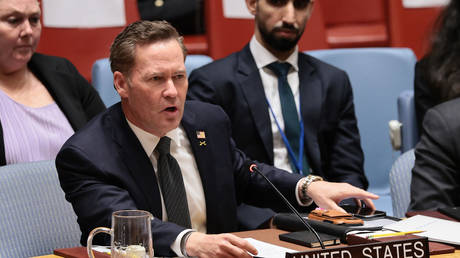
If you have seen the video—and millions of people have watched those shaky, compressed frames loop endlessly across their screens—you know the exact second the temperature in the room drops. One moment, there is the familiar, low-frequency hum of international diplomacy, that polite murmuring where words are chosen specifically to say nothing at all. The next, the United States ambassador to the United Nations is pointing a rigid finger, his voice cutting cleanly through the noise, demanding physical space from the Cuban foreign minister.
Most news reports treated the clip like a stray firework at a garden party. They gave you the transcript. They noted the date, the venue, the titles of the men involved, and the predictable flurry of official statements that followed within the hour. They framed it as a viral outburst, a momentary loss of composure in a building designed to prevent precisely that kind of friction.
They missed the point entirely.
When you watch that footage with the sound turned off, you are not looking at a spontaneous spat between two bureaucrats who skipped lunch. You are looking at the physical manifestation of a sixty-year standoff compressed into thirty-six inches of contested carpet. You are watching the exact moment when abstract foreign policy—the kind written in dense, footnoted white papers in Washington and Havana—suddenly acquires a pulse, a temperature, and a boundary line drawn in the air by an outstretched arm.
The Architecture of Invisible Walls
To understand why two words echoed so loudly, you have to understand the room they were spoken in.
Diplomacy is, by design, a theater of distance. Every table in the United Nations is measured to keep breath from mingling, every microphone is engineered to flatten emotion into a neutral midrange, and every protocol officer is trained to ensure that two adversaries never accidentally occupy the same square foot of hallway without a script. The entire apparatus exists to keep history from becoming personal.
I remember the first time I walked through the corridors of a major diplomatic summit as a young observer, clutching a press badge that felt heavier than it was. What struck me wasn't the grand speeches in the main chamber. It was the choreography of the hallways. You could watch two delegations approach each other from opposite ends of a marble corridor, spot each other fifty yards out, and execute a silent, synchronized drift toward opposite walls—maintaining eye contact just long enough to acknowledge existence, never long enough to invite a conversation. It was a ballet of avoidance, practiced so often it looked like instinct.
Think of international relations between estranged nations like two neighbors sharing a thin apartment wall after a bitter, decades-old dispute. For years, they communicate only by sliding formal notices under the door or shouting through the drywall where neither has to look the other in the eye. Every grievance is amplified because there is no face attached to it. Then, one Tuesday morning, both open their front doors at the exact same second to pick up the newspaper. Suddenly, there is no drywall. There is no prepared statement. There is only proximity, and proximity forces an immediate, visceral reaction before the brain can consult the rulebook.
That is what happened in that hallway.
When the Cuban minister stepped forward—whether intentionally to force an unscripted confrontation on camera or simply to press a point that had been ignored inside the chamber—he breached the invisible wall that makes cold conflicts manageable. And when the American ambassador barked those two words, he wasn't just defending his personal bubble. He was re-erecting sixty years of American containment policy in real time, using his own body as the border fence.
What the Cameras Did Not Show
Let us step outside the fluorescent lighting of that corridor for a moment and picture someone who will never be invited to a summit.
Consider Elena—a fictional composite, though her circumstances mirror those of hundreds of thousands of real families living along the Malecón in Havana today. Elena is a retired schoolteacher whose pension buys roughly a carton of eggs and two pounds of rice on the informal market. Her daughter lives in Miami, working two shifts at a clinic to send remittances that keep Elena’s refrigerator humming through rolling blackouts.
To Elena, the shouting match in that hallway is not political theater. It is the weather system that dictates her life.
When Washington tightens sanctions, Elena feels it in the pharmacy shelves that hold empty boxes instead of blood pressure medication. When Havana cracks down on dissent and refuses structural economic reforms, Elena feels it in the silence of her neighbors who have quietly packed a single suitcase and left for a perilous journey north. For Elena, the distance between the United States and Cuba is not measured in the ninety miles of saltwater separating Key West from Havana. It is measured in the years since she last held her grandchildren.
And on the other side of that ninety-mile stretch, consider Mateo—another hypothetical figure, a second-generation Cuban American business owner in Hialeah whose father arrived in 1962 with a cardboard suitcase and a deep, unhealed scar from having his family’s livelihood confiscated by the state. For Mateo, any diplomatic gesture that looks like softening toward Havana feels like an erasure of his father’s suffering, a betrayal of people who paid the ultimate price for resisting an authoritarian system.
Hold both of those lives in your mind at the same time.
This is the exhausting, agonizing reality that gets flattened whenever a thirty-second video goes viral. On the internet, the confrontation becomes a scoreboard. One side cheers the ambassador for showing spine and refusing to be intimidated by a representative of a repressive regime. The other side mocks the outburst as bullying, pointing to decades of economic embargo that have choked an island nation of eleven million people.
Both reactions are predictable. Both miss the tragedy.
Because the real story isn't who won the exchange in the hallway. The real story is that after more than half a century, the most sophisticated diplomatic minds on earth still have no better mechanism for dealing with each other than standing nose-to-nose and shouting in a corridor.
Sixty Years of Muscle Memory
History does not sit neatly in textbooks; it lives in the nervous systems of the people who inherit it.
To understand the reflex behind "Back up," you have to trace the long, jagged line leading back to 1959. When Fidel Castro’s revolutionaries marched into Havana, the Cold War was entering its most volatile decade. Within three years, the Bay of Pigs invasion had failed, the Cuban Missile Crisis had brought humanity within a hair’s breadth of nuclear annihilation, and the United States had imposed a comprehensive economic embargo that would outlast the Soviet Union itself.
Over the decades, that conflict hardened into something deeper than policy. It became identity.
In Washington, standing firm against Havana became a bipartisan litmus test, reinforced by domestic politics in Florida and a genuine, ongoing record of human rights abuses on the island—political prisoners, censored press, and an apparatus of state surveillance that treats independent thought as treason. Even when the Obama administration attempted a historic thaw in 2014, reopening embassies and easing travel restrictions, the foundations remained fragile. Within a few years, the pendulum swung violently back, restoring Cuba to the State Sponsors of Terrorism list and tightening financial restrictions once again.
In Havana, meanwhile, the siege mentality became the ruling party’s most reliable fuel. Every economic failure, every crumbling apartment building, every power grid collapse could be laid at the feet of el bloqueo—the blockade. When you build an entire political mythology around standing defiant against a northern colossus, walking right up to an American envoy with cameras rolling is not a breach of etiquette. It is domestic propaganda gold, filmed in high definition for the evening broadcast back home.
Look closely at the video again with that history in mind.
Notice the positioning of the cameras. Notice the calm, almost deliberate pace of the Cuban delegation as they close the gap, and the sudden, sharp defensive snap of the American response. Neither man was improvising from scratch. They were executing scripts written before either of them held their current title—muscle memory passed down through generations of diplomats who learned early on that in this particular bilateral relationship, giving an inch on camera is treated back home as surrendering a mile.
The Illusion of Strength
There is a seductive trap in modern politics, amplified a thousandfold by social media algorithms: we confuse volume with resolve, and confrontation with strategy.
When a diplomat loses his cool—or deliberately deploys anger as a tactical weapon—the clip travels fast because human brains are wired to stop scrolling at the sight of conflict. Pundits dissect the body language. Supporters turn the quote into a slogan. For forty-eight hours, everyone feels as though something decisive has happened.
Then the forty-eight hours pass, and nothing has changed.
The political prisoners in Havana are still in their cells. The power grid on the island still fails for twelve hours a day. The migration crisis at the southern border—driven in part by hundreds of thousands of Cubans fleeing economic collapse—continues unabated. The diplomatic channels remain clogged with mutual suspicion, making even basic cooperation on coast guard rescues, environmental protection, or narcotics trafficking painfully slow.
I have spent years watching leaders mistake theatrical toughness for actual leverage. It is an easy mistake to make, especially when you are standing under hot lights with a microphone in front of you and a domestic audience hungry for a clear villain. Real diplomacy—the slow, unglamorous work of finding narrow openings where human suffering can be reduced without legitimizing tyranny—rarely produces a viral clip. It looks boring on television. It requires patience that voters rarely reward and nuance that fits poorly into a headline.
Shouting "Back up" feels decisive in the moment. It draws a clean line on the floor.
The problem is that a line on the floor is not a bridge, and it is not a plan. It is simply an admission that the conversation has stopped working.
Where the Story Actually Lives
If you want to know what happens next, stop looking at the podiums in New York and start looking at the departure gates at José Martí International Airport in Havana.
Over the past few years, Cuba has experienced the largest demographic exodus in its modern history. Hundreds of thousands of young doctors, engineers, teachers, and artists have left the island—not out of ideological fervor, not to become pawns in a geopolitical chess match, but simply because they looked at their futures and saw a locked door. Entire neighborhoods are emptying out of their working-age adults, leaving behind an aging population trying to survive on pensions that have been hollowed out by inflation.
When you place that quiet, ongoing human hemorrhage beside the loud, brief flare-up in a diplomatic hallway, the contrast is almost unbearable.
In that corridor, two well-dressed officials argued over personal space—three feet of clean, air-conditioned floor in one of the most secure buildings in the world. Meanwhile, ninety miles south of Florida, millions of ordinary people are navigating a daily reality where space—economic space, civic space, breathing room—has shrunk to almost nothing.
That is the invisible stake buried beneath every viral diplomatic clip. Every time a confrontation hardens positions on both sides, the window for practical, human-centered solutions narrows just a little bit more. Hardliners in Havana use the footage to prove that Washington is hostile and unreasonable, justifying further crackdowns on anyone who calls for reform. Hardliners in Washington use the same footage to argue that engagement is pointless, blocking measures that might ease the daily suffocation of ordinary Cuban families.
Both sides walk away from the hallway feeling vindicated. Both sides leave the people in the middle worse off than before.
The Echo After the Frame Freezes
We live in an era that rewards the sharp elbow and the viral retort, an era where diplomacy increasingly resembles a cage match staged for an audience watching on six-inch screens. It is easy to watch that video, pick a side, feel a brief jolt of righteous satisfaction, and swipe to the next story.
It is much harder to sit with the discomfort of what that moment actually represents.
It represents sixty years of accumulated scar tissue that neither side knows how to heal without looking weak to its own constituents. It represents the triumph of posture over progress, and the quiet tragedy of millions of lives suspended in the crossfire between two stubborn histories.
Watch the video one more time, right up to the final frame before the feed cuts out. The finger drops. The crowd shifts. Security steps in to smooth the edges, ushering each delegation toward its respective exit so the schedule can resume on time. Within minutes, the hallway is empty again, the carpet unmarked, the air still.
Ninety miles off the coast of Florida, the lights in Havana flicker out for the night, and millions of people sit in the dark, waiting to see who will finally take a step forward.