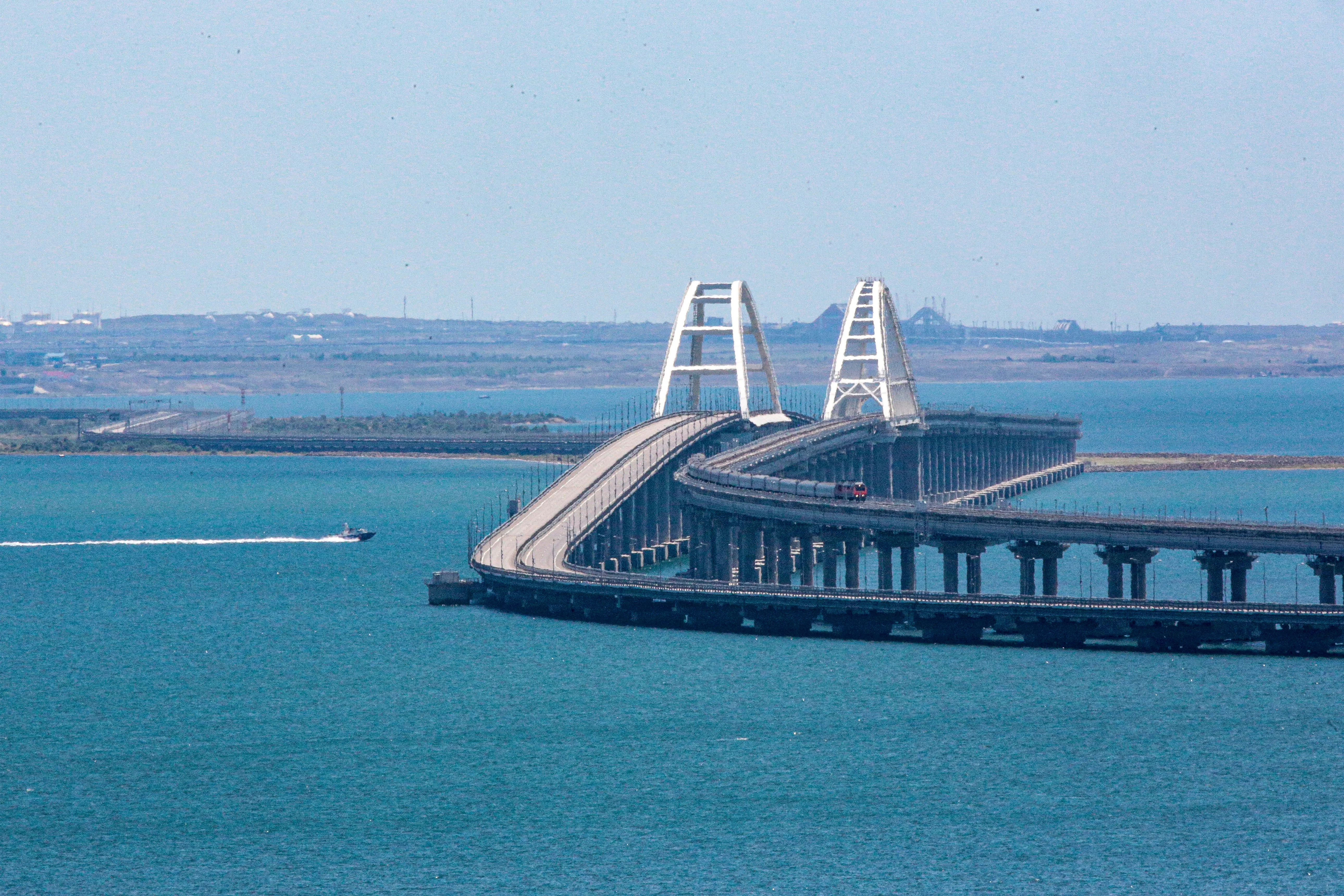
When Ukraine strikes a major Russian bridge with drones and missiles, headlines usually focus on the dramatic explosions. That misses the real story. Every time Kyiv hits a critical span—whether it's the Kerch Strait Bridge linking mainland Russia to occupied Crimea or crossings over the Seym River in Kursk—it isn't just blowing up concrete and steel. It's systematically choking off the Russian military's nervous system.
Let's be honest about how modern warfare works on the Eastern Front. Tanks and artillery shells don't teleport to the trenches. They move by rail and heavy transport trucks, and bridges are the ultimate choke points. If you've ever watched how military logistics operate in Eastern Europe, you know Russian doctrine relies almost entirely on railway networks to haul massive quantities of ammunition, fuel, and armored vehicles. Knock out a single major railway bridge, and entire divisions suddenly face supply starvation within days. Also making waves in this space: Why Ukraine Keeps Striking the Crimean Bridge Despite Heavy Civilian Costs.
The Strategic Reality Behind Ukraine Bridge Strikes
Most casual observers look at a map, see a damaged bridge, and assume Russian engineers will just throw up a pontoon crossing and keep moving. That's a massive misconception.
Heavy main battle tanks like the T-90M weigh nearly 50 tons. Supply trains carry thousands of tons per trip. Temporary pontoon bridges are fragile, slow, and sitting ducks for follow-up drone strikes. During the Kursk incursion, when Ukrainian forces systematically destroyed three key bridges over the Seym River using HIMARS rockets and precision-guided munitions, Russian troops didn't just drive around them. Thousands of soldiers were effectively trapped against the river, forcing Moscow into chaotic, vulnerable ferry operations that Ukrainian reconnaissance drones tracked in real time. Further insights on this are explored by The Guardian.
The Kerch Bridge remains the crown jewel of these targets, and for good reason. Built at a cost of roughly $3.7 billion after Russia's 2014 annexation of Crimea, it serves as both Vladimir Putin's personal prestige project and the primary logistics artery for Russian forces in southern Ukraine. Following the October 2022 truck bombing and the July 2023 naval drone attack by Ukraine's Security Service (SBU) using experimental "Sea Baby" unmanned surface vessels, Russia had to drastically restrict heavy military freight across the span. Even when traffic resumed, Moscow was forced to divert precious air defense systems—including S-400 batteries and Pantsir-S1 units—away from active front lines just to guard one piece of infrastructure.
That's the hidden math of deep-strike warfare. You don't even have to drop the entire bridge into the water to win. You just have to make it too dangerous to use at full capacity.
How Drones and Missiles Work Together in Modern Strikes
A few years ago, hitting a heavily defended bridge hundreds of kilometers behind enemy lines required an expensive squadron of manned strike aircraft. Today, Ukraine pulls it off with coordinated swarms of unmanned systems and long-range standoff weapons.
Here is how a combined strike actually unfolds in practice:
- Decoy saturation comes first. Ukraine launches waves of cheap, long-range one-way attack drones—like the Bober or Lyutyi—to force Russian radar operators to turn on their emitters and waste expensive surface-to-air interceptors.
- Electronic warfare suppression follows. Specialized drones and ground-based jammers target local air defense frequencies, blinding short-range point defenses around the bridge pillars.
- Precision kinetic strikes finish the job. Once defenses are overwhelmed or distracted, high-value munitions like Western-supplied Storm Shadow, SCALP-EG, or ATACMS missiles streak in toward specific structural weak points—usually support piers or expansion joints rather than the flat road deck.
If you've ever studied structural engineering, you know why targeting the deck is a rookie mistake. Punching a hole through asphalt looks dramatic on Telegram videos, yet repair crews can patch a road surface in forty-eight hours. Cracking a load-bearing concrete pier sitting in deep water? That takes months of specialized marine engineering equipment, which itself becomes a target the moment it arrives on site.
Why Air Defense Alone Can't Save Fixed Infrastructure
Russia possesses one of the densest layered air defense networks on the planet. Yet bridges keep getting hit. Why?
Because bridges don't move. Russian commanders know where the bridge is, and Ukrainian planners know the exact coordinates down to the millimeter. When defenders are forced to protect a static target 24 hours a day, seven days a week, fatigue and resource depletion inevitably set in. Ukraine can pick the exact weather window, time of night, and flight path—often skimming drones just meters above water or terrain to stay beneath radar horizons until the final seconds.
Moscow has tried everything to counter this. They've parked barges alongside the Kerch Bridge, deployed smoke generators that cloak the span in thick white fog, and installed underwater boom barriers to stop sea drones. None of it solves the core dilemma. Every barge, radar truck, and naval patrol boat tied down defending a bridge in the rear is one less asset supporting offensive operations in Donetsk or Zaporizhzhia.
The Escalation Cycle Nobody Wants to Admit
Whenever aerial attacks escalate around major Russian infrastructure, Western commentary immediately spirals into hand-wringing about red lines. Critics argue that striking bridges inside internationally recognized Russian territory or occupied Crimea provokes harsher retaliation against Ukrainian cities.
Honestly, that framing gets the cause and effect completely backward. Russia has been hammering Ukraine's electrical grid, dams, apartment blocks, and grain ports with Kinzhal hypersonic missiles, Kalibr cruise missiles, and Shahed drones since the opening weeks of the full-scale invasion. Ukraine isn't escalating out of nowhere—it's finally acquiring the domestic drone manufacturing capacity and Western missile permissions needed to fight back symmetrically.
According to data tracked by defense analysts at organizations like the Center for Strategic and International Studies (CSIS) and the Institute for the Study of War (ISW), Ukraine's domestic defense industry scaled up long-range drone production exponentially between 2023 and 2026. Kyiv no longer has to beg for permission every time it wants to hit a logistics hub three hundred kilometers inside Russian territory. Homegrown systems like the Palianytsia missile-drone hybrid give Ukrainian commanders unilateral strike options that didn't exist at the start of the war.
What Makes Bridge Strikes Different From Refineries or Airfields
Over the past two years, Ukraine has run parallel campaigns against Russian oil refineries, ammunition depots, and military airbases. Each target set hits Moscow differently:
- Oil refineries squeeze the Kremlin's war budget and cause domestic fuel shortages, though global markets and spare refining capacity cushion the immediate battlefield impact.
- Airfields force Russia to relocate Su-34 fighter-bombers further east, extending flight times and reducing the number of glide-bomb sorties per day.
- Bridges produce immediate, localized operational paralysis.
When an ammunition depot explodes in Toropets or Tikhoretsk, it's a catastrophic loss of stockpiles. When a bridge collapses over a major river or strait, it severs the artery connecting all future stockpiles to the troops holding the line. Infantry units can ration shells for a week. They can't ration water, medical evacuations, or diesel fuel indefinitely when the only road behind them ends in a pile of twisted rebar.
Look at the liberation of Kherson in late 2022 as the textbook blueprint. Ukrainian forces didn't have to storm the city street by street in a bloody urban siege. Instead, they spent months systematically shredding the Antonivskyi Bridge and the Nova Kakhovka dam crossing with precision rocket artillery. Once Russian logistics became mathematically unsustainable, Moscow had no choice but to order a humiliating retreat across the Dnipro River.
Common Myths About Ukraine's Long-Range Strike Campaign
If you follow defense coverage online, you'll run into plenty of bad takes whenever another strike hits the news. Clearing up a few of them helps put these attacks into proper perspective.
First, a single strike rarely "destroys" a mega-bridge permanently. Reinforced concrete structures built to withstand earthquakes and ice floes are remarkably resilient. What Ukraine is actually doing is attritional infrastructure warfare—chipping away at structural integrity, forcing weight limits, halting rail traffic for weeks at a time, and draining Russian engineering reserves.
Second, Western missiles aren't doing all the heavy lifting anymore. While ATACMS and Storm Shadow missiles pack devastating bunker-busting warheads, Ukraine's indigenous drone fleet now accounts for the vast majority of deep strikes inside Russia. Domestic startups and state-backed bureaus iterate designs in weeks rather than years, adapting to Russian electronic warfare jamming faster than traditional defense contractors ever could.
Third, air raids on Russian logistics aren't just symbolic morale boosters. Yes, watching a symbol of Russian imperial control burn boosts Ukrainian morale and embarrasses the Kremlin domestically. Inside the Ukrainian General Staff, however, these targets are selected strictly through cold logistical calculus: how many tons of supply per day pass over this point, and how long will it take Russia to reroute?
How to Follow This Story Without Falling for Propaganda
Information warfare runs hotter around bridge strikes than almost any other type of engagement. Russian state media routinely claims all incoming drones and missiles were intercepted, blaming any visible fires on "falling debris." Meanwhile, unverified social media accounts often exaggerate damage before satellite imagery confirms the reality.
If you want an accurate read on how much damage a strike actually caused, ignore the first six hours of Telegram chatter and watch for three concrete indicators instead:
- Commercial satellite imagery from providers like Maxar or Planet Labs, which usually surfaces within 24 to 48 hours and clearly shows scorched decks, collapsed spans, or pontoon construction.
- Traffic and ferry monitoring via local transit channels, which reveal whether heavy trucks and freight trains are actually moving or sitting in multi-kilometer backups.
- FIRMS thermal anomaly data from NASA's satellite fire-tracking system, which picks up intense heat signatures at exact bridge coordinates in near real time.
Track those three data points whenever the next wave of drones and missiles hits a Russian crossing, and you'll know within a day whether Moscow is facing a minor repair job or a full-blown operational crisis.