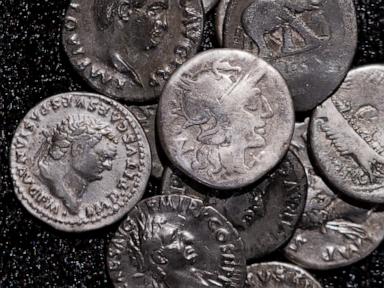
An amateur metal detectorist working near the Harz Mountains in northern Germany recently uncovered the largest hoard of ancient Roman silver coins ever found in the region. This extraordinary discovery pushes far beyond local folklore, forcing historians and archaeologists to completely rethink the actual boundaries of the Roman Empire's economic and military footprint in Germania.
For decades, standard historical narratives suggested that Roman influence north of the Limes—the fortified border system—was limited to sporadic diplomatic contact, small-scale bartering, and occasional military skirmishes. The recovery of over 800 silver denarii and antoniniani, spanning reigns from Augustus down to the mid-third century CE, shatters that comfortable assumption. This is not a casual drop or a forgotten trader's pocket change. This represents a massive, deliberate cache of imperial currency buried intentionally outside imperial territory, raising urgent questions about how wealth actually moved across the ancient European frontier. You might also find this similar story useful: Why Arrest Headlines About Killings of Women in South Africa Miss the Real Crisis.
The Geography of the Find
The location matters just as much as the metal itself. Modern excavation parameters confirm the hoard was hidden near Rauschenwasser, within the federal state of Lower Saxony. This positioning places the burial site deep inside the territory of the Germanic Cherusci and neighboring tribes—territories where legions famously met disaster under Arminius in 9 E.C. at the Battle of the Teutoburg Forest.
To find hundreds of pristine Roman silver coins minted decades apart in a zone that was supposedly hostile to everything Roman exposes a deep, ongoing commercial and political entanglement. Mercenary pay, state subsidies paid to allied Germanic chieftains, or accumulated war plunder are the primary suspects. As extensively documented in latest articles by Al Jazeera, the results are notable.
Ancient currency did not travel by accident. Silver denarii served as the global reserve currency of the ancient Mediterranean world. When merchants, diplomats, or mercenaries moved goods through the dense forests of northern Europe, they carried hard cash because local barter economies struggled to value complex commodities at scale. The sheer density of this specific find indicates a permanent, institutionalized financial pipeline running straight through the heart of barbarian Europe.
Decoding the Denarii
Numismatists working with state heritage authorities have begun cataloging the individual pieces. The timeline etched into the silver tells a compelling story of accumulation. Older coins show heavy circulation wear, smoothed edges, and deliberate test cuts where suspicious merchants checked the purity of the metal beneath the silver wash. Newer coins gleam with sharper relief, minted during periods of severe imperial debasement under the Severan dynasty and the chaotic Crisis of the Third Century.
This chronological span proves the hoard was not gathered overnight. Families, tribal elites, or military syndicates hoarded these coins over generations, storing their wealth in the most stable medium available to the ancient world.
When Roman emperors paid annual tributes or subsidies to Germanic leaders to keep the peace along the border, those funds did not vanish. They cascaded down local trade networks, accumulating in the hands of chieftains who understood that Roman silver held purchasing power even among people who despised Rome's political hegemony.
The Logistics of Ancient Wealth Storage
Burying a hoard of this magnitude required planning, discretion, and acute awareness of local dangers. In an era before banks, security vaults, or digital ledgers, earth was the safest vault available.
- Ceramic Vessels: The coins were preserved inside a degraded earthenware pot, a common technique for sub-surface storage that kept moisture out during harsh winters.
- Strategic Placement: The site chosen was removed from permanent settlements yet close enough to recognizable terrain features for the owner to return.
- The Owner's Fate: The fact that the hoard remained in the ground for nearly two millennia proves that whoever buried it never came back. War, disease, or sudden displacement likely claimed them before they could reclaim their capital.
Reassessing Roman-Germanic Relations
The traditional historical framework relied heavily on written accounts left by Roman senators and generals like Tacitus. Those sources carried a distinct political bias, portraying Germania as a dark, uncivilized periphery populated by fierce warriors who rejected Roman civilization.
Archaeology continues to dismantle that simplistic propaganda. The Rauschenwasser hoard joins a growing body of material evidence demonstrating that the frontier was porous, dynamic, and deeply integrated into Mediterranean trade circuits.
Germanic elites craved Roman luxury goods—wine, olive oil, glassware, and high-status textiles. To acquire them, they exported amber, furs, cattle, and mercenary manpower. Silver coin hoards represent the liquid capital of that trans-border economy. Every denarius unearthed in Lower Saxony is a physical receipt for a transaction that elite Roman historians preferred to downplay.
The Amateur Detectorist Dilemma
This discovery also highlights a tense, ongoing debate within European heritage management regarding amateur metal detecting. Unlike the United Kingdom, where the Portable Antiquities Scheme actively integrates hobbyists into the official archaeological record, many European jurisdictions maintain restrictive, bureaucratic regimes that criminalize unauthorized searching or create adversarial relationships between finders and state institutions.
In this instance, the finder immediately notified the Lower Saxony State Office for Cultural Heritage. That decision saved the context of the find. If the exact soil stratigraphy, surrounding organic material, and precise GPS coordinates had been lost to illicit looting, historians would have been left with a collection of loose coins devoid of historical context.
State authorities must adapt to the reality of widespread detector use. Ignoring or overly criminalizing hobbyists drives discoveries underground, feeding the illicit antiquities black market and destroying irreplaceable historical data forever. When professional archaeologists and responsible metal detectorists collaborate, extraordinary chapters of human history emerge from the dirt.
The silver coins of Rauschenwasser sit in a climate-controlled laboratory today, cleaned, cataloged, and analyzed. They are quiet now, stripped of the friction, violence, and commerce that brought them across an empire's border. Yet they remain stubborn, unyielding proof that the ancient world was far more connected, complex, and commercially driven than ancient writers ever admitted or modern textbooks usually teach.