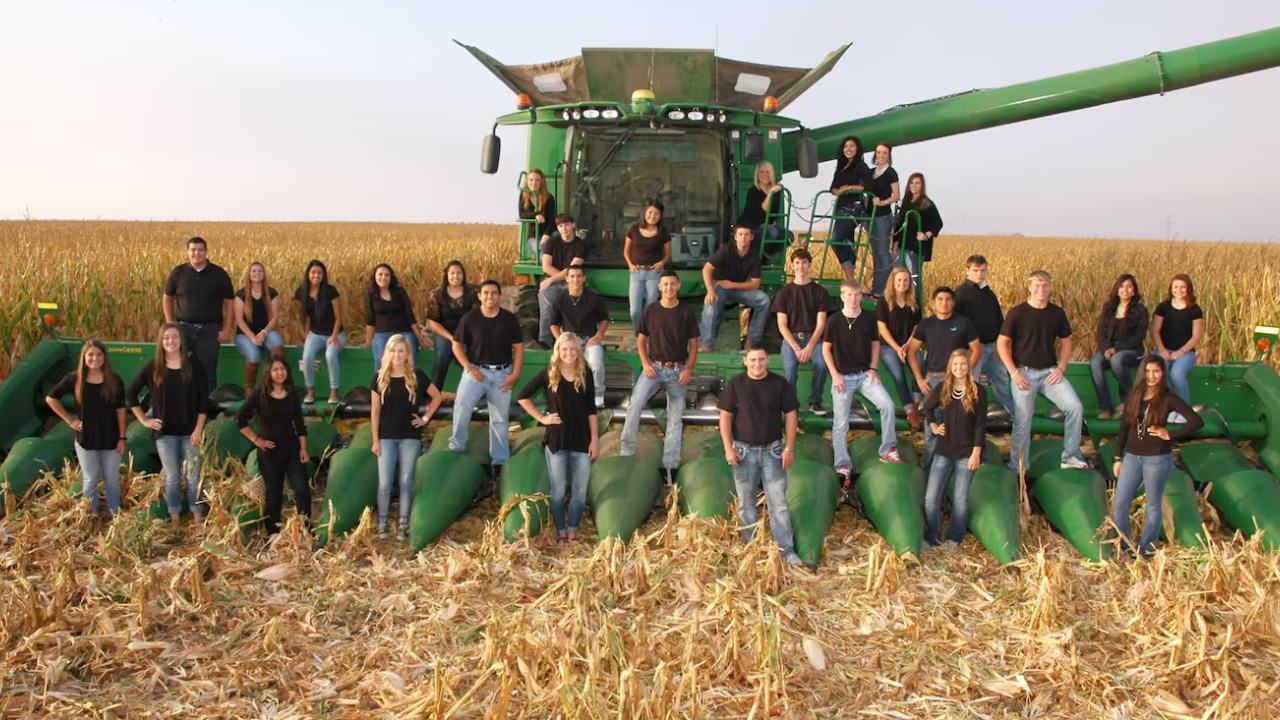
Since 2009, Luke Bryan has converted temporary agricultural real estate into a repeatable philanthropic engine, generating 97 college scholarships and 11 million meals through his annual Farm Tour. Most entertainment coverage treats these figures as simple public relations milestones. From an operational and corporate strategy perspective, the tour represents a closed-loop commercial model where live entertainment, agricultural corporate sponsorships, and localized philanthropy subsidize one another to solve rural market inefficiencies.
Traditional touring economics rely on fixed urban infrastructure—arenas, amphitheaters, and stadiums—where high ticket volume offsets rigid venue overhead. The Farm Tour inverts this model by building temporary concert infrastructure on working family farms in secondary and tertiary agricultural markets. By intentionally bypassing major metropolitan hubs, the tour captures an underserved consumer demographic while creating a high-affinity activation environment for agricultural conglomerates. The philanthropic outputs—scholarships and food bank distribution—are not detached charitable add-ons; they are the structural mechanisms that justify corporate sponsorship capital, secure local municipal cooperation, and insulate the brand against commercial fatigue.
The Structural Architecture of the Farm Tour Model
To understand how an annual six-to-eight-date tour sustains multi-million-meal outputs and near-century scholarship counts over more than a decade, the operation must be broken down into three interdependent operational pillars.
1. Geographic Arbitrage and Infrastructure Conversion
Standard touring routes optimize for population density to minimize routing costs per ticket sold. The Farm Tour executes a strategy of geographic arbitrage. By staging concerts in rural communities across the Midwest and South—often during the autumn harvest window—the production eliminates direct competition from traditional urban entertainment venues.
Operating on raw farmland introduces severe logistical friction. Temporary staging, power generation, perimeter security, sanitation, and traffic control must be trucked into locations lacking permanent utility grids. This increases variable production costs per show compared to a standard amphitheater date. The economic viability of this setup depends entirely on converting that raw friction into experiential scarcity. Attendees are not buying a standard concert ticket; they are buying an exclusive, site-specific cultural event. This pricing power offsets the temporary infrastructure build-out while creating a distinct physical environment that corporate sponsors cannot replicate inside a standard urban arena.
2. B2B Sponsorship Underwriting via Audience Alignment
In standard music touring, corporate sponsorships are largely awareness plays—logo placement on digital screens or concourse activations aimed at a fragmented demographic. On the Farm Tour, corporate partners such as Bayer, Citibank, and regional agricultural suppliers engage in high-precision business-to-business (B2B) and business-to-consumer (B2C) alignment.
When an agricultural science company like Bayer underwrites a tour stop on a working farm, the audience is composed heavily of primary decision-makers: farm owners, agricultural operators, equipment buyers, and rural consumers. The cost per thousand impressions (CPM) is higher than broad-market advertising, yet the conversion and brand-affinity metrics are superior because the environment matches the product's actual use case. Corporate sponsorship capital absorbs the elevated variable costs of rural production while directly funding the philanthropic pool.
3. Localized Philanthropic Distribution
The tour’s philanthropic output is split into two distinct mechanisms: human capital investment (scholarships) and immediate caloric relief (meal distribution).
- Human Capital Investment (97 Scholarships): Since 2009, the tour has awarded 97 college scholarships to students from farming families within the specific communities hosting the concerts. By restricting eligibility to local residents attending regional colleges or universities, the tour prevents capital flight. The financial aid directly subsidizes the next generation of regional workforce talent, creating multi-year goodwill among local families and municipal leaders.
- Caloric Relief Supply Chain (11 Million Meals): Rather than writing lump-sum checks to national charities, the tour integrates directly with regional food banks and national partners like Feeding America. Through mechanisms such as Bayer’s "#Here'sToTheFarmer" social media campaigns and direct sponsor matching, digital engagement and ticket sales are converted into wholesale food procurement funds. Because regional food banks operate with high purchasing efficiency—often securing multiple meals per dollar through bulk agricultural partnerships—sponsorship dollars achieve a massive multiplier effect.
Deconstructing the Two-Tiered Philanthropic Output
Evaluating 97 scholarships alongside 11 million meals requires separating long-term structural impact from short-term operational throughput. Conflating the two obscures how the tour actually allocates capital.
The Scholarship Mechanism: High Cost Per Unit, Long-Term ROI
Awarding 97 scholarships over roughly 15 years averages between six and seven scholarships per annual tour cycle—roughly one per tour stop. In pure financial volume, a single college scholarship represents a fixed, predictable capital outlay (typically ranging from $1,000 to $5,000 per recipient in similar entertainment-backed funds, though exact individual award amounts vary by year and sponsor contribution).
The strategic value of the scholarship program is not volume; it is political and community friction reduction. Staging a concert for 15,000 to 20,000 attendees on a rural two-lane highway creates massive localized disruption: road closures, emergency service strain, noise, and agricultural land wear. Local county commissioners, sheriffs, and neighboring landowners approve permits and absorb this disruption because the economic and educational return stays inside the county line. Awarding a scholarship to a local high school senior from a farming family transforms the tour from an external commercial extraction event into a civic investment.
The Meal Distribution Engine: Low Cost Per Unit, High Volume Throughput
Eleven million meals distributed since 2009 equates to an average of roughly 733,000 meals per year. Unlike scholarships, which require administrative vetting, selection committees, and individual disbursement, meal distribution relies on existing wholesale logistics networks.
The mechanics of modern food bank accounting explain this scale. Food banks do not purchase groceries at retail prices; they acquire surplus agricultural goods, bulk staples, and manufacturer donations at wholesale or salvage rates. Through Feeding America’s network, a single dollar donated by a corporate sponsor typically translates into at least 10 meals. Therefore, generating 733,000 meals annually requires approximately $73,300 in direct wholesale food funding per year—a fraction of a major corporate sponsor’s annual marketing budget.
By tying meal generation to fan participation—such as matching funds for every social media share using a specific campaign hashtag—the tour converts passive concertgoers into active brand advocates for the corporate sponsor. The fan feels they have contributed to hunger relief at zero marginal cost to themselves, the artist reinforces their authentic rural identity, and the sponsor generates massive earned media impressions while fulfilling Corporate Social Responsibility (CSR) mandates.
The Cause-and-Effect Chain Most Coverage Misses
Mainstream entertainment reporting frames the Farm Tour as a linear story: a successful country artist decides to give back to his roots, and big numbers result. That framing misses the commercial feedback loop that makes the charity sustainable over 17 years.
The true causal chain operates in four stages:
- Authenticity Signal: Luke Bryan’s background as the son of a Georgia peanut farmer establishes baseline credibility. Without this biographical foundation, corporate agricultural sponsorships would read as cynical greenwashing or opportunistic pandering to rural consumers.
- Risk Mitigation for Sponsors: Agricultural corporations face persistent public relations challenges regarding environmental impact, seed patenting, and consolidation. Aligning with an authentic cultural figure who actively subsidizes family farms allows these corporations to deploy marketing budgets into a trusted environment.
- Capital Injection: Sponsor fees underwrite the heavy logistical overhead of building temporary concert venues in cornfields and pastures. Without sponsor underwriting, ticket prices would have to rise to levels that would price out the core rural demographic, collapsing attendance.
- Civic License to Operate: The resulting ticket volume and sponsor matches fund the scholarships and food banks. Those tangible local benefits guarantee that host farmers, local vendors, and municipal authorities welcome the tour back the following year, securing the physical real estate required for future dates.
If any single link in this chain breaks, the philanthropic output collapses. Remove the corporate sponsors, and the unit economics of rural temporary staging turn negative. Remove the local scholarships, and county governments revoke permitting or increase municipal security fees to prohibitive levels. Remove the artist’s authentic agricultural tie, and the core audience rejects the corporate activations.
Operational Limitations and Structural Vulnerabilities
While the Farm Tour model is highly efficient within its specific niche, replicating or scaling it exposes four distinct operational constraints.
1. Weather and Agricultural Timing Risk
Staging outdoor events in late September and October across the Midwest and South exposes the production to severe meteorological volatility. Early autumn rainstorms do not merely inconvenience attendees; they turn dirt access roads and parking pastures into impassable mud, halting semi-truck load-ins and emergency vehicle access. Unlike an urban amphitheater with paved parking lots and covered seating, a single heavy rain event on a working farm can force a complete cancellation, resulting in total loss of sunk production costs. Furthermore, scheduling must navigate the narrow window between crop maturation and active harvest so host farmers do not lose revenue from damaged yield.
2. The Scalability Ceiling
The Farm Tour has remained intentionally capped at roughly six to eight dates per year. Expanding the tour to 30 or 40 dates would destroy its unit economics. First, the logistical burnout of assembling and disassembling full-scale festival infrastructure on unimproved land cannot be sustained across a standard six-month touring cycle without exponentially increasing crew and equipment lease costs. Second, scarcity drives both ticket demand and sponsor pricing. Scarcity forces regional fans to travel and concentrates corporate marketing budgets into a two-week high-visibility blitz. Scaling the tour nationwide would dilute sponsor return on investment (ROI) and turn a high-margin specialty product into a grueling, low-margin logistical slog.
3. Dependence on Wholesale Food Supply Chains
The 11-million-meal metric relies heavily on the efficiency of regional food banks and agricultural surplus networks. When inflation drives up wholesale food prices, fuel costs, and trucking rates, the purchasing power of each donated dollar drops immediately. Maintaining consistent meal output during periods of agricultural supply chain contraction requires corporate sponsors to increase their cash commitments simply to keep meal counts flat, creating budget friction during economic downturns.
4. Key-Person Concentration Risk
Unlike a standalone music festival brand (such as Stagecoach or Bonnaroo) that can rotate headliners annually while retaining institutional equity, the Farm Tour is entirely dependent on a single artist's personal brand and touring schedule. The entire B2B sponsorship apparatus, host-farm recruitment, and philanthropic disbursement pipeline rely on Luke Bryan’s active participation. There is no turnkey succession mechanism built into the asset.
Strategic Blueprint for Replicating High-Affinity Cause Touring
For brand strategists, artist managers, and corporate philanthropy directors looking to build a similar closed-loop model in other sectors (such as manufacturing, maritime industries, or outdoor recreation), execution requires strict adherence to four operational rules:
- Anchor in Non-Standard Real Estate: Bypass traditional venues where corporate branding is background noise. Secure temporary access to working industrial, agricultural, or civic sites where the physical environment naturally validates the sponsor's core business.
- Restrict Philanthropy to the Immediate Blast Radius: Abandon vague national charitable pledges. Tie financial disbursements—whether educational grants, trade apprenticeships, or direct material aid—strictly to the zip codes absorbing the physical disruption of the event. Use local philanthropy as a direct mechanism to secure municipal permitting and community cooperation.
- Engineer Zero-Friction Fan Conversion: Structure sponsor matching programs around behavioral triggers that require no additional financial outlay from the ticket buyer. Social media amplification, on-site QR check-ins, and ticket-tier allocations convert existing audience enthusiasm into measurable corporate CSR metrics.
- Enforce Strict Supply Scarcity: Cap the event series at fewer than ten annual dates. Maintain high experiential value, protect crew and infrastructure margins from logistical overextension, and force corporate partners to compete for limited inventory within a concentrated marketing window.