The ink was barely dry on the June 17 memorandum of understanding when the drones started flying.
Just two weeks after the United States and Iran signed a fragile interim peace deal to halt a four-month-old war, the Strait of Hormuz is back on fire. If you thought a diplomatic framework would easily untangle the world's most critical maritime chokepoint, the events of the last 48 hours prove otherwise.
The US military just wrapped up a consecutive second day of retaliatory airstrikes inside Iran. This massive kinetic response follows back-to-back attacks on commercial shipping vessels passing through the region. It's a heavy blow to anyone hoping the 60-day diplomatic window would bring stability to global energy routes.
Here is what is actually happening on the water, why the ceasefire is failing, and what it means for global commerce.
Two Days of Strikes and Counterstrikes
The latest escalation began on Thursday, June 25, when the M/V Ever Lovely, a Singapore-registered commercial container ship, was targeted while navigating the waterway near the coast of Oman. According to White House officials, Iranian forces launched at least four one-way attack drones at shipping lanes. Three were intercepted, but one struck the upper deck of the Ever Lovely. While the vessel sustained damage, no crew members were injured, and it managed to continue its journey.
The American response was swift. On Friday, June 26, US Central Command launched a series of targeted airstrikes against Iranian missile sites, coastal radar stations, and drone storage facilities near the southern port city of Sirik.
Instead of backing down, regional forces pushed further. Early on Saturday, June 27, a second commercial vessel—a Panama-flagged tanker—was hit by a projectile in the strait, damaging its bridge.
Hours later, CENTCOM executed a second, broader wave of airstrikes. This second round hit:
- Military surveillance infrastructure
- Tactical communication networks
- Regional air defense installations
- Drone storage warehouses
- Active minelaying naval capabilities
Iran's Islamic Revolutionary Guard Corps quickly claimed retaliatory strikes against US military bases in the region, warning of an even broader conflict if American operations continue.
The Battle of the Shipping Lanes
The real driver behind this sudden collapse isn't just basic hostility. It's a fundamental disagreement over who controls the geography of the Strait of Hormuz and who gets to profit from it.
Before the June 17 agreement, Iran had completely choked off traffic through the waterway. This blockade forced global prices for fuel, fertilizer, and consumer goods to spike wildly. The interim deal was supposed to create a 60-day window where Iran would use its "best efforts" to allow commercial transit without charging fees.
The United Nations maritime agency, the International Maritime Organization, immediately tried to capitalise on this window. They launched an evacuation operation to move hundreds of stranded vessels out of the gulf. To keep things safe, the UN mapped out an alternative shipping lane that hugs the southern coast of Oman, completely avoiding the central part of the strait.
Tehran isn't having it.
Iran wants all maritime traffic to utilize a northern shipping lane that cuts directly through its territorial waters. Why? Because the Iranian government plans to levy heavy transit tolls on every single ship using the route.
Ebrahim Azizi, head of the Iranian parliament's national security committee, made their stance clear by stating that the Strait of Hormuz is governed by Iran and any violation of their shipping instructions will be met decisively. From Tehran's perspective, attacking ships on the UN route isn't violating the ceasefire—it's enforcing their local rules.
Shaking Up the Peace Talks
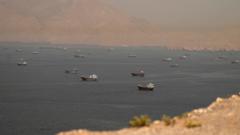
This economic friction has completely halted the UN evacuation process. Out of roughly 615 trapped ships, only 115 managed to escape through the Omani lane before the International Maritime Organization froze all operations. The remaining 500 ships are stuck once again until the shipping coalition secures ironclad safety guarantees.
The maritime friction has triggered a fierce political response in Washington. President Donald Trump described the drone strikes as a foolish violation of the memorandum of understanding. He took to social media to warn that the US might be forced to militarily complete the job, stating that if that happens, the Islamic Republic of Iran will no longer exist.
Meanwhile, Vice President JD Vance, the administration’s chief negotiator on this conflict, emphasized that the US has strictly adhered to the ceasefire terms and warned that future violence will be met with equal violence.
The Reality for Global Shipping
If you run a commercial shipping company or track global supply chains, the hope of a quick normalization is gone. Marine data analytics firm Windward notes that while the strait technically remains open, the pace of commercial normalization has dropped significantly.
On the Wednesday before the first drone strike, 78 vessels transited the strait—the highest daily volume since the war began. Today, multiple tankers have reversed course entirely, refusing to gamble on whether an insurance policy will cover a drone strike to the bridge.
What we are looking at isn't a total return to all-out war just yet, but rather a dangerous game of leverage. Iran knows its control over the strait is its strongest bargaining chip in ongoing negotiations in Switzerland regarding its nuclear program and ballistic missile stockpiles. By hitting commercial tankers instead of US warships, Tehran is testing how far it can push the boundaries of the ceasefire without triggering a full-scale American military invasion.
If you are operating assets or managing supply logistics tied to Gulf trade routes, your immediate next steps require shifting away from the assumption of an open waterway. You need to adjust maritime insurance budgets to account for prolonged high-risk premiums through at least the remainder of the 60-day negotiation window. Logistics teams should pause any route planning reliant on the UN-backed Omani lane until the International Maritime Organization officially resumes evacuations. Finally, ensure all regional transit manifests strictly document non-military cargo status to minimize targeting profiles under Iran's self-declared northern lane instructions. Expect more turbulence ahead; this diplomatic transition is going to be incredibly rocky.