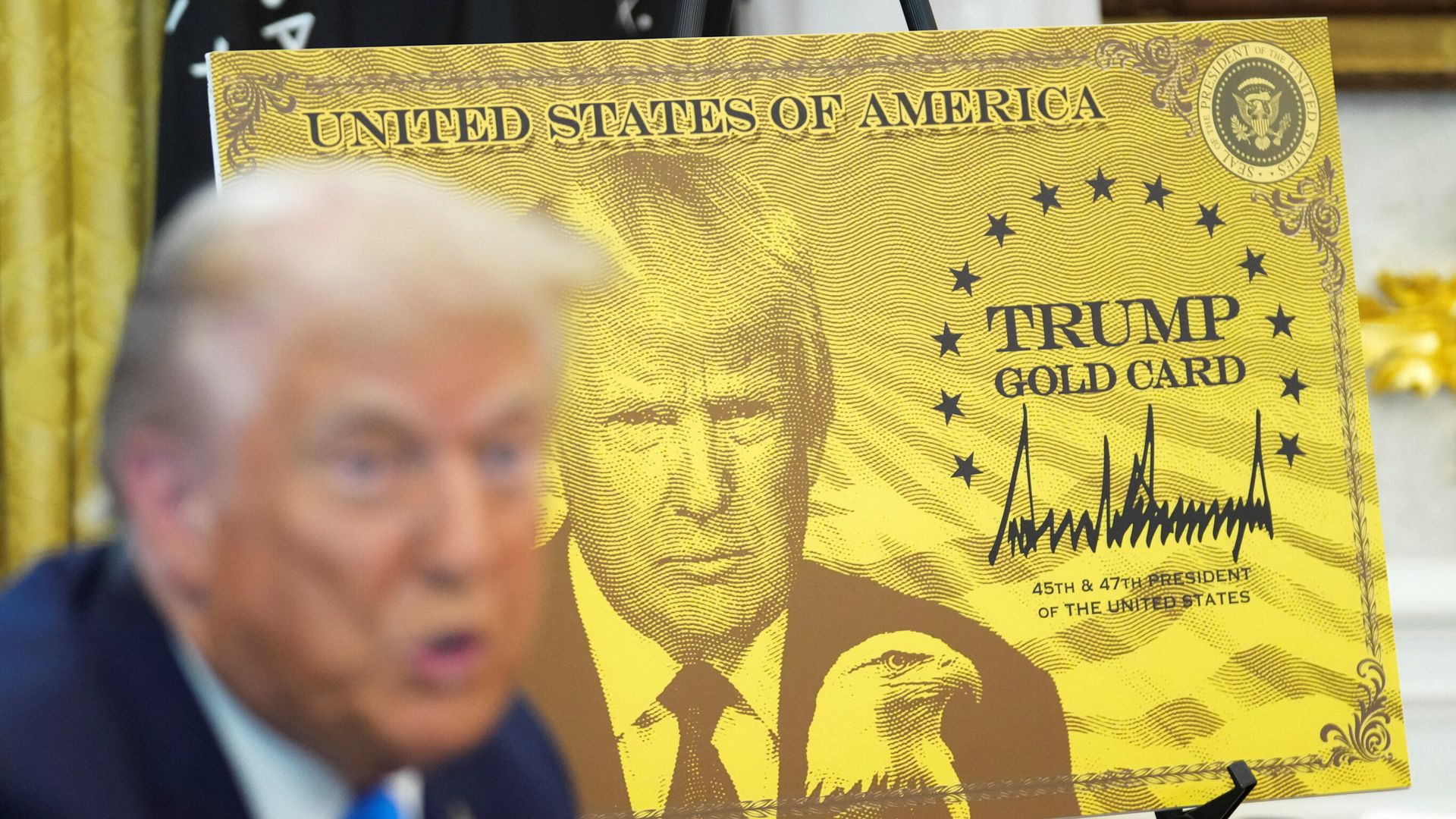
The financial press is currently obsessed with a rounding error. They are staring at Donald Trump’s $1,000,000 "gold card" and complaining that the US Treasury hasn’t seen a "dividend" yet. It is the kind of shallow, spreadsheet-driven analysis that misses the entire point of how modern political capital and brand-backed financial instruments actually function.
If you are waiting for a direct deposit into the federal budget from a commemorative membership card, you are fundamentally misunderstanding the architecture of 21st-century finance. The Treasury is fine. The real action is happening in the secondary markets of influence and the psychological floor these assets create for a brand that refuses to die.
The Myth of the Direct Revenue Pipeline
Most commentators are stuck in a 1995 mindset. They believe that if a political figure launches a high-tier financial product, the primary goal is a simple "buy-sell-profit" loop for the government. That is small-time thinking.
The US Treasury does not run on the sales of novelty items. The Treasury runs on debt issuance, tax receipts, and the management of the dollar's status as the global reserve currency. To suggest that a million-dollar card is failing because it hasn’t "paid dividends" to the federal government is like complaining that a Ferrari hasn't helped solve the city's public transit deficit. It was never designed to do that.
I have watched consultants waste years trying to map out direct-to-government revenue streams from private-public hybrid branding. It almost never works that way. The value is found in the liquidity of attention.
Why the "Gold Card" is a Liquidity Play, Not a Tax Strategy
When an asset is priced at $1,000,000, the price tag is the filter. It is an entry barrier. The "lazy consensus" says this is a failed fundraising attempt because the volume of sales isn't hitting "mass market" levels.
In reality, the goal of a high-ticket item like this is to anchor the value of the entire ecosystem. It’s the "Hermès Birkin" strategy applied to political branding. By establishing a million-dollar ceiling, every other piece of merchandise—the $99 NFTs, the $500 sneakers, the $1,000 coins—suddenly looks like a bargain.
The Treasury doesn't need the million dollars. What the political machine needs is a high-water mark that signals "success" to a base that equates price with power.
Understanding the Mechanics of Symbolic Assets
Let’s look at the actual math of influence.
$$V = \frac{A \times S}{L}$$
In this simplified model for the value of a symbolic asset ($V$), you have Attention ($A$) multiplied by Scarcity ($S$), divided by the Liquidity ($L$) of the offering.
If you flood the market, the value crashes. By keeping the "gold card" elusive and "yet to pay dividends," the scarcity remains intact. The moment the Treasury actually starts processing these funds as standard revenue, the card becomes a commodity. As long as it remains in this state of "limbo" that the media hates, it retains its status as a legendary, untouchable asset.
The Flawed Premise of "People Also Ask"
If you look at what people are searching for regarding this card, the questions are predictably narrow:
- "How much money has the gold card raised?"
- "Can I buy a Trump gold card for the Treasury?"
- "Is the $1m card a scam?"
These questions are built on the false premise that this is a standard retail transaction. It isn’t.
If you are asking how much it "raised," you are treating a political movement like a bake sale. You should be asking how much earned media the card generated. A million-dollar price point creates a week of headlines. If the campaign had to buy that much airtime on major networks, it would cost $50 million.
The card didn't "fail" to pay dividends; it already paid them in the form of millions of dollars in free advertising. The critics are counting the pennies in the register while the brand is stealing the entire store.
The Counter-Intuitive Truth About Political Wealth
Here is the part where most people get uncomfortable: Wealth in the modern era is not about what you have in the bank. It is about what you can convince people something is worth.
The US Treasury is a massive, sluggish entity. It cannot react to cultural shifts. Private branding exercises, even those tied to high-ranking officials, move at the speed of social media.
I have seen private equity firms use similar "anchor products" to inflate the perceived value of a portfolio. You put one "unsellable" trophy asset at the top of the list, and it makes the rest of the garbage in the fund look like a steal. That is exactly what is happening here. The "gold card" is the trophy asset. It exists to be talked about, not to be audited by a mid-level clerk at the IRS.
The Risks of the Contrarian Stance
I will admit the downside: this strategy relies entirely on the continued relevance of the individual. If the brand fades, the million-dollar anchor becomes a million-dollar anchor around the neck of the organization.
But as long as the news cycle continues to feed the fire, the "failure" to pay dividends is actually a win. It keeps the story alive. It keeps the "outsider" narrative functioning. It suggests that the "system" is too broken to even handle the massive wealth being offered to it.
Stop Looking at the Ledger
The media wants a balance sheet. They want to see a line item that says "Gold Card Revenue: $X,XXX,XXX." They aren't going to get it, and that’s the point.
The card is a signaling device. It signals to donors that the stakes are high. It signals to the opposition that the movement has deep-pocketed backers. It signals to the Treasury that there are financial forces at play that they don't yet understand.
If you are waiting for a dividend, you are the mark. The real players are watching the shift in how political power is being tokenized and sold to the highest bidder, one "failed" million-dollar card at a time.
Throw away your accounting textbook. This isn't about revenue. It’s about dominance.
The Treasury is a spectator in a game where the rules were rewritten a decade ago. If you can't see the value in a "failed" million-dollar asset, you aren't paying attention to how the world actually works.
Stop asking when the Treasury will get its cut. Start asking why you still think the Treasury is the most important player in the room.