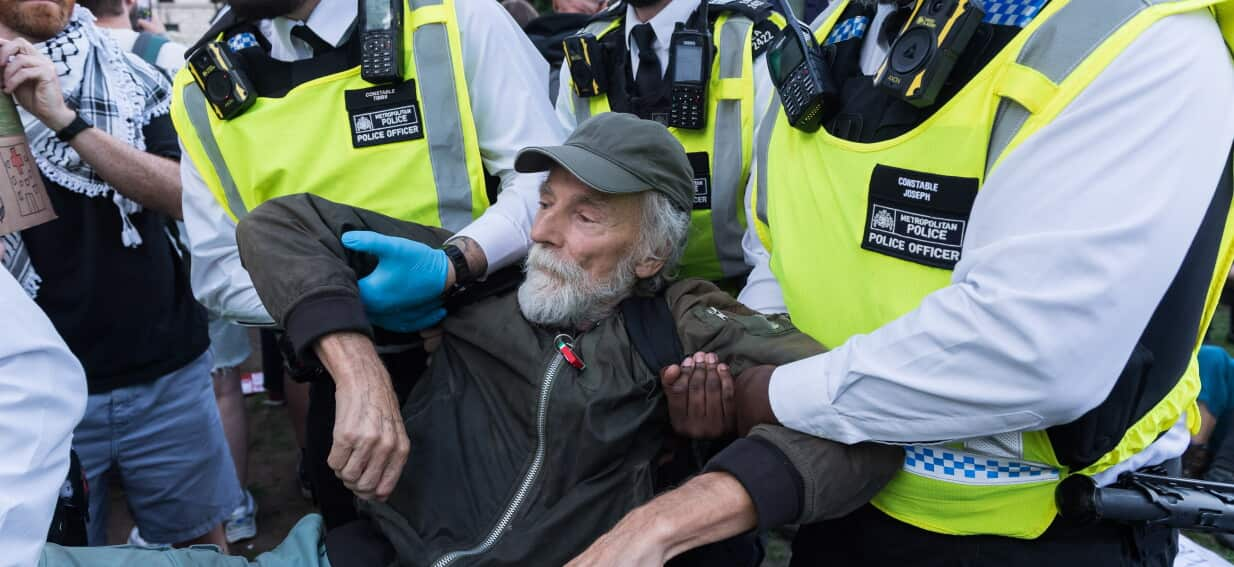
The British state is attempting to redraw the legal boundary between criminal property damage and domestic terrorism. In courtrooms from London to Manchester, prosecutors and government officials have pushed to classify Palestine Action—a direct-action network known for splashing red paint on defense factories and smashing equipment—under the same statutory umbrella used for armed insurgents and mass-casualty extremists. If the state succeeds in treating aggressive industrial sabotage as terrorism, it will hand the Home Office sweeping powers to ban activist groups, freeze bank accounts, and prosecute peaceful sympathizers without ever proving a threat to human life.
That is the core tension driving the UK court battles surrounding Palestine Action. For decades, British law maintained a clear, if occasionally strained, distinction between rowdy civil disobedience and political terror. One landed you in front of a magistrate for criminal damage or aggravated trespass; the other put you in Belmarsh prison under the Terrorism Act 2000. Now, that line is blurring in real time.
How the Terrorism Act 2000 Stretched Beyond Bombs and Bullets
To understand why a group armed primarily with hammers, crowbars, and fire extinguishers filled with latex paint is being discussed alongside proscribed militant organizations, you have to look at the fine print of British statute. When Parliament passed the Terrorism Act 2000, lawmakers drafted a notoriously broad definition of terrorism. Under Section 1 of the Act, terrorism does not require killing or injuring anyone. It includes "serious damage to property" designed to influence the government or intimidate the public for a political, religious, or ideological cause.
For twenty years, successive governments assured civil liberties lawyers that this clause would be reserved for catastrophic infrastructure attacks—things like blowing up power grids or sabotaging water supplies. Prosecutors rarely used it against street-level activists.
Then came the sustained campaign against Elbit Systems UK, the British subsidiary of Israel's largest defense contractor. Founded in 2020, Palestine Action abandoned traditional marching and lobbying in favor of targeted, repetitive disruption. Activists occupied rooftops, chained themselves to gates, and systematically destroyed machinery inside factories in Oldham, Shenstone, and Bristol.
Standard criminal prosecutions began to falter. In several high-profile trials, juries acquitted activists who argued their actions were necessary to prevent greater harm—a legal defense known as lawful excuse or the prevention of crime. Even when judges narrowed those defenses, the sheer volume of arrests overwhelmed local court dockets while failing to stop the next raid.
Faced with juries refusing to convict and factories repeatedly shut down, the state reached for heavier weaponry. Police began invoking counter-terrorism powers during arrests, holding suspects for extended periods without charge, raiding homes under terrorism warrants, and subjecting activists to Schedule 7 port stops—powers originally designed to intercept returning foreign fighters at Heathrow.
The Mechanics of Proscription and Why It Matters
The ultimate weapon in the Home Secretary's arsenal is proscription. Under Part II of the Terrorism Act 2000, the government can officially ban an organization if it believes the group is "concerned in terrorism." Once an organization is added to the proscribed list, the legal ground shifts beneath everyone remotely connected to it.
Membership becomes a crime carrying up to 14 years in prison. Wearing a T-shirt with the group's logo, sharing its press releases on social media, or donating ten pounds to its bail fund becomes a criminal offense. Landlords can be prosecuted for letting the group hold a meeting in a community hall.
Lobbying groups, defense industry executives, and certain political figures—most notably Lord Walney, the government's independent adviser on political violence and disruption—have openly floated the idea of treating direct-action networks like Palestine Action as domestic extremists or moving toward outright proscription. The logic from the security establishment is straightforward: when a group explicitly states its goal is to force a foreign-owned defense manufacturer out of Britain through repeated, costly sabotage, it is using serious property damage to coerce corporate and government policy.
Yet legal scholars and veteran defense solicitors point out a glaring flaw in that reasoning. Terrorism, in both common understanding and international legal norms, relies on indiscriminate fear. It targets the public to create psychological terror. Palestine Action's tactics, while undeniably unlawful and expensive for the targets, are narrowly focused on commercial and military supply chains.
Consider a hypothetical example to see how far this net could spread. Imagine a group of local farmers in rural England who repeatedly slash the tires of corporate logging trucks and pour sand into the fuel tanks of bulldozers to stop an unwanted highway project. Under a literal reading of Section 1 of the Terrorism Act, that is serious damage to property intended to influence government infrastructure policy. If the precedent set against Palestine Action holds, those farmers could theoretically be processed through the same counter-terrorism apparatus as an al-Qaeda cell.
The Filton Raid and the Escalation of Charges
The turning point arrived in August 2024, when activists breached an Elbit Systems research and development facility in Filton, near Bristol. According to police reports, a vehicle was used to ram the perimeter, and activists caused over a million pounds' worth of damage inside the building, allegedly clashing with security guards and responding police officers.
The state's response was unprecedented for a domestic protest group. Detectives from Counter Terrorism Policing South East took over the investigation. Suspects were detained under Section 41 of the Terrorism Act, allowing police to hold them for up to 14 days before bringing charges—a stark departure from the standard 24-to-96-hour window under the Police and Criminal Evidence Act.
When charges were finally brought, prosecutors stopped just short of charging the defendants with direct terrorism offenses, opting instead for criminal damage, violent disorder, and burglary. However, the Crown Prosecution Service explicitly informed the court that it would argue the offenses had a "terrorist connection."
That distinction sounds technical, yet its impact is massive. Under the Sentencing Act 2020, if a judge agrees that an ordinary crime has a terrorist connection, it becomes an aggravating factor that automatically drives up prison sentences. More importantly, it places the convicted individual under strict terrorist offender notification requirements upon release—meaning years of intense police monitoring, travel bans, and restrictions on internet use, identical to those imposed on convicted bomb-makers.
Juries Versus Judges in the British Courtroom
The battle over Palestine Action has exposed a quiet constitutional crisis inside the English legal system: the growing friction between the judiciary and the jury box.
For centuries, the British jury has acted as a democratic safety valve. When the state prosecutes citizens for politically charged acts, twelve ordinary people get to decide whether the behavior truly warrants criminal punishment. In early Palestine Action trials, defense barristers successfully persuaded juries that activists who damaged Elbit facilities were acting out of genuine moral conviction to stop weapons components from reaching conflict zones.
The state hated losing those cases. In response, the Court of Appeal issued a landmark ruling in 2024—stemming from cases involving climate protesters from Insulate Britain and Just Stop Oil, but immediately applied to Palestine Action—that drastically curtailed what defendants can say in court. Judges ruled that political beliefs, international law arguments, and moral justifications are legally irrelevant to charges of criminal damage.
Trial judges began banning defendants from even mentioning Gaza, civilian casualties, or the Israeli military in front of the jury. In several instances, activists who tried to explain their motives from the witness stand were held in contempt of court and jailed on the spot.
By shifting the legal framing toward terrorism and stripping away jury defenses, prosecutors have effectively insulated their cases from public sympathy. You cannot argue "lawful excuse" against a terrorism-connected charge, and a jury is far less likely to acquit when the courtroom atmosphere is saturated with counter-terrorism protocols, armed police outside the building, and judicial warnings about national security.
The Financial Chokehold Before Any Verdict
Long before a single defendant sets foot in the Old Bailey, the terrorism label does its work through the financial system. Modern banking compliance is terrified of regulatory penalties. When police launch a counter-terrorism investigation into a group, banks do not wait for a conviction to act.
Palestine Action has repeatedly seen its bank accounts frozen or abruptly closed without explanation. Payment processors have severed ties, cutting off crowdfunding streams used to pay legal fees and administrative costs. Under the Proceeds of Crime Act and counter-terrorism financing regulations, handling money suspected of facilitating terrorist property damage carries severe institutional risk.
This creates a form of extrajudicial punishment. By designating an investigation as counter-terrorism, the state triggers an automatic financial blockade that starves an activist network of resources while the presumption of innocence is still supposed to apply. Even if every single defendant in the Filton case were eventually acquitted of having a terrorist connection, the financial infrastructure of the movement has already been dismantled.
What Happens When Dissent Loses Its Legal Guardrails
The defense industry has a legitimate right to operate within the law without having its factories smashed up and its employees intimidated. Nobody seriously argues that breaking into private property with sledgehammers is protected free speech. The criminal law already contains severe penalties for aggravated burglary, violent disorder, and criminal damage—offenses that carry up to ten years or life imprisonment in extreme cases.
The danger lies in why the British government feels those existing laws are insufficient. Prosecuting someone for criminal damage requires proving specific physical acts to a jury of peers. Labeling a movement as terrorist—or tainting it with counter-terrorism powers—allows the state to bypass ordinary due process. It turns political association into a liability, chills journalistic coverage, and intimidates ordinary citizens who might otherwise attend a rally or sign a petition.
History shows that powers created to crush unpopular radicals never stay confined to their original targets. Once the legal threshold for terrorism is lowered to encompass property damage by anti-war activists, that same machinery remains oiled and ready for the next union strike, environmental blockade, or political movement that causes too much economic disruption for the government of the day to tolerate.


