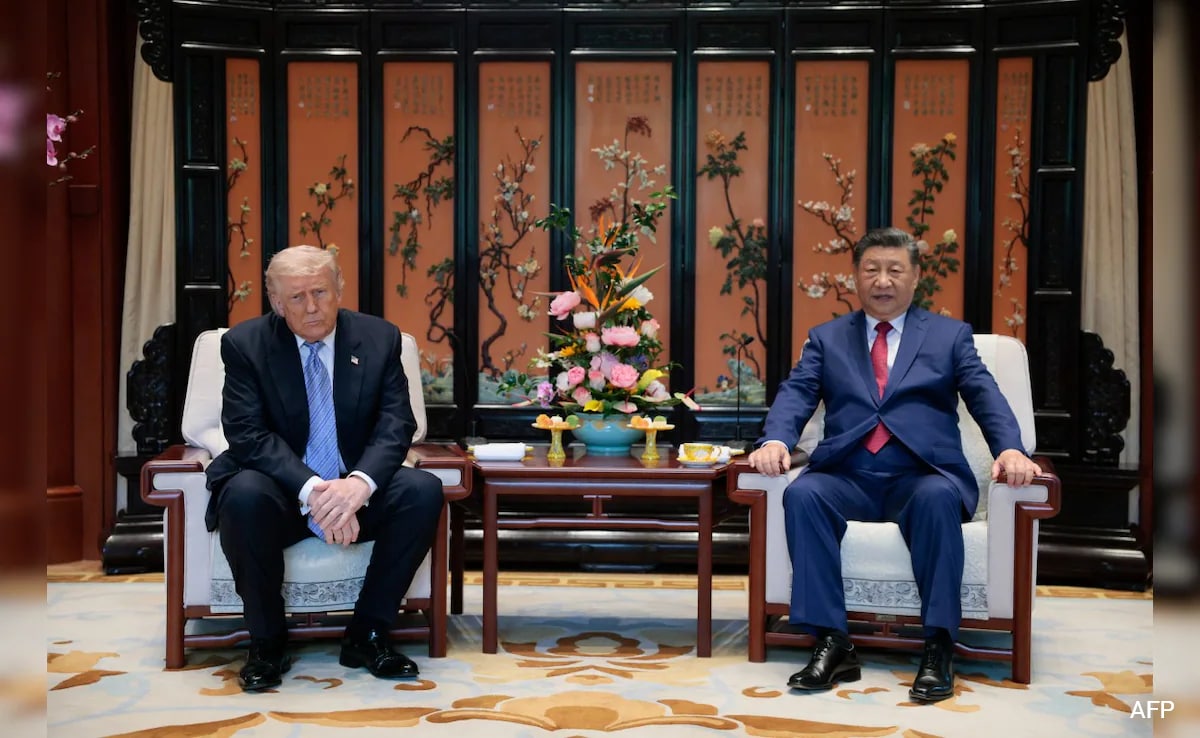
The air inside the Great Hall of the People carries a specific, sterile weight. It is the scent of floor wax, old velvet, and the crushing gravity of two empires trying to occupy the same rug. When the leaders of the United States and China meet, the world expects a choreographed ballet of diplomacy. We want the firm handshakes, the translated pleasantries, and the measured statements about mutual cooperation.
But behind the heavy oak doors, the choreography often dissolves into a brawl.
In 2017, during Donald Trump’s visit to Beijing, the veneer of diplomatic grace didn't just crack. It shattered. What should have been a high-stakes summit turned into a chaotic scramble for physical space, characterized by a White House aide being tackled and reporters being physically barred from witnessing the very history they were sent to record. One aide famously summarized the atmosphere in a single, visceral profanity. He called it a "sh*t show." It wasn't just a comment on logistics; it was a realization that when the world’s two largest egos collide, the people caught in the middle become collateral damage.
Imagine being the staffer tasked with carrying the "football"—the briefcase containing the nation’s nuclear launch codes. Your job is to be a ghost. You are a shadow that must never be more than a few feet from the President. But as the American delegation moved through the Great Hall, Chinese security officials decided the shadow wasn't invited. A physical altercation broke out. A U.S. official was shoved. High-level aides were tackled to the floor.
The "football" was momentarily separated from the leader of the free world.
Think about the silence of that moment. The sheer, terrifying absurdity of a nuclear briefcase being the center of a hallway scuffle. This wasn't a policy disagreement or a trade dispute. This was a raw, primal struggle for dominance played out in the most literal sense. It was about who gets to walk through which door and who has the power to stop them.
The War for the Lens
While the physical scuffle over the nuclear briefcase was happening in the shadows, another battle was raging in the light. The press corps—the men and women whose entire existence is dedicated to being the eyes and ears of the public—found themselves staring at a wall of suits.
Reporters weren't just being asked to step back. They were being actively, forcefully blocked.
In the high-stakes world of international summits, visibility is the only currency that matters. If a camera isn't there to capture the handshake, did the handshake even happen? For the Chinese hosts, controlling the narrative means controlling the frame. If you can physically prevent a reporter from seeing an awkward glance or a tense exchange, you can rewrite the history of the meeting before the ink is even dry.
The tension was thick enough to choke on. American press officials, usually the ones enforcing the rules, found themselves pleading, shouting, and eventually shoving back just to ensure the world could see what was happening. It was a breakdown of the most basic rules of engagement. When the "S-word" was uttered by that frustrated aide, it wasn't an exaggeration. It was a diagnosis of a system that had completely failed to account for the human element of friction.
The Invisible Stakes of a Shove
We often think of diplomacy as a series of papers signed at long tables. We analyze the tariffs, the territorial claims, and the carbon emissions targets. These are the "cold facts." But these facts are built on a foundation of human ego and physical presence.
When a Chinese security guard tackles an American official, he isn't just following a protocol. He is sending a message. He is saying, "In this house, your rules do not apply." When an American aide shouts back, they are saying, "We will not be invisible."
This friction is the heartbeat of geopolitics. It is the messy, sweating, shouting reality that exists underneath the polished surface of the nightly news. The 2017 summit was a microcosm of the larger relationship between these two superpowers. It was a dance where neither partner knew who was leading, and both were wearing steel-toed boots.
The tragedy of the "sh*t show" isn't just that a few people got bruised or that a few reporters missed a shot. The tragedy is what it reveals about the fragility of our global order. If the two most powerful nations on Earth cannot agree on who gets to walk through a hallway, how can we expect them to agree on the future of the South China Sea or the ethics of artificial intelligence?
The Cost of the Closed Door
Consider the reporter standing at the back of the room, notebook in hand, heart racing as a security detail moves to block their view. That reporter represents you. They represent the right of the governed to know what the governors are doing. When that reporter is blocked, a door is slammed in the face of the public.
The chaos in Beijing was a reminder that transparency is an act of constant, exhausting will. It is not a given. It is a territory that must be defended every single day, often in the most mundane settings. The struggle wasn't over a secret treaty; it was over a line of sight.
We live in an era where information is weaponized. We see deepfakes, state-sponsored propaganda, and carefully curated social media feeds. In that environment, the raw, unedited, "chaotic" truth of a hallway scuffle is more valuable than any official press release. That "sh*t show" was the most honest moment of the entire summit. It showed the world the truth: these two powers are deeply, fundamentally at odds, and the tension is so high it can no longer be contained by protocol.
The bruises faded. The nuclear briefcase was eventually reunited with the President. The official statements were released, full of the usual platitudes about "fruitful discussions" and "mutual respect." But the image that remains isn't the two leaders standing side-by-side.
The image that remains is the scuffle in the hallway. The blur of a dark suit hitting the floor. The sound of a raised voice echoing off the marble. The realization that even at the highest levels of human achievement, we are still just people fighting for a bit of ground, terrified of losing face, and struggling to stay in the room.
The velvet rope is supposed to keep the world in order. But sometimes, it’s just something else to trip over.