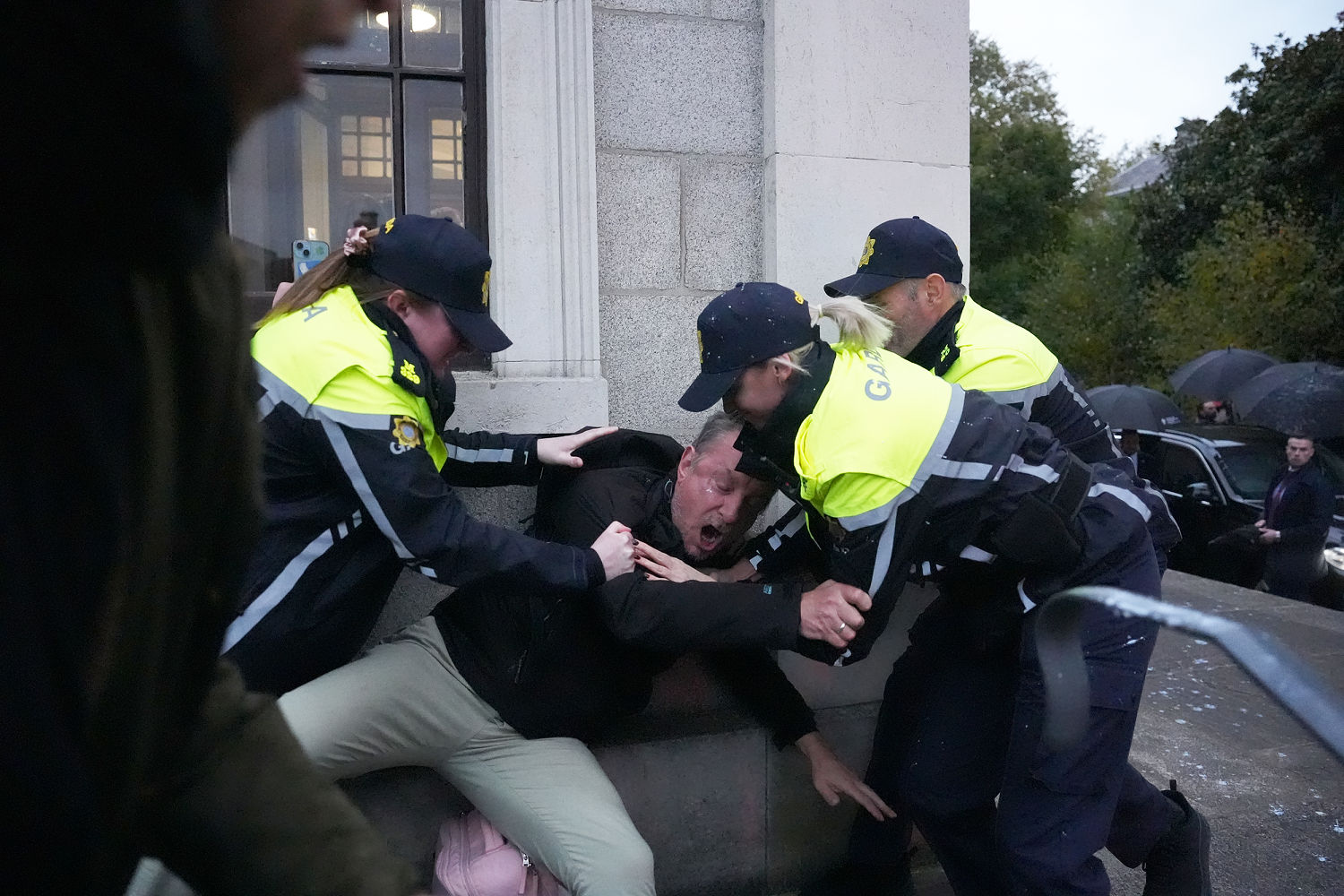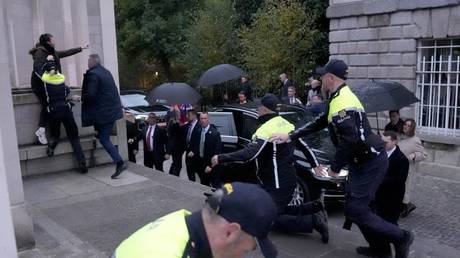
No pro-Palestinian protesters threw milk at former U.S. President Joe Biden during a visit to Ireland. Viral social media posts circulating a short video clip claiming to show such an incident rely on misattributed, out-of-context footage from a completely different location and event.
Viral misinformation rarely requires sophisticated technology. It requires speed, emotional resonance, and an audience primed to believe a specific narrative. When a grainy video clip surfaces on platforms like X, TikTok, or Telegram with an explosive caption, the mechanics of modern outrage take over long before basic fact-checking can catch up.
The Mechanics of Misattributed Footage
The claim that demonstrators pelted Joe Biden with milk in Ireland follows a classic disinformation playbook known as cheapfakes or out-of-context media. Unlike generative AI deepfakes, which require rendering software and computing power, cheapfakes use real video from past events and simply alter the caption to manufacture a new reality.
In this specific instance, the circulating title relies on a combination of plausible-sounding elements. Joe Biden has well-documented ancestral ties to Ireland and made a high-profile trip there in April 2023. Simultaneously, public demonstrations regarding U.S. foreign policy in the Middle East have frequently followed Biden at public appearances throughout 2023 and 2024. Merging these two unrelated realities creates a story that feels intuitively true to casual scrollers.
However, cross-referencing official travel logs, Secret Service press pool reports, and verified news wire footage from Ireland reveals no such security breach occurred. Throwing any liquid or object at a sitting or former U.S. president triggers an immediate, massive response from the United States Secret Service and local law enforcement—in Ireland's case, the Garda Síochána. Such an event would dominate international headlines across every major broadcast network, not remain confined to unverified social media aggregators.
Why Milkshaking Became a Political Trope
To understand why the detail about milk resonated so easily, look at recent political history in the United Kingdom and Ireland.
Milkshaking—the act of throwing milkshakes or dairy products at political figures—emerged as a distinct form of street protest in the UK in 2019. High-profile figures across the political spectrum, including Nigel Farage and Tommy Robinson, were targeted during public walkabouts. The tactic gained traction because it generated striking visual media without causing severe physical injury, effectively humiliating targets on camera.
Because the visual language of dairy-based protests is already established in British and Irish political culture, attaching that specific detail to a false headline makes the fabrication sticky. Audiences remember seeing similar protests in the region, lowering their skepticism when a new clip claims to show it happening to an American leader.
How Secret Service Protocols Make Viral Claims Implausible
Security experts analyzing viral claims of physical attacks on U.S. presidents look first at perimeter logistics.
When a U.S. president travels abroad, particularly to a country like Ireland where public walkabouts are traditional, the security apparatus is immense. Months before Air Force One touches down, advance teams map every street, roof, and crowd barrier.
- Buffer Zones: Crowds are kept behind reinforced metal barricades at distances calculated to prevent thrown projectiles from reaching the protectee.
- Counter-Surveillance: Plainclothes agents and local intelligence officers embed within crowds specifically to spot individuals carrying concealed liquids, bags, or signs mounted on heavy poles.
- Immediate Extraction: If an object is thrown toward a president, agents do not simply wipe it off and continue walking. Protocols dictate immediate physical shielding and rapid extraction to an armored vehicle.
During Biden's April 2023 visit to Belfast, County Louth, and County Mayo, crowds were heavily vetted and separated by extensive fencing. Any breach involving thrown liquids would have resulted in immediate arrests, official police statements, and exhaustive coverage by the dozens of White House press corps journalists traveling within feet of the president at all times.
The Economics of Outrage Aggregators
The persistence of titles like "Pro-Palestinian protesters pelt Biden with milk in Ireland (VIDEOS)" points directly to the business model of engagement farming.
Following policy shifts across major social networks that allow users to monetize high-impression posts, a cottage industry of anonymous news aggregators has flourished. These accounts do not employ reporters, verify sources, or adhere to editorial standards. Their sole objective is to maximize clicks, replies, and shares within the first sixty minutes of posting.
Adding parenthetical tags like (VIDEOS) or BREAKING in all-caps exploits algorithmic preferences for multimedia content and urgency. Even when users click the post only to comment that the video is fake or from a different year, the platform's algorithm registers that interaction as high engagement, pushing the post into even more feeds.
Verifying Viral Protest Claims in Real Time
Journalists and researchers use straightforward open-source intelligence (OSINT) techniques to dismantle false protest videos within minutes. Anyone encountering sensational footage can apply the exact same checks before hitting share.
Check the Weather and Clothing
Compare the weather in the viral clip against historical weather data for the alleged location and date. A crowd wearing heavy winter coats in a video supposedly filmed during a mild spring afternoon is an immediate red flag.
Inspect Architecture and Signage
Look past the central action to the background. Street signs, license plates, police uniforms, and storefront typography are virtually impossible to fake in casual street footage. Irish police uniforms, road markings, and Dublin or Belfast architecture look distinctly different from those in American cities like Washington, D.C., or Chicago, where many domestic protest clips actually originate.
Trace the Audio
Listen closely to accents in the crowd and the specific chants being used. Protesters in Dublin sound markedly different from demonstrators in London, New York, or Toronto. Furthermore, check if the audio track matches the ambient acoustics of the environment, as bad actors frequently dub protest chants over unrelated crowd footage.
Reverse Image Search Keyframes
Taking a screenshot of a distinct frame—such as a specific banner, a building facade, or a prominent face—and running it through reverse image search engines like Google Lens or TinEye will almost always surface the original upload date and true context of the video.
In an information environment flooded with recycled footage, the burden of proof rests entirely on verifiable primary sources, not viral captions.