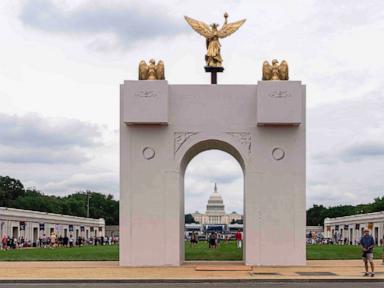
You don't just drop a 250-foot triumphal arch in the middle of the Potomac River corridor without triggering a massive legal war. Yet that's exactly what the federal government is trying to push through right now, and Virginia and Washington, D.C. just stepped in to block the bulldozers before the first shovel hits the dirt.
If you've been following the clash over Donald Trump's proposed Independence Arch, you know the administration wants construction moving immediately. They're framing it as a grand, historic centerpiece to mark the nation's 250th anniversary. But Virginia and the District of Columbia aren't buying the rush, and their new joint lawsuit argues the government is trampling federal environmental laws, historic preservation mandates, and basic regional jurisdiction just to get the concrete poured on a tight timeline.
Honestly, anyone who has ever tried to get a simple deck permit approved in Northern Virginia or D.C. knows how absurd this fast-track push looks from the ground.
What the Virginia and DC Lawsuit Actually Argues
The core of the legal challenge isn't about whether a giant neoclassical monument looks good on a rendering. It's about process, authority, and the rules that govern one of the most heavily protected stretches of land in the United States.
Virginia and D.C. filed their suit to halt immediate site preparation and construction, joining an already crowded docket of conservation groups and preservationists suing over the project. The plaintiffs point out that the Memorial Circle area—sitting right between the Lincoln Memorial and Arlington National Cemetery—isn't empty real estate waiting for a vanity build. It's a tightly regulated historic and environmental zone where federal agencies are legally required to conduct exhaustive reviews before altering the sightlines, traffic patterns, or riverbed ecology.
Here is where the administration's rush runs straight into a brick wall. Under the National Environmental Policy Act (NEPA) and the National Historic Preservation Act, major federal construction projects on protected parkland must go through public comment periods, environmental impact statements, and consultations with local jurisdictions. Virginia and D.C. argue the federal government bypassed or truncated those mandatory steps in an effort to break ground immediately.
They're also raising serious alarms about traffic, infrastructure, and jurisdictional boundaries. Memorial Circle and the Arlington Memorial Bridge carry tens of thousands of commuters, tourists, and funeral processions every single day. You can't close lanes, reroute approaches, or sink massive foundation pilings next to the Potomac without impacting D.C. streets and Virginia highways. Both jurisdictions say they were essentially sidelined while federal officials tried to treat a complex bi-jurisdictional transportation hub like a private construction lot.
Why the Government Wants Work to Begin Immediately
Speed is the entire point for the administration. Monumental architecture in Washington normally takes a decade or more to plan, fund, review, and build. Think about how long it took to get the Eisenhower Memorial or the World War II Memorial from a sketch to a ribbon-cutting.
The administration knows that if this project gets bogged down in standard multi-year environmental reviews and design commission hearings, it won't happen on their watch. By pushing for immediate site work, the government is trying to create facts on the ground. Once heavy machinery moves in, trees come down, and foundation work begins, stopping a project in federal court becomes dramatically harder for plaintiffs. Judges are notoriously reluctant to halt half-built infrastructure once millions of dollars have already been sunk into excavation.
Supporters of the arch argue that endless bureaucratic red tape has crippled America's ability to build grand public monuments. From their perspective, cutting through years of committee gridlock is the only way to deliver a bold, celebratory landmark for the country's 250th anniversary. They view the lawsuit from Virginia and D.C. as pure political obstruction dressed up in procedural paperwork.
The History and Rules Governing the Memorial Core
To understand why this specific site is such a legal minefield, you have to look at how Washington's monumental core is protected. This isn't just about aesthetics.
The alignment between the Lincoln Memorial, the Arlington Memorial Bridge, and Arlington House was deliberately designed over a century ago as a symbolic link between North and South after the Civil War. Every inch of that visual corridor is governed by strict master plans managed by the National Park Service, the National Capital Planning Commission (NCPC), and the U.S. Commission of Fine Arts.
When you drop a massive, 250-foot structure right into that axis, you aren't just adding a statue. You're fundamentally altering the historic vista that federal law explicitly protects. Preservation experts have pointed out that the scale of the proposed arch dwarfs surrounding landmarks and disrupts the deliberate open sightlines across the Potomac.
Even more practically, the land around Memorial Circle sits on reclaimed river marsh and complex underlying infrastructure. Driving deep structural pilings to support tens of thousands of tons of stone and concrete carries real engineering risks to the adjacent bridge abutments and riverbanks. Skipping comprehensive geotechnical and environmental reviews isn't just a technical violation—it's a massive engineering gamble.
How This Joins a Growing Wave of Legal Challenges
Virginia and D.C. aren't fighting this battle alone. Their lawsuit lands on top of existing legal challenges filed by historic preservation organizations, environmental watchdogs, and local civic groups who have been fighting the project since the initial plans surfaced.
Why does the entry of Virginia and D.C. change the game? Legal standing.
When a private advocacy group sues the federal government over a monument, the Justice Department's first move is always to argue that the group lacks standing—meaning they haven't suffered a direct, concrete injury that gives them the right to sue. Courts throw out environmental and preservation lawsuits on standing grounds all the time.
States and municipal governments are a completely different story. Virginia and the District of Columbia have direct sovereign and quasi-sovereign interests in their borders, their roadways, their water quality, and their statutory consultation rights under federal law. When D.C. and Virginia tell a federal judge that an unreviewed construction project is going to gridlock their roads and damage shared Potomac River resources, the court has to listen. The government can't simply brush them off as annoyed bystanders.
What Happens Next in Federal Court
The immediate flashpoint is a request for a preliminary injunction—a court order freezing all physical work at the site while the broader lawsuit plays out.
To win that freeze, Virginia and D.C. have to convince a federal judge of two main things: that they are likely to win on the merits of their statutory claims, and that allowing construction to start now would cause irreparable harm. In preservation and environmental law, tearing up parkland, altering historic sightlines, and pouring concrete are textbook examples of irreparable harm because you can't easily undo them once they're done.
If the judge grants the injunction, the government's push to start work immediately is dead in the water, and the project gets pulled into months—or years—of litigation and mandatory federal reviews. If the judge denies it, crews could start clearing the site within days while the legal arguments drag on in the background.
If you live in the DMV area, drive across the Memorial Bridge, or care about how public land gets developed in the nation's capital, keep your eyes on the federal docket in D.C. over the next few weeks. You can track the filings directly through the U.S. District Court for the District of Columbia or follow updates from the National Capital Planning Commission's public meeting schedules, because the ruling on that initial injunction will decide whether this arch ever moves past a blueprint.