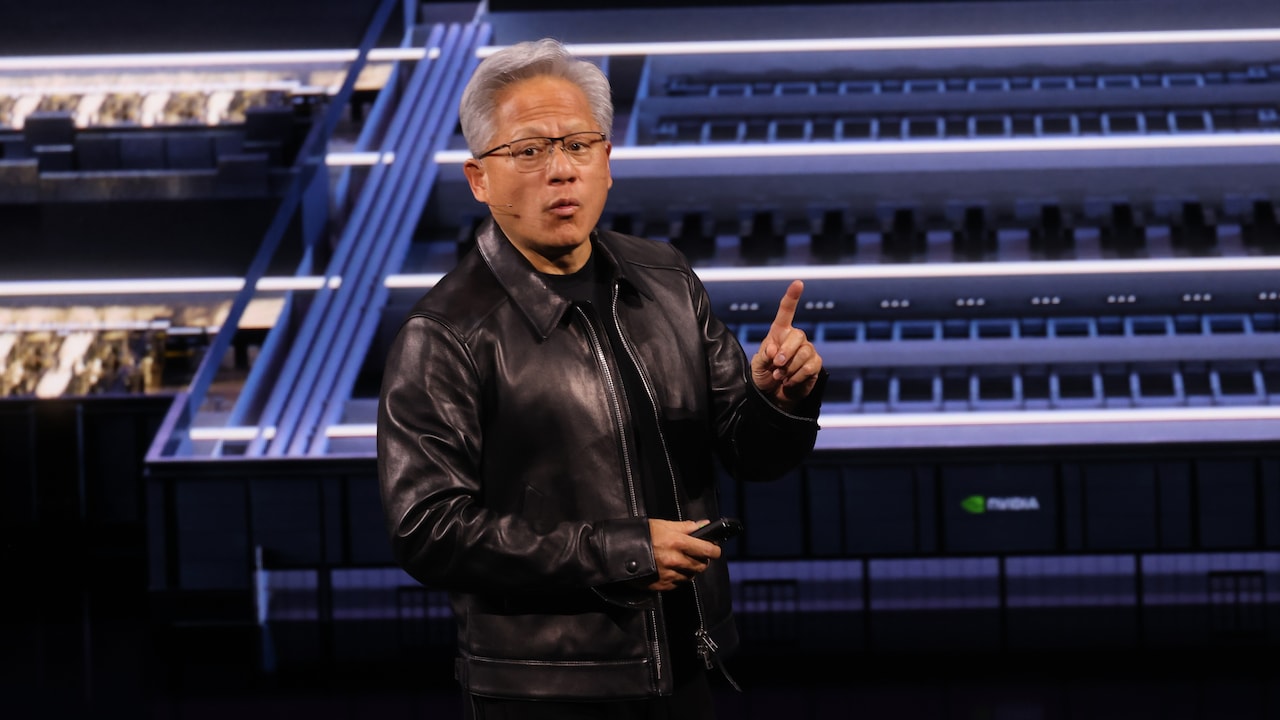
Nearly a trillion dollars materialized out of thin air on Monday, November 23, 2026. That's what happens when a board of directors realizes it just fired the one person holding the modern AI economy together.
Nvidia shares exploded 31.48% to close at $165.05. In a single trading session, the chipmaker's market capitalization jumped roughly $950 billion—climbing from $3.03 trillion to nearly $3.98 trillion. It was the biggest single-day dollar gain for any listed company in U.S. history, shattering Microsoft's previous $450 billion record set back in July.
Most financial coverage framed this as a victory lap. Markets cheered, tech indexes surged, and retail traders celebrated on social media.
They're looking at the wrong scoreboard. While the headline numbers look triumphant, the real story behind Jensen Huang's 11-day exile and sudden reinstatement reveals a dangerous fragility at the center of global tech.
The 11-Day Crisis That Broke the Board
To understand why the stock jumped 31.5%, you have to look at the panic that preceded it.
On November 12, 2026, Jensen Huang resigned as president, CEO, and director of Nvidia. The exit followed damaging revelations regarding multiple extramarital affairs, most notably a relationship with Alice Huang—a former executive and controlling shareholder at Singapore-based cloud firm Megaspeed, whom U.S. intelligence officials suspected of acting as an asset for Beijing.
For 11 days, Nvidia tried to pretend it could run on autopilot. CFO Colette Kress stepped in as interim CEO. The board formed a new National Security and Export Control Oversight Committee. Less than a week before the reversal, board members insisted they had no intention of bringing Huang back.
Wall Street didn't buy it. Even after Nvidia posted blowout third-quarter results on November 17—with revenue surging 103% to a record $115.8 billion—the stock kept bleeding. By Friday, November 20, shares had dropped nearly 23% from their pre-resignation levels, closing at $125.53.
Here's why the fundamentals didn't save the stock: investors weren't buying quarterly earnings. They were buying Jensen Huang. Without him, external CEO candidates were reportedly ruling themselves out of the running, and the market began pricing in the collapse of Nvidia's multi-year product roadmap.
How Washington Forced the Reversal
Boards rarely reverse a high-profile ouster in under two weeks on their own. They didn't here, either.
According to Bloomberg, the decision to reinstate Huang came together in just a few hours on Sunday afternoon, November 22. The board didn't even consult interim CEO Colette Kress or other senior executives before pulling the trigger. Instead, they were responding to direct pressure from the White House.
President Donald Trump openly lobbied for Huang's return, calling him a "great patriot" and arguing that the American economy needed him at the helm. Behind closed doors, Nvidia's board had hesitated because of the national security cloud hanging over the Megaspeed investigation. Trump cleared that hurdle personally.
In an interview with CNBC, Trump stated that he gave Nvidia's board direct assurance that Huang didn't pose a national security threat. He also posted on Truth Social that U.S. Attorney General Todd Blanche confirmed the Justice Department possessed no evidence that Huang had engaged in unlawful conduct.
Armed with political cover from the Oval Office, Nvidia Chair Harvey Jones announced a unanimous board vote on Monday morning. "Jensen is the right person to lead Nvidia," Jones said.
The Math Behind a $1 Trillion Relief Rally
When financial headlines scream that a company "added $1 trillion in value," casual readers often picture a vault filling up with cash. That's not how market cap works.
Nvidia has roughly 24.15 billion shares outstanding. Multiplying Friday's closing price of $125.53 by that share count put the company's valuation at $3.03 trillion. When Monday's buying frenzy pushed the stock up $39.52 per share to $165.05, simple multiplication tacked on $954 billion in paper wealth.
Context matters here. This wasn't fresh growth. It was a relief bounce.
- The recovery gap: Monday's surge reclaimed roughly 82% of the value lost after Huang's November 12 resignation.
- The October peak: Even at $165.05, Nvidia remained 32.2% below its all-time intraday high of $243.37 set on October 6, 2026. Getting back to that peak requires another 47.5% climb.
- The broader ripple: Because Nvidia sits at the center of the AI trade, its rebound dragged the entire market upward. The Nasdaq Composite jumped between 6.5% and 6.9%, the Philadelphia Semiconductor Index surged 14.1%, and Taiwan's Taiex posted its largest intraday point gain on record the following day.
Wall Street analysts immediately split into two camps. Goldman Sachs, Citi, and UBS maintained or raised their buy ratings, betting that Huang's return eliminates execution risk. JPMorgan refused to budge from its underweight rating, dismissing the move as an emotional relief rally that ignores mounting structural headwinds.
Key-Person Risk Just Became Undeniable
I've watched corporate governance drama play out in Silicon Valley for decades—from Steve Jobs returning to Apple in 1997 to Sam Altman's five-day ouster at OpenAI in 2023. Nothing compares to what just happened at Nvidia.
Apple in 1997 was a struggling niche computer maker worth a few billion dollars. OpenAI in 2023 was a private startup. Nvidia is a publicly traded pillar of the global financial system, making up a massive chunk of the S&P 500's total weight.
When a $3 trillion enterprise loses nearly a quarter of its value because one man leaves—and gains nearly $1 trillion back the second he walks through the door—you aren't looking at a normal corporation. You're looking at extreme key-person risk.
Institutional investors hate single points of failure. Yet Nvidia's board just proved to the entire world that they don't have a viable succession plan. Worse, by cutting interim CEO Colette Kress out of the Sunday deliberations, the board undermined its own executive bench. If an unexpected health issue or a new legal hurdle removes Huang tomorrow, shareholders now know the exact price of that vacuum.
The Regulatory Storm Hasn't Passed
If you think Huang's return means business as usual, look at what's happening in Washington right now.
The White House may have cleared Huang for takeoff, but Congress isn't playing along. Democratic lawmakers and several Republican senators have slammed the reinstatement as a national security liability. Huang is scheduled to sit for a high-stakes, closed-door transcribed interview before three House committees on December 1, 2026. Lawmakers want to know exactly what information he shared with Alice Huang and whether sensitive U.S. chip architecture leaked to Beijing.
Meanwhile, the regulatory vice is tightening around Nvidia's actual business operations:
- Trade blacklists: The U.S. government moved to add Megaspeed to its trade blacklist, cutting off shipments of American goods and technology to a firm Nvidia previously listed as an official cloud partner.
- Southeast Asia restrictions: Morningstar equity analyst Brian Colello noted that Nvidia still faces tightening export curbs across Southeast Asia, targeting data centers that rent cloud compute to Chinese AI developers.
- SEC scrutiny: Nvidia confirmed in its reinstatement announcement that it continues to cooperate with ongoing government inquiries, which include a Securities and Exchange Commission probe examining the company's accounting practices.
- Internal guardrails: To appease regulators, Nvidia is creating a new Chief Compliance Officer role reporting directly to its governance committee, alongside its new national security oversight panel.
President Trump even floated the idea of a presidential pardon for Huang ahead of his congressional testimony, though Vice President JD Vance later walked that back by saying a pardon isn't necessary. When the Vice President has to publicly clarify whether your CEO needs a federal pardon, the crisis isn't over.
How Investors Should Play Nvidia Now
Chasing a 31% single-day spike is usually a fast way to lose money. If you hold Nvidia, watch semiconductor ETFs, or simply track the AI sector, treat this rebound with cold realism rather than euphoria.
First, check your portfolio concentration. Because Nvidia swung by nearly $1 trillion in a single day, passive index funds and tech-heavy portfolios absorbed massive volatility. If NVDA makes up more than 10% to 15% of your individual stock holdings, use this bounce to trim your exposure and rebalance into less politically exposed infrastructure plays.
Second, circle December 1 on your calendar. Huang's testimony before House investigators will generate leaks, headlines, and potential subpoenas. Expect sharp intraday swings whenever lawmakers step in front of microphones outside the hearing room.
Third, watch the December 8–9 Federal Reserve meeting. Even as Nvidia rallied on Monday, the U.S. 10-year Treasury yield hovered near 4.95% as bond traders priced in rate pressures. High yields compress valuation multiples for growth stocks regardless of who sits in the CEO chair.
Nvidia got its founder back, and the stock market got its favorite adrenaline shot. Until the congressional hearings wrap up and export rules settle, though, every dollar of that $1 trillion bounce sits on a political fault line.