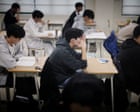
Silence.
Not the gentle, accidental quiet of a library on a Sunday afternoon, nor the peaceful stillness of an empty church at dawn, but a heavy, manufactured vacuum engineered by an entire nation holding its collective breath for nine agonizing hours.
If you have ever stood outside a South Korean high school on the third Thursday of November, you know the strange, electric tension that hangs in the crisp autumn air. Stock markets open an hour late so commuter traffic will not rattle the windows of testing centers. Construction sites go dead. Even the sky goes quiet; commercial flights are grounded or rerouted across the peninsula for thirty-five minutes during the afternoon English listening comprehension section, lest the roar of a passing jet engine obscure a single spoken syllable.
This is the Suneung—the College Scholastic Ability Test. For roughly half a million teenagers each year, this single day determines which university they will attend, which corporations will interview them, whom they might eventually marry, and where they will sit on the rigid social ladder for the rest of their adult lives.
For decades, the enemies of this sacred fairness were analog and clumsy. A scrap of paper tucked into a mechanical pencil. A whispered answer across an aisle. A tiny earpiece smuggled beneath long hair.
Now, the threat is invisible, weightless, and sitting right on the bridge of a student's nose.
The Anatomy of a Modern Smuggler
Consider a hypothetical teenager—let us call him Min-jun—standing in line outside a testing hall in Gangnam at 7:30 in the morning. He is wearing a standard wool coat, carrying a clear plastic bag holding his government-issued computer-grade marking pen, a spare eraser, and a packed lunch. He looks exhausted, hollowed out by years of sixteen-hour study days at private cram schools known as hagwons.
On his face sits a pair of sleek, black acetate frames. To a tired proctor checking admission slips at the door, they look identical to the glasses worn by seventy percent of the students filing past.
Except they are not ordinary glasses. Embedded seamlessly inside the thick temple arms are micro-speakers aimed directly at Min-jun's ear canals, a pinhole camera capable of capturing high-resolution text, and a low-energy Bluetooth transceiver paired with a modified smartphone sewn into the lining of his winter coat. If Min-jun looks down at a calculus problem, a subtle tap on the frame snaps a photo. Seconds later, a multimodal artificial intelligence model processes the image, solves the differential equation, and whispers the exact multiple-choice digit directly into his ear—completely inaudible to the student sitting two feet away.
This is not science fiction. It is the exact nightmare keeping officials at South Korea's Ministry of Education awake at night.
As wearable hardware shrinks and generative AI models become fast enough to reason through complex university entrance exams in real time, the traditional architecture of standardized testing is buckling. What used to require an elaborate syndicate of human accomplices—someone outside the building reading questions, a team of tutors solving them, a radio transmitter beaming answers back—now fits inside a pair of consumer smartglasses sold at airport duty-free shops.
Rolling Up the Sleeves
When you walk into a Suneung testing room today, the atmosphere feels less like an academic exercise and more like a high-security border crossing.
Before the first bell rings, every single electronic device must be surrendered. Smartphones, smartwatches, digital cameras, e-readers, Bluetooth earphones, and even basic electronic calculators are sealed inside individual bags and collected at the front of the room. Possessing even a powered-off phone in your pocket after the warning bell is grounds for immediate disqualification and a ban from taking the exam the following year.
Yet the arrival of wearable AI has forced proctors to become forensic investigators of the human body and its accessories.
Under tightened regulations rolled out across testing centers nationwide, authorities have instituted mandatory physical inspections that feel startlingly intimate. Proctors now walk the aisles instructing students to roll up their sleeves before the test begins, checking wrists and forearms for concealed fitness trackers, smart bands, or skin-colored micro-receivers.
Glasses receive special scrutiny. Any eyewear suspected of containing cameras, microphones, or wireless transmitters is strictly prohibited. If a student arrives wearing thick-framed glasses that resemble smart eyewear—devices like Ray-Ban Meta frames or similar camera-equipped spectacles—proctors are authorized to inspect the hinges, check for charging ports or LED indicators, and confiscate them on the spot, forcing the student to take the test without them or rely on backup lenses. Even analog watches are subjected to verification to ensure no digital displays or hidden communication modules lurk beneath the glass.
Metal detectors sweep the aisles. Signal-jamming protocols and monitoring vans patrol the perimeters of major testing districts, hunting for rogue frequencies.
I remember talking to a veteran high school teacher in Daejeon who had proctored the Suneung twelve times over his career. He told me that ten years ago, his biggest worry was making sure the wall clock didn't tick too loudly or run thirty seconds slow. Today, he spends his mornings studying teardown diagrams of consumer electronics just so he knows what a concealed charging pin looks like on the inside of an eyeglass hinge. "You feel like a prison guard," he admitted, his voice heavy with a mix of duty and sadness. "These kids are trembling from stress, and my first interaction with them is asking them to pull back their sleeves and hand over their glasses so I can inspect the plastic."
Why an Entire Country Obsesses Over Fairness
To an outsider reading about sleeve checks and banned smartglasses in a newspaper, these measures can sound paranoid, almost dystopian. Why go to such extreme lengths over a multiple-choice test?
To understand the ferocity of South Korea's crackdown, you have to understand the fragile social contract that built the modern country. Rising from the ashes of the Korean War in the 1950s with almost no natural resources, South Korea bet its entire future on human capital. Education became the great equalizer—the one ladder that a farmer's child or a factory worker's daughter could climb to reach the highest levels of government, medicine, or business, regardless of family wealth or political connections.
The Suneung was designed to be blind. The exam booklet does not care who your father is. It does not care how much money your family donated to a foundation. On that Thursday in November, everyone answers the exact same questions at the exact same minute.
When artificial intelligence enters that room, it shatters that blindness.
High-end smartglasses, discreet bone-conduction earpieces, and private API subscriptions to frontier AI models are not cheap. They are tools of financial privilege. If wealthy families can purchase invisible technological advantages that allow their children to bypass years of grueling preparation, the Suneung stops being a meritocratic ladder and becomes an auction. And in a society where intense economic inequality already fuels record-low birth rates and pervasive youth anxiety, the perception that the country's single most important exam is rigged would trigger a profound cultural rupture.
Consider what happens next if trust collapses. Universities lose faith in national test scores and revert to subjective admissions interviews and legacy preferences—systems that historically favor the elite. Parents panic, pouring even more money into underground tech brokers promising "undetectable" exam hardware. The entire psychological foundation of Korean meritocracy crumbles from the inside out.
The Cat-and-Mouse Trap
Here is the uncomfortable truth that policymakers rarely say out loud: hardware bans are always fighting yesterday's war.
Think of the arms race between anti-doping agencies and Olympic athletes. By the time regulators develop a blood test for a synthetic hormone, chemists have already synthesized a slightly different molecule that slips right past the screen.
Consumer technology moves on an even faster cycle. Two years ago, smartglasses were clunky, obvious, and easy to spot from across a classroom because of bulky camera lenses and glowing status lights. Today, optical waveguides and micro-cameras are buried inside frames that weigh less than fifty grams and pass casual visual inspection at arm's length. Within a few years, contact lenses with embedded micro-displays and sub-millimeter inductive coils may move from research labs into gray-market storefronts.
Proctors cannot ask half a million teenagers to remove their contact lenses at 8:00 AM.
Even more troubling is the psychological toll of this surveillance spiral. Imagine being an eighteen-year-old who has spent three years sacrificing sleep, friendships, and hobbies to prepare for this day. Your hands are already cold with adrenaline. Your stomach is knotted. Now, every time you adjust your glasses because your nose is sweating, or rub your wrist because your muscles are cramping, you see a proctor's eyes lock onto your hands, calculating whether you are triggering a hidden camera.
The very measures meant to protect honest students end up treating every single one of them like a suspect.
Beyond the Metal Detector
So how do you protect an exam when the cheating device can eventually become indistinguishable from the human body?
Some education reformers in Seoul have begun arguing—quietly at first, and now with growing urgency—that the answer cannot live solely inside a metal detector or a rulebook of banned accessories. If you design an exam that rewards rapid pattern recognition, formulaic problem-solving, and memorized retrieval, you are essentially designing a test that an AI model can ace in milliseconds.
You cannot out-ban a technology that is disappearing into everyday objects. Eventually, you have to change what you are measuring, or change the environment where it happens.
Some institutions are exploring Faraday-shielded testing rooms—classrooms lined with conductive mesh that blocks all cellular, Wi-Fi, and Bluetooth signals from entering or leaving the walls. Without a wireless bridge to a smartphone or cloud server, a pair of smartglasses becomes just an expensive piece of plastic and glass. Yet retrofitting thousands of public high schools across South Korea with military-grade signal shielding would cost hundreds of millions of dollars, and even that would not stop an offline, locally stored AI model running directly on a tiny chip inside a shoe heel or a belt buckle.
Others point toward a deeper shift: moving away from a single, high-stakes, all-or-nothing multiple-choice gauntlet toward continuous, multi-year evaluations, oral defenses, and live problem-solving workshops where a student has to explain why they arrived at an answer in front of human examiners. An AI can whisper a number into your ear; it cannot convincingly improvise a nuanced debate about ethics or defend the logic of a mathematical proof when a professor asks an unexpected follow-up question.
Yet anyone who knows South Korea knows how terrifying that prospect is to the public. Subjective grading invites favoritism. Oral interviews invite bias. For all its brutal, soul-crushing rigidity, the Suneung survives because people trust an optical scanner reading pencil marks more than they trust human judgment.
The Heavy Quiet
As November approaches each year, the preparations resume with clockwork precision. The Ministry of Education prints hundreds of thousands of warning posters illustrating forbidden watches and prohibited eyewear. Testing supervisors rehearse their morning inspection routines. Police officers map out escorts for late students rushing through morning traffic.
Inside those quiet classrooms, the rules are absolute. Sleeves rolled up. Pockets emptied. Glasses checked.
Outside, in the world beyond the school gates, artificial intelligence continues its relentless march—writing code, diagnosing scans, translating languages, and shrinking into frames so light you forget you are wearing them.
For nine hours on a single Thursday, South Korea builds a wall around half a million teenagers, determined to keep the future out so the past can remain fair.
Then the final bell rings at 5:45 PM, the doors swing open, and the students walk straight back into a world where the machine is already waiting for them.


