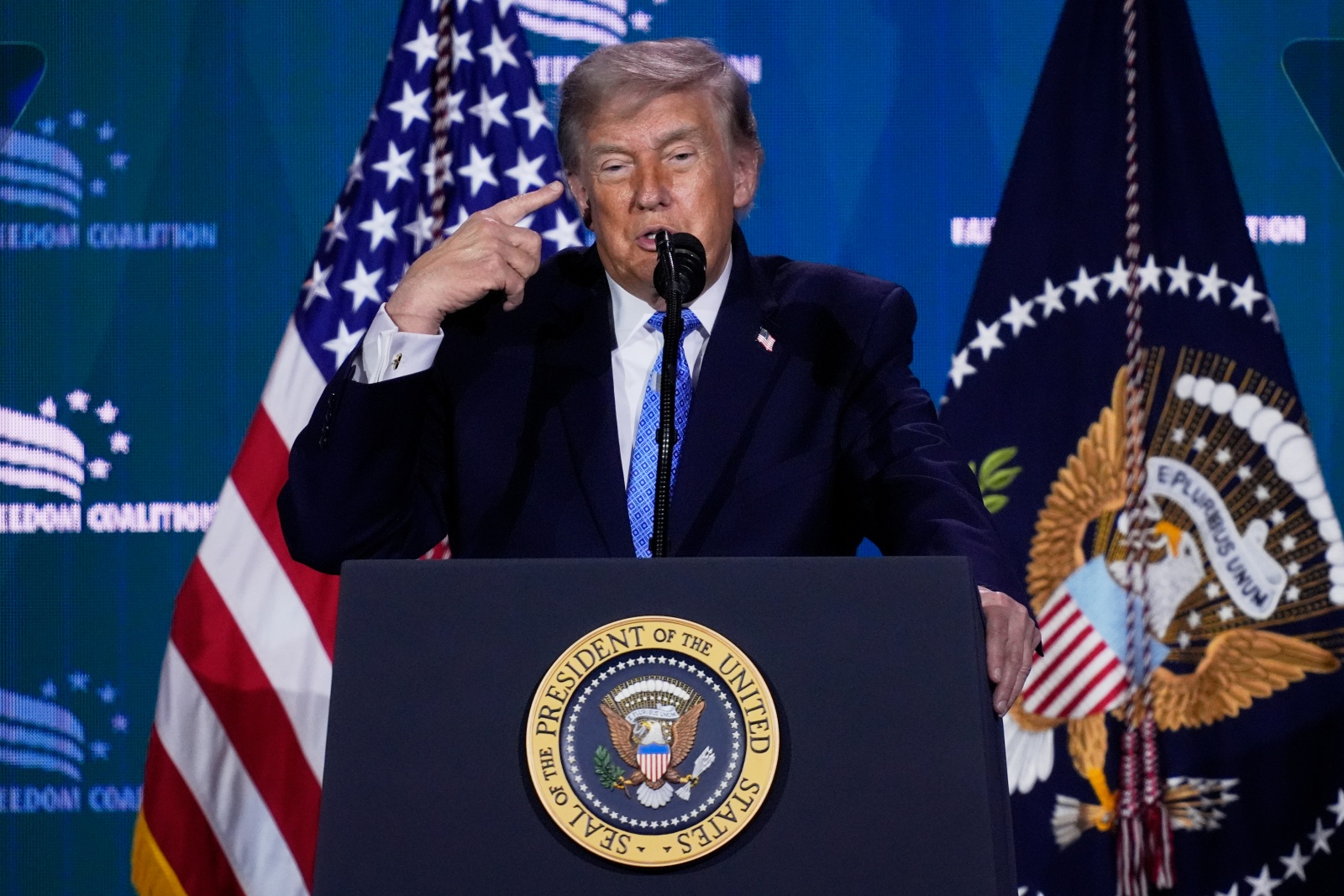
The political class is fighting a ghost. When former President Trump commands headlines by labeling "communism" the greatest threat to America since the World Wars, he is playing a well-worn tape. The media eats it up. The opposition outrages on cue. Everyone retreats to their partisan bunkers, comfortable in a familiar, decades-old rhetorical war.
It is a beautiful distraction. It is also entirely wrong.
The lazy consensus in mainstream political commentary treats the word "communism" as a literal, looming structural takeover of the United States economy. Pundits debate whether marginal tax rates or green energy subsidies constitute a Soviet-style march toward state ownership of production. This debate is intellectually bankrupt. It fundamentally misunderstands global economics and mistakes standard bureaucratic expansion for an ideological crusade.
The actual risk to the United States is not a red flag over the Capitol. The actual risk is deep, structural stagnation driven by an unholy alliance of corporate protectionism and state-backed financial engineering. While Washington hunts for Marxists under the bed, the real engine of American prosperity is rusting from the inside out.
We are not facing an ideological invasion. We are facing a competence crisis.
The Cold War Playbook is Obsolete
To understand why the "communism" narrative persists, you have to look at how political branding works. It is cheap. It requires zero policy nuance. Branding an opponent a communist invokes a historical memory of clear victory. It suggests an enemy with a centralized headquarters that can be defeated by defense spending and grand speeches.
The reality of modern geopolitics blows this premise apart.
Consider China, the nation most frequently cited as the standard-bearer for this supposed communist threat. Anyone running a global supply chain knows that China is not operating on Marxist principles. They operate on state capitalism—a hyper-pragmatic, mercantilist model designed to dominate global markets through state-subsidized industrial capacity.
The Precision Correction: Communism demands the abolition of private property and the total state ownership of the means of production. State capitalism uses private corporate entities as instruments of national power while maintaining a highly controlled, aggressive market economy.
When the state coordinates with massive private enterprises to monopolize rare earth minerals or flood the market with electric vehicles, that is not communism. That is industrial warfare. Fighting it with anti-communist rhetoric is like bringing a musket to a cyber warfare drone fight.
I have watched corporate boards and policymakers waste thousands of hours prepping for abstract ideological standoffs while completely ignoring the fact that foreign state-backed competitors are systematically undercutting American manufacturing cost structures. Washington thinks it is in a debate over philosophy. The rest of the world is just executing a business plan to out-produce us.
The Illusion of the Managed Economy
The domestic version of the scare narrative is equally detached from reality. The political right often warns that government regulations and social safety net expansions are the top of a slippery slope toward a command economy. The political left counters by pretending these expansions are purely altruistic fixes for a broken system.
Both sides miss the point because they fail to look at where the capital actually goes.
We do not have a system trending toward state ownership. We have a system trapped in cronyism. Look at the data surrounding the largest government interventions over the last two decades: the 2008 financial bailouts, the trillions injected during the 2020 pandemic, and the ongoing industrial subsidies for semiconductor plants and green infrastructure.
Did these interventions nationalize the banks or the tech sector? No. They socialized the risk while keeping the profits strictly private.
[Traditional Capitalism] -> Risk is Private / Profit is Private
[True Socialism]        -> Risk is Public  / Profit is Public
[The Modern US Reality] -> Risk is Public  / Profit is Private
This is the actual mechanism rotting the American economy. When you guarantee that the largest institutions will never be allowed to fail, you destroy the core feature of capitalism: creative destruction. In a healthy system, bad management dies so that new, efficient companies can grow from the ashes. By keeping zombie companies alive through endless credit injection and regulatory moats, the government is not introducing communism. It is introducing sclerosis.
The Peterson Institute for International Economics and various market studies have repeatedly shown that regulatory accumulation disproportionately harms small businesses while protecting established incumbents. True ideological state-planned economies seek to crush corporate giants; the American system coddles them to ensure political stability.
Intellectual Property and the Death of Innovation
If you want to find the real threat to American dominance, stop looking at tax brackets and start looking at the patent office.
A standard economic question often asked is: Does big government stifle innovation?
The consensus answer is usually a simple "yes" based on taxes or paperwork. But the brutal, honest answer is more complex. The government stifles innovation by acting as an enforcement arm for corporate cartels.
The initial intent of intellectual property laws was to encourage creation by granting temporary monopolies. Today, the system has been completely inverted. The largest technology and pharmaceutical firms use patent thickets—thousands of overlapping patent claims on a single product—to lock out competitors for decades.
Imagine a scenario where a small startup develops a breakthrough medical device that could cut healthcare costs by 50 percent. In a pure market, they win. In our current reality, a legacy healthcare giant hits them with thirty simultaneous patent infringement lawsuits. The startup does not die because its product is bad; it dies because it cannot afford the five-year legal retainer required to prove its innocence.
This is not a failure of capitalism caused by creeping left-wing ideology. It is a failure of state capacity. The legal and regulatory frameworks have been captured by insider interests to prevent competition. The danger is not that the state will seize the factories, but that the state will continue to pass laws making it illegal for anyone else to build a better factory.
The Cost of the Outdated Threat Matrix
Every minute a politician spends railing against an abstract, twentieth-century ideology is a minute spent ignoring the structural vulnerabilities that threaten to tank the standard of living in the West.
The true vulnerabilities are concrete, compounding, and largely ignored:
- The Sovereign Debt Debt-Trap: The US national debt is growing at a rate that far outpaces real GDP growth. This is not driven by an ideological desire to expand the state, but by a bipartisan refusal to make hard choices regarding entitlement spending and tax revenues. The end result is financial repression—inflating away the value of currency to manage the debt pile, which acts as a massive hidden tax on the middle class.
- The Infrastructure Deficit: While political factions argue over vocabulary, physical infrastructure is decaying. The American Society of Civil Engineers consistently grades US infrastructure at near-failing levels. It takes a decade of environmental reviews and bureaucratic sign-offs to build a simple rail line or expand a port, while global competitors build entire logistics networks in a fraction of the time.
- The Educational Misalignment: The American education system is producing historically low rates of proficiency in math and foundational sciences, while simultaneously saddling a generation with billions in non-dischargeable debt for degrees with zero market value. A nation that cannot produce engineers, technicians, and builders cannot sustain global leadership, regardless of its political philosophy.
This is the downside to the contrarian reality: fixing these problems requires grinding, unglamorous policy work. It requires reforming the administrative state, streamlining legal frameworks, and forcing entrenched corporate monopolies to face real competition. It is much easier to give a speech about saving the nation from a communist takeover than it is to reform the National Environmental Policy Act or dismantle the pharmaceutical lobby.
Stop Fighting Yesterday's Wars
The obsession with framing every national challenge through the lens of mid-century ideological struggles is a form of intellectual cowardice. It allows leaders to avoid addressing the reality of an economy that is growing heavily stratified, overly bureaucratic, and increasingly risk-averse.
The United States is not in danger of becoming Venezuela or the Soviet Union. The cultural, historical, and institutional foundations of American individualism are far too deeply entrenched for a total collectivization of society to take root.
The real danger is that America becomes a high-tech version of late-stage Western Europe or Imperial Rome: a stagnant, debt-burdened society where asset prices are permanently detached from wages, where the young can no longer afford to buy homes or start families, and where the economic system functions primarily to protect the wealth of the well-connected at the expense of everyone else.
This economic sclerosis does not arrive with a violent revolution or a dramatic change in government structure. It arrives quietly, wrapped in the language of stability, protection, and historical nostalgia.
If you want to protect the future of the country, stop listening to politicians hunt for ideological phantoms. Start looking at the structural bottlenecks, the corporate handouts, and the regulatory moats that are quietly strangling the dynamism of the American market.
Turn off the television, ignore the red scare performance art, and demand an entirely different set of questions.