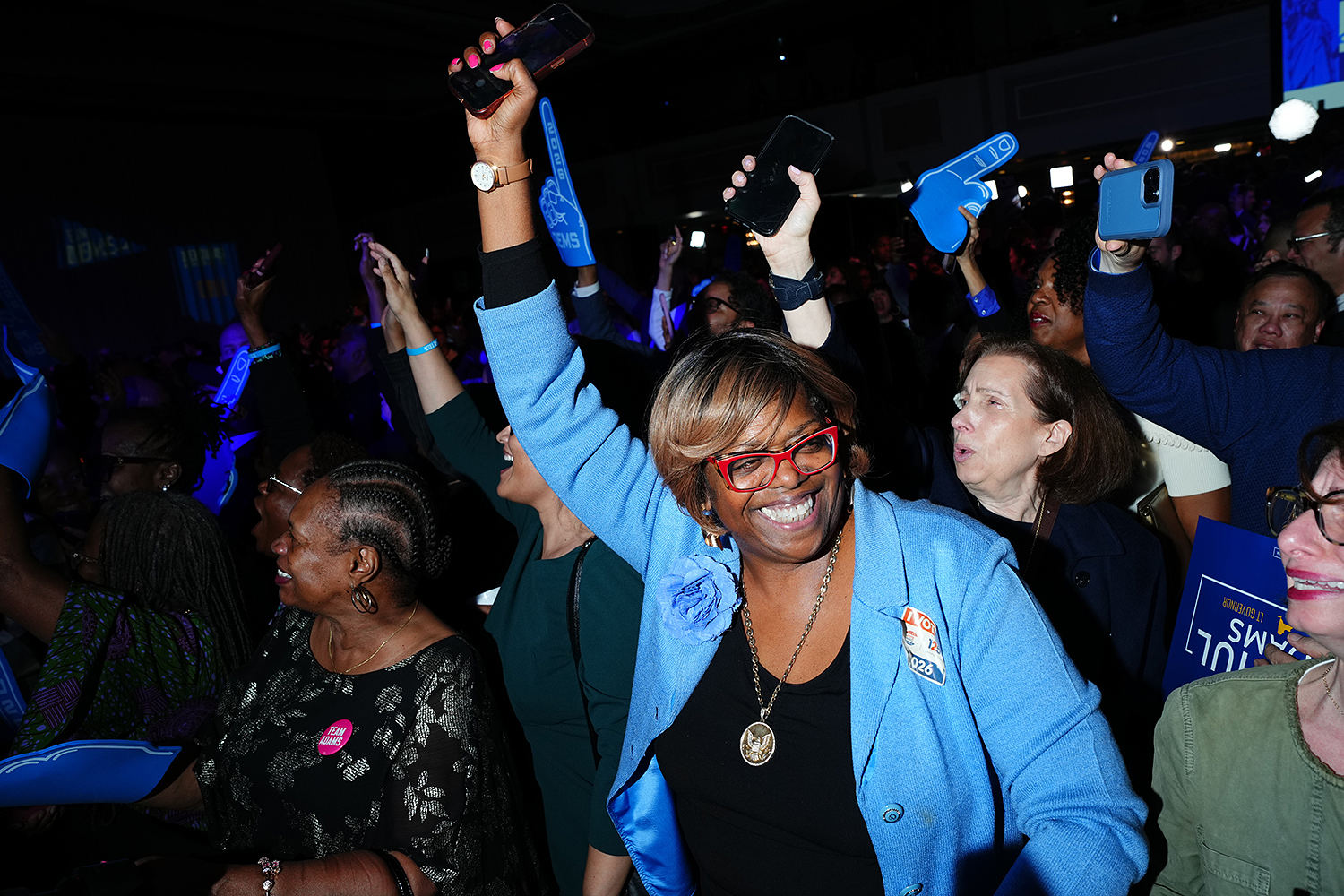
Cheering crowds. Defeated slumped shoulders. Clinking glasses in one room, dead silence in another.
Every major broadcast cycle, legacy newsrooms serve up the exact same visual diet: watch parties across the U.S. framed as instant x-rays of the national mood. One room erupts; another sinks into gloom. The caption always implies the same thing: Look at how America feels right now.
That framing is lazy. Worse, it is analytically backwards.
Photo galleries of watch parties across the U.S. do not capture civic participation or genuine political reckoning. They capture manufactured crowd theater staged for cameras, cable panels, and social feeds. Confusing a room full of activists or loyalists staring at a glowing screen with "the country" is one of the cheapest habits in modern political media.
The Lazy Consensus Around Watch Parties Across the U.S.
The standard photo essay follows a predictable script. Shot one shows jubilant supporters waving flags or hugging under harsh venue lights. Shot two cuts to quiet faces, bowed heads, or half-empty tables somewhere else. Put them side by side, and you get instant emotional symmetry: celebration and gloom locked in visual combat.
Here is the flaw in that story. Emotions inside a watch party are reactive, hyper-local, and heavily skewed toward the most politically engaged sliver of the population. Political science research on partisan sorting and media habits consistently shows that intense partisans—those most likely to show up at organized events and consume wall-to-wall coverage—are not representative of the broader electorate. Many voters decide late, tune out nightly outrage, or experience results quietly at home without staging a public performance.
A photograph of gloom at a campaign headquarters or bar does not measure voter grief across a congressional district. It measures the mood of thirty people who already had an emotional stake strong enough to leave the house on a weeknight.
Why Visual Symmetry Tricks Smart Readers
Human pattern recognition loves contrast. When a photo gallery pairs elation on the left with sorrow on the right, the brain reads that contrast as proof of a clean, dramatic binary.
Real-world outcomes rarely arrive as clean binaries in the moment. Early returns skew by precinct, mail-in processing speed, time zones, and turnout composition. A room celebrating at 8:30 p.m. can easily be staring at unrepresentative early numbers, while a quiet room at 9:00 p.m. may simply be waiting on late-counting urban or suburban precincts.
Treating raw facial expressions in a single snapshot as a verdict misses the mechanics underneath. You are watching crowd psychology reacting to partial information, often filtered through partisan cable commentary engineered to maximize tension.
What Actually Happens Inside These Rooms
I have spent years covering campaigns, media production, and public events, and I have watched newsrooms and campaign staffers burn serious money staging rooms that look good on a three-second cut. Half the "organic energy" you see in those frames exists because a producer or advance operative told people where to stand, when to clap, or which corner had the best lighting.
Let's be precise about what these gatherings actually are. A watch party is a social viewing event organized around a live broadcast—an election night, a debate, a major ruling, or a high-stakes cultural event. In politics, it serves three practical functions that have almost nothing to do with informing the public:
- Morale and donor retention: Campaign aides and party chapters use watch parties to keep volunteers, bundlers, and local activists plugged into the network so they stay active in the next cycle.
- Media earned-time bait: A lively room gives local affiliates and national networks an easy B-roll hook to pair with anchor chatter.
- Social proof for insiders: Attendees post clips and photos to signal belonging and commitment within their political tribe.
None of those functions require the room to reflect swing voters, undecided households, or durable policy shifts. In fact, the incentives push in the opposite direction: the louder and more partisan the room, the more photogenic the clip.
Imagine a scenario where a local campaign rents out a sports bar in a battleground county. Twenty staffers and die-hard volunteers arrive early, cluster near the television with branded signs, and cheer every favorable chyron while a camera crew films for ninety seconds. Meanwhile, two miles away, an independent voter finishes a shift, skips the coverage entirely, and reads a summary the next morning. Which scene gets photographed? The bar. Which scene tells you more about how ordinary people actually live with political outcomes? The quiet kitchen table.
A Quick Reality Check on Room vs. Reality
| Dimension | What Watch Party Photos Show | What Actually Drives Outcomes |
|---|---|---|
| Sample makeup | Activists, staff, regulars, camera-ready guests | Broad electorate, including low-salience and late deciders |
| Timing bias | Spike reactions to early or partial updates | Final certified counts and multi-week policy impacts |
| Emotional signal | Performative highs and acute disappointment | Mixed feelings, pragmatism, exhaustion, or indifference |
| Media value | Instant visual contrast for celebration and gloom | Slower data journalism that takes effort to read |
The Wrong Question Everyone Keeps Asking
When readers look at coverage of watch parties across the U.S., they usually ask: What does the mood in these rooms tell us about where the country is headed?
That is the wrong question. A better question is: Why are we letting curated crowd reactions substitute for hard evidence?
Here is how to handle the classic "People Also Ask" questions around this topic without falling for the illusion:
Do watch parties predict the final outcome?
No. A room full of celebration can precede a narrow loss once late ballots drop, and a subdued room can precede a surprise holdout. Treating room energy as a scoreboard is a rookie mistake.
Why do journalists keep publishing these photo galleries?
Because visual drama is cheap to produce and easy to scan. Putting joyful faces next to dejected ones creates instant narrative friction without requiring deep reporting or statistical context.
Are watch parties completely useless?
Not as social gatherings. If your goal is community, camaraderie, or blowing off steam with friends who share your worldview, gathering to watch a broadcast together is completely fine. It is only useless—and misleading—when treated as political intelligence.
Actionable Ways to Read Coverage Without Getting Played
If you care about accurate information rather than manufactured adrenaline, change how you consume event coverage starting tonight.
- Skip the reaction gallery first. Read the underlying reporting, precinct data, or structural analysis before looking at crowd photos. If the photos change your conclusion, your conclusion was built on shaky ground.
- Audit the incentives in the frame. Ask who organized the gathering, who invited the cameras, and what happens if the room looks dead. When a campaign or group hosts an event, the room is curated.
- Watch the lag between emotion and reality. Sharp spikes of gloom or euphoria in real-time broadcasts often fade within days as facts settle and daily routines resume.
- Separate spectacle from stakes. A tense night on television does not automatically rewrite local budgets, courts, or community life overnight. Focus on concrete policy mechanics rather than broadcast theatrics.
Where My Contrarian Take Can Backfire
Being contrarian has its own traps, and I will own them. Dismissing every watch party as pure theater can make a cynical observer blind to genuine grassroots momentum or real shifts in local organizing energy. Sometimes a crowded room does signal real enthusiasm on the ground, just as a dead room can signal real burnout among core supporters.
Political analysts like Samuel Popkin, Morris Fiorina, and Diana Mutz have long examined how voters process information, sort into groups, and react to conflict in mass media. The takeaway from serious scholarship is not that emotion never matters; it is that media spectacle distorts both the scale and the meaning of that emotion.
Overcorrecting into total cynicism is just another lazy shortcut. The disciplined move is skepticism toward the camera frame, paired with respect for real data.
Stop mistaking a roomful of people yelling at a screen for the pulse of a nation.


