National sports apparel operates as a highly efficient vehicle for mass alignment, converting complex cultural identities into a standardized consumer good. When a national football jersey shifts from a symbol of collective unity to a polarizing political marker, it reflects deeper systemic fractures within the state itself. In Colombia, the iconic yellow, blue, and red shirt—the Tricolor—has undergone a structural transformation. It has been repurposed from a neutral athletic uniform into a highly charged instrument of political signaling, class demarcation, and ideological alignment.
Understanding this shift requires moving beyond sentimental narratives about sports culture. Instead, we must analyze the precise socio-political mechanisms, historical precedents, and economic incentives that have turned a piece of athletic wear into a proxy battleground for Colombia's fractured public sphere.
The Tri-Partite Framework of Cultural Symbol Appropriation
The transformation of the Colombian football kit from a sporting asset to a political weapon occurs through three distinct mechanisms. Cultural symbols rarely lose their neutrality by accident; instead, they are co-opted when specific factions recognize their value for mass mobilization.
+-----------------------------------------------------------+
|               POLITICAL APPROPRIATION PATHWAY             |
+-----------------------------------------------------------+
| 1. Symbolic Arbitrage:                                    |
|    Capture 90%+ baseline trust of the national team.     |
+-----------------------------------------------------------+
|                             │                             |
|                             ▼                             |
+-----------------------------------------------------------+
| 2. Class-Based Demarcation:                               |
|    Commercialization isolates lower-income tiers via price.|
+-----------------------------------------------------------+
|                             │                             |
|                             ▼                             |
+-----------------------------------------------------------+
| 3. Ideological Hegemony:                                  |
|    Outgroup exclusion transforms the jersey into an       |
|    anti-government or pro-establishment uniform.          |
+-----------------------------------------------------------+
1. Symbolic Arbitrage
Political movements frequently look for established cultural assets that carry high emotional resonance and low baseline resistance. The Colombian national football team (La Selección) historically enjoys a level of public trust and cross-demographic appeal that traditional political institutions, such as congress or political parties, cannot achieve. By adopting the jersey during street protests, political rallies, and legislative debates, conservative and center-right coalitions executed a strategy of symbolic arbitrage. They transferred the broad, unquestioned legitimacy of the sporting asset onto their specific partisan agendas.
2. Class-Based Demarcation
The accessibility of the official jersey creates an economic filter. As global sportswear manufacturers increase retail prices to maximize profit margins, ownership of an authentic national kit becomes a marker of disposable income. This economic stratification splits the symbol into two distinct tiers: the official premium kit, which is worn predominantly by middle-to-upper-class citizens during anti-government demonstrations, and unauthorized replicas, which are worn by the working-class majority. The price tag of the authentic garment creates a reliable proxy for socio-economic status, reinforcing class divides under the guise of national pride.
3. Ideological Hegemony and Outgroup Exclusion
When a dominant political faction successfully links a national symbol to its specific platform, the symbol undergoes a functional shift. It is no longer an inclusive badge of citizenship. Instead, it becomes an exclusionary tool designed to signal ideological compliance. Citizens who do not align with the faction using the symbol face a difficult choice: they must either wear the jersey and risk being misidentified as supporting that political agenda, or abandon the jersey entirely, which allows their opponents to claim a monopoly on patriotism.
Historical Inflection Points: From Narco-Aesthetics to Left-Right Polarization
The politicization of the Colombian jersey is not a recent anomaly, but rather the modern iteration of a decades-long evolution in how sports, capital, and state power interact.
During the late 1980s and early 1990s, the golden era of Colombian football was deeply tied to the informal economy of narcotics trafficking. Major club teams like Atlético Nacional, América de Cali, and Millonarios functioned as money-laundering mechanisms and reputational laundering assets for rival cartels. The national team’s success during this period, culminating in the famous 5-0 victory over Argentina in 1993, temporarily masked these deep criminal ties under a wave of euphoric nationalism. The yellow shirt during this era represented a fragile, state-sanctioned distraction from severe institutional instability and violence.
The current era of polarization, however, stems from a different structural catalyst: the 2016 Peace Accord with the FARC and the subsequent wave of mass civil unrest between 2019 and 2021.
During the Paro Nacional (national strike) of 2021, the structural fracture of the symbol became clear:
- Anti-Government Protesters: Adopted the flag of Colombia flown upside down, alongside indigenous symbols like the Wiphala and the guard uniforms of the Guardia Indígena. They viewed the traditional deployment of the national jersey as a symbol of institutional complacency and state-sanctioned violence.
- Anti-Strike/Pro-Establishment Blocs: Organized counter-marches where the explicit dress code was the yellow national football jersey. By dressing their movement in the colors of La Selección, these groups framed the anti-government protesters not merely as political opponents, but as existential threats to the nation itself.
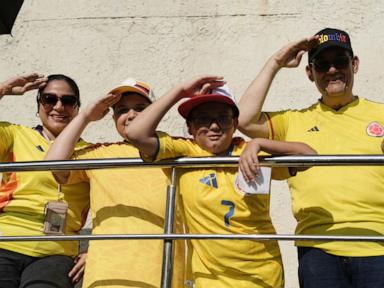
This environment turned the act of wearing the jersey into an active political choice. A citizen walking through Bogotá or Medellín in a yellow kit was no longer seen simply as a football fan; they were read as a defender of the status quo, military institutions, and conservative economic policy.
The Economic Engine: Corporate Neutrality vs. Hyper-Polarized Markets
Global sportswear brands find themselves caught in a difficult position due to this polarization. The financial model of a national team kit supplier relies on achieving maximum market penetration across all consumer segments. When a kit becomes politically polarizing, it threatens the brand's return on investment by alienating a large portion of the target market.
The market response to this polarization reveals a clear economic challenge:
                  ┌──────────────────────────────┐
                  │ Kit Polarization Escorates   │
                  └──────────────┬───────────────┘
                                 │
                 ┌───────────────┴───────────────┐
                 ▼                               ▼
  ┌─────────────────────────────┐ ┌─────────────────────────────┐
  │      Consumer Backlash      │ │     Brand Neutralization    │
  │ Outgroup stops purchasing   │ │ Shifts to alternative kits  │
  │ to avoid political mis-ID   │ │ (black, dark blue, white)  │
  └─────────────────────────────┘ └─────────────────────────────┘
To counter this risk, product design strategies have shifted toward color neutralization. Kit manufacturers have increasingly introduced alternative away kits featuring non-traditional colors like black, dark blue, or minimalist white. These designs are intentionally stripped of direct national flag associations. This product diversification allows consumers to support the national team while opting out of the domestic political culture war tied to the primary yellow kit.
Furthermore, the rise of the alternative kit market highlights a major limitation in traditional sports marketing metrics. Standard sales data often fails to capture why a specific product line fluctuates in popularity. A dip in sales for a primary yellow kit alongside a spike in sales for a neutral away kit is rarely just a shift in aesthetic preference. Instead, it often serves as a quantifiable indicator of a consumer base trying to avoid political crossfire.
Structural Geographies of the Tricolor
The political meaning of the Colombian football shirt also changes depending on geography. The symbol operates differently based on local political climates and regional demographics.
In conservative urban centers like Medellín or the affluent northern quarters of Bogotá, the yellow jersey remains a common sight during civic holidays and political demonstrations. In these spaces, the shirt reinforces a traditional, business-friendly, and centralized vision of Colombian identity.
Conversely, in regions deeply affected by armed conflict and historic state neglect, such as the Pacific coast (e.g., Buenaventura, Cali) or the southern departments, the jersey carries a more complicated meaning. While residents of these areas passionately support the Afro-Colombian athletes who form the core of the national team's roster, they often reject the yellow shirt as a symbol of civic pride during political actions. For these communities, the official kit represents a centralized state apparatus that celebrates their athletic labor on the pitch while marginalizing their communities economically and socially.
This geographical divide shows that the jersey cannot be viewed as a single, uniform symbol. It functions instead as a flexible canvas that reflects the deep regional and class divisions within the country.
Strategic Outlook for Cultural Asset Protection
For organizations, brands, and institutional leaders looking to navigate hyper-polarized cultural environments, the weaponization of the Colombian jersey offers an important case study. Relying on the long-term neutrality of a national symbol is no longer a viable strategy. When structural political polarization passes a certain threshold, every shared cultural asset will eventually be claimed by one side or another.
To protect the value of these shared symbols, institutional stakeholders must deploy clear operational strategies:
- De-couple Corporate Branding from Partisan Events: Corporate sponsors must build strict legal and promotional firewalls to ensure their logos and products are not featured in partisan political rallies or ideological campaigns.
- Diversify Visual Portfolios: Marketing strategies must move away from relying on a single, high-risk national color palette. Developing alternative visual options helps protect consumer engagement across deeply divided markets.
- Focus on the Human Element Over the Institutional Symbol: Advertising and community engagement should focus on the individual stories, community work, and diverse backgrounds of the athletes themselves, rather than relying on abstract national symbols like flags or anthems that are easily co-opted by political factions.
The ongoing polarization of the Colombian football jersey shows that sports are never truly separate from politics. When a society loses its shared political center, the stadium ceases to be a neutral sanctuary. Instead, the uniform worn by fans becomes an active, visible indicator of the deep divisions shaping the nation.