Pain has a sound, but sometimes it is expressed entirely in silence.
For months, the public watched the former commander-in-chief navigate the margins of public life. At eighty-three, Joe Biden carried the accumulated wear of half a century in the American arena. But beneath the tailoring and the practiced stride of a man who spent decades standing behind podiums, a quiet cellular rebellion was taking root.
In May of the previous year, just months after stepping away from the White House, the diagnosis became public: prostate cancer. At the time, it felt like another private sorrow locked behind institutional doors. Yet bodies do not care about political timelines or historical legacies. They simply keep score.
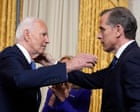
Recently, during a wide-ranging interview broadcast by the BBC, Hunter Biden pulled back the curtain on his father's physical reality. The words were stark, unvarnished by political spin or public relations curation.
The cancer had spread.
It had metastasized into the bones and further.
Consider what bone metastasis actually means in human terms. It is not an abstract medical filing or a talking point for a news ticker. It is an invasion of the body's internal scaffolding. When malignant cells migrate into skeletal structures, they disrupt the delicate architecture that holds a person upright. Every movement, every shift of weight, becomes a negotiation with agony.
"It's very painful and it's very debilitating in many respects," Hunter acknowledged, his voice catching as the weight of the moment settled over the room.
There is an inherent tragedy in watching a parent fade. Most people understand this transition intimately. We watch the giants of our childhood shrink. We see the hands that once lifted us grow frail, the steps that once paced a room slow down. But for the Biden family, this private grief has played out under the white-hot glare of global scrutiny. Every health scare, every stumble, every policy debate has been dissected by millions of strangers.
Yet, the portrait painted by his son is not one of total surrender. It is something far more complex.
"I wish he would complain more, because it's not good," Hunter noted, touching upon a lifelong stubbornness that defined his father's career. Joe Biden has never been a man eager to display vulnerability. For decades, admitting pain was viewed as a political liability—a weakness opponents could weaponize. That hyper-vigilance does not simply switch off because a person leaves office. Even now, facing a disease that gnaws at his bones, the former president resists the luxury of complaint.
Instead, he keeps moving.
He remains out in the public sphere, talking about the issues that shaped his life, driven by an almost stubborn faith in the American experiment. It is a strange dichotomy. The physical shell is breaking down, besieged by a debilitating illness, yet the internal engine of civic duty refuses to idle. He is a man caught between the limits of biology and the persistence of habit.
As the family prepares for the upcoming release of his memoir, Promise Me, America, after the mid-term elections, the juxtaposition is hard to ignore. The title itself echoes an older promise made to a dying son, Beau, years ago. Life comes full circle in cruel, unpredictable ways. The man who once demanded promises from others now finds himself keeping a silent, grueling pact with his own mortality.
It is really sad to watch.
That sentence lingers long after the interview ends. It strips away the titles, the Secret Service details, the history books, and the political divisions. Left standing in the cold light of day is simply an aging father, a worried son, and the quiet, relentless passage of time.