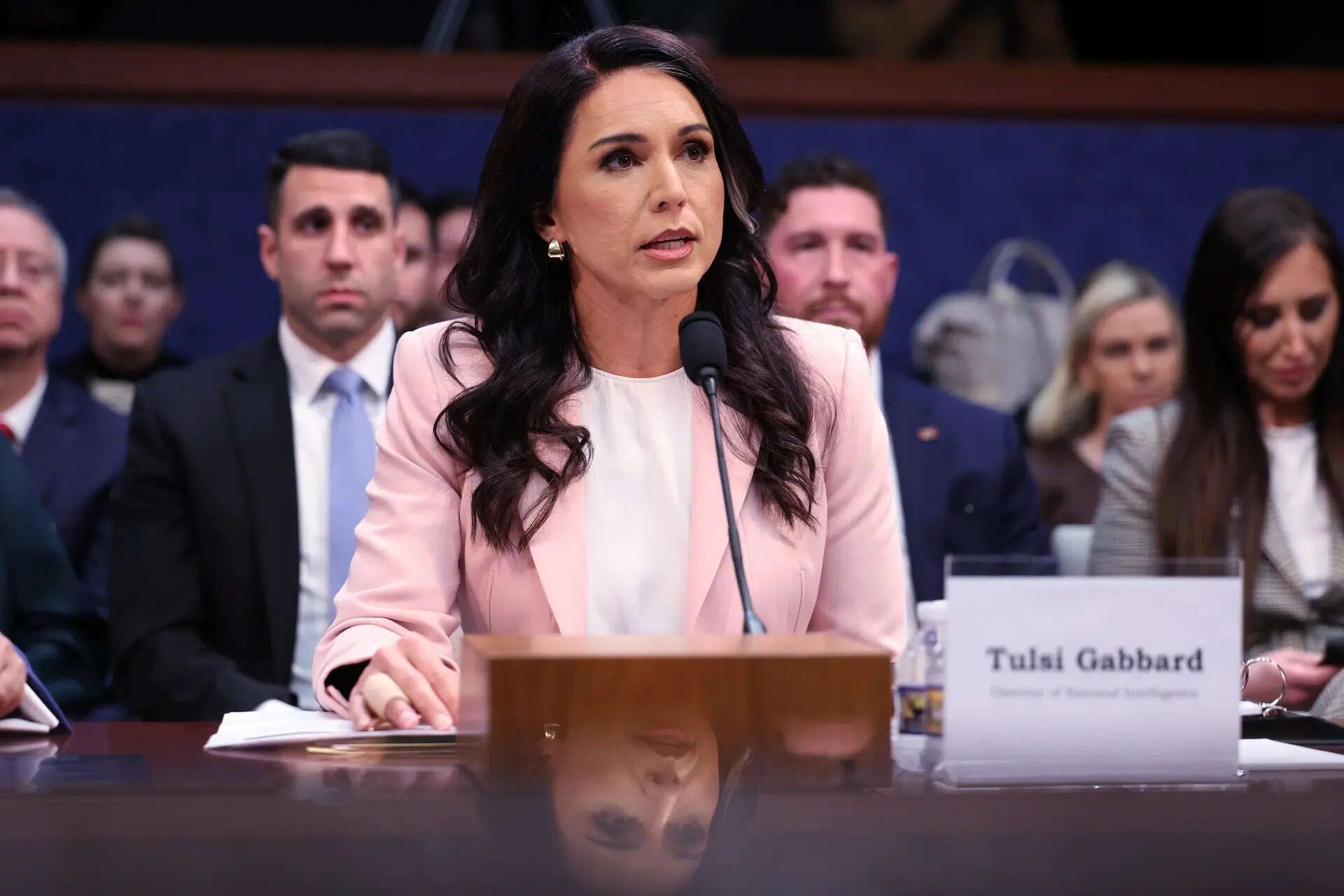
The Director of National Intelligence carries a weight that cannot be measured in pounds or grams. It is a burden of secrets, a heavy, invisible vapor of global threats, whispered warnings, and the terrifying responsibility of knowing exactly what might go wrong before the rest of the world wakes up to the news. For Tulsi Gabbard, that weight was her daily bread. She sat at the apex of the most sophisticated information-gathering machine ever devised by human hands.
But there is a different kind of weight that hits harder. It doesn't come from a classified briefing or a satellite feed from a distant border. It comes from the sound of a clinical, sterile hallway. It comes from the silence in a living room when the television is off and the only thing left to face is a medical report.
Gabbard has stepped down. She has walked away from the inner sanctum of American power, resigning her post as the nation’s spy chief. The reason isn't a scandal or a political shift. It is her husband, Abraham Williams, and his battle with cancer.
Power is a seductive thing. We are taught from a young age that the ladder is the only direction that matters. Up. Always up. To reach the position of Director of National Intelligence is to reach a height where the air is thin and the view covers the entire globe. From that seat, you see the movements of armies and the shifts of economies. You are the architect of a nation’s safety.
Then, the phone rings.
The diagnosis of a spouse changes the physics of a life. Suddenly, the "big picture" of geopolitics shrinks down to the size of a single person. The global map is replaced by an anatomical one. The strategic objectives are swapped for treatment cycles and recovery milestones.
Consider the hypothetical choice. Imagine you are holding the keys to the most influential intelligence network on Earth. You have the ear of the President. You have the ability to shape history. On the other side of the scale, you have a quiet house and a man who needs you to hold his hand through the nausea and the fear of the unknown.
Most people in Washington choose the keys. They choose the legacy. They choose the noise.
Gabbard chose the quiet.
This isn't just a story about a resignation; it is a story about the hierarchy of human needs. We often talk about "work-life balance" as if it were a neat equation we could solve with a better calendar app or a more efficient morning routine. It’s a lie. Balance is a myth. Life is a series of radical prioritizations. You cannot be the shield for a nation and the primary caregiver for a cancer patient at the same level of excellence simultaneously. One will eventually bleed into the other.
The intelligence community is a world built on the concept of "mission first." It is an environment that demands total immersion. When you are the one responsible for synthesizing the output of seventeen different agencies, you don't really have "off" hours. The world doesn't stop spinning, and the threats don't take the weekend off.
To step away from that is an act of immense vulnerability. It is an admission that, despite all the rank and the titles, we are fundamentally fragile creatures. We are bound by our biology and our hearts.
Abraham Williams is a cinematographer. He is a man who has spent his life looking through a lens, framing the world so others can see it more clearly. Now, the frame has tightened. The focus has shifted. Cancer is an intruder that demands every bit of your attention. It is a thief of time and a wrecker of plans.
When a high-profile figure leaves the stage for personal reasons, the political machines usually start spinning. They look for the hidden angle. Was she pushed? Was there a disagreement behind closed doors? Was this a calculated move for a future run?
But sometimes, the simplest explanation is the most profound. Sometimes, the "human element" isn't a PR shield; it’s the truth.
We live in an era where we are constantly told to lean in, to grind, to be "on" 24/7. We lionize the leaders who sleep four hours a night and sacrifice everything for the sake of the mission. We have made a religion out of the career. But what happens when the career can't comfort you in the middle of the night? What happens when the mission doesn't care if you're lonely?
Gabbard’s departure is a reminder that the most important "intelligence" we can ever possess is the knowledge of what truly matters when the lights go down.
There is a specific kind of courage required to walk into the Oval Office and say, "I can't do this anymore because I am needed elsewhere." It is a different brand of bravery than the one required to serve in a war zone or face down a political opponent. It is the bravery of being replaced. It is the quiet confidence of knowing that the world will keep turning without you at the helm, but your home will not.
The report of her resignation sent ripples through the capital. Analysts began wondering about the succession plan. Pundits debated what this meant for the administration’s foreign policy. The machinery of state immediately began the process of filling the void she left behind.
But away from the cameras, in a private space where the titles don't matter, there is just a husband and a wife. There is the scent of a home, the sound of a sigh, and the terrifying, beautiful reality of being present for the person you love.
History is often written as a series of great men and women making great decisions on a grand stage. We see the treaties signed, the wars won, and the laws passed. We rarely see the moments where those same people decide to stop being "great" so they can simply be "good."
The documents on her desk will be read by someone else. The briefings will continue. The secrets will find new ears to inhabit. The national security apparatus is a self-healing organism; it closes the gap and moves forward.
But for Abraham Williams, the presence of his wife is not something that can be replaced by a deputy or an acting director. Her presence is the only thing that matters.
In the end, the most significant thing Tulsi Gabbard did during her tenure might not have been a policy decision or a strategic shift. It might have been the way she left. By choosing the person over the power, she offered a silent, stinging rebuke to a culture that forgets we are humans before we are professionals.
She put down the briefcase. She walked out of the room. She went home.
And in that quiet house, away from the eyes of the world, the real work begins.