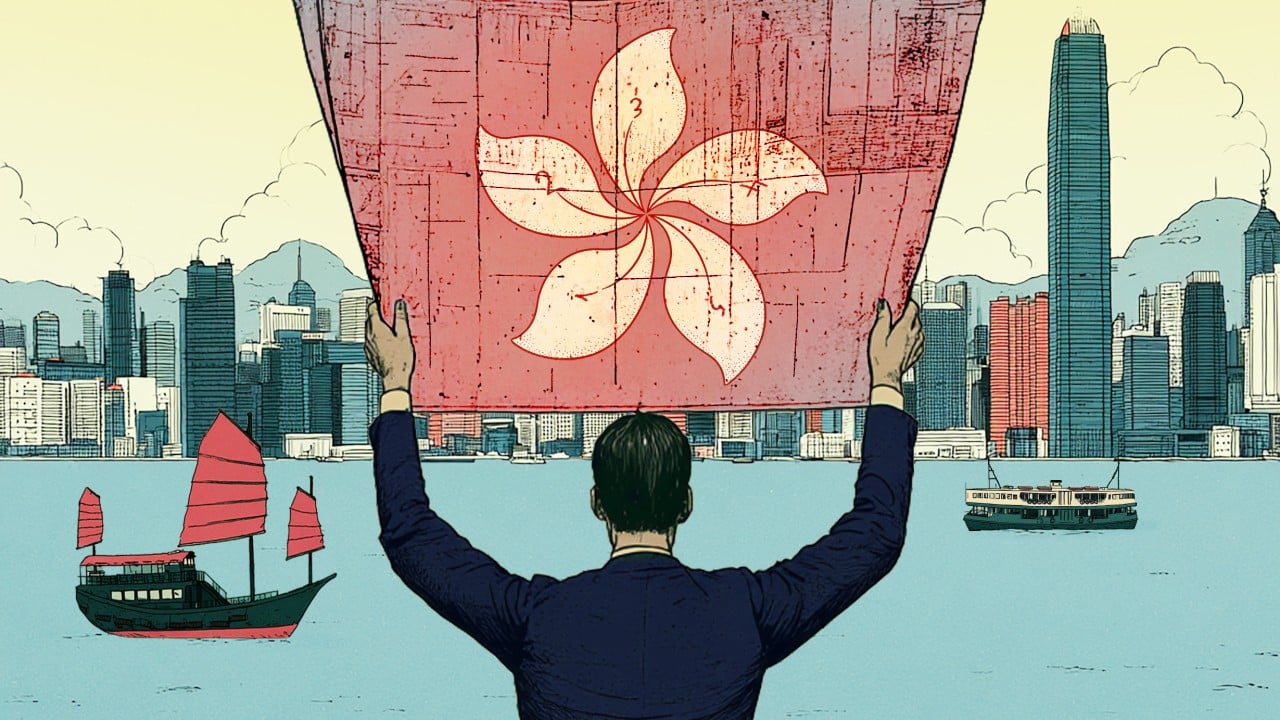
The air in Victoria Harbour always smells of salt, diesel, and a very particular kind of nervous energy. Standing on the Star Ferry pier, watching the ferries churn the grey-green water into foam, you can feel the city pressing against your ribs. Hong Kong has never been a place for standing still. If you pause for even a second, the current catches you and sweeps you past the neon canyons of Central, right out toward the South China Sea.
Right now, the city is pausing. Not out of choice, but out of calculation.
High above the harbour, inside the glass-and-steel monoliths where policy papers are stacked like bricks, a quiet panic is taking shape. It has a specific name, though bureaucrats prefer to call it a strategic alignment. The five-year plan is coming. Every five years, blueprints are drawn, targets are set, and the massive machinery of governance tries to anticipate the future. But this time, the shadow looming from the north is heavy. Beijing has expectations. Massive, unyielding, towering expectations.
And the local blueprint? It looks dangerously small.
To understand why this matters, you have to look past the stock market ticker tape and the glossy tourism brochures. You have to look at ordinary lives.
Consider Wai-fung. He is forty-two, an architect who spends his days staring at CAD drawings of cramped residential towers that sell for astronomical sums per square foot. His office overlooks the construction sites reclaimed from the harbor—billions of dollars of sand and concrete poured into the sea to buy a little more breathing room. Wai-fung is tired. His parents live in a public housing estate in Sham Shui Po, where three generations share four hundred square feet of living space that smells faintly of medicinal herbs and old paper.
Wai-fung does not care about geopolitical directives on paper. He cares about whether his six-year-old daughter will ever be able to afford an apartment without chaining herself to a thirty-year mortgage that consumes every waking breath. He cares about whether the city he loves will still have a soul by the time she grows up, or if it will simply become a sterile corporate transit lounge for mainland capital.
This is the human chasm at the heart of Hong Kong’s current governance crisis. Beijing wants integration. Beijing wants innovation hubs, Greater Bay Area synergies, deep-tech dominance, and a seamless digital economy that plugs directly into Shenzhen’s frantic motherboard. These are not unreasonable demands. They are economic survival strategies in a world that has grown colder and more fractured.
Yet, ambition on a spreadsheet does not automatically translate to ambition on the ground.
When you read the draft outlines of the local administration's five-year roadmap, you notice a strange timidity. It reads like a list of compliance checkboxes rather than a manifesto for reinvention. It talks about housing targets, talent schemes, and land supply—all vital metrics, sure. But it lacks fire. It lacks the desperate, brilliant audacity that turned a collection of barren rock islands into a global financial titan in the latter half of the twentieth century.
History shows us what happens when Hong Kong loses its nerve. The city was built by refugees and risk-takers who had nothing to lose and everything to prove. They did not wait for permission from a central committee; they improvised. They built shipping empires out of sampans and textile factories out of corrugated iron.
Today, the bureaucracy is paralyzed by risk aversion. Every decision is filtered through a labyrinth of committees, consultations, and safety protocols designed primarily to avoid mistakes rather than to achieve greatness. The result is a stagnant middle ground. The plans are safe enough to satisfy the auditors in Beijing, but dull enough to leave the local populace completely uninspired.
Wai-fung sits at his drafting table, erasing a wall that encroaches too close to a light shaft. He tells me, over a bitter cup of milk tea that has cooled too much, that nobody believes the targets anymore.
"They tell us we are building a world-class innovation hub," he says, tapping his pen against the laminated wood of his desk. "But innovation requires failure. And here, failure is a career death sentence. If you propose something bold, the bureaucrats ask you how many forms it requires. If you suggest a radical redesign of our urban geography, they ask you about property developer lobbying groups. How can we match Beijing's ambition when our hands are tied by our own past success?"
That is the crux of the dilemma. Hong Kong is a victim of its own architectural and financial legacy. The economic model that made it rich—high land prices, low taxes, hands-off governance—is reaching its absolute thermodynamic limit. You cannot build a Silicon Valley on real estate speculation alone. You cannot inspire a generation of young tech entrepreneurs when fifty percent of their startup capital goes toward paying extortionate rent for a windowless co-working space in Kwun Tong.
The five-year plan must address this structural rot. Not with tweaks, but with surgery.
Beijing’s expectations are not just about economic output; they are about relevance. The central government looks at Singapore surging ahead as a neutral hub, looks at Shenzhen dominating hardware manufacturing, and wonders why Hong Kong is still arguing over harbor reclamation timelines and civil service efficiency metrics. Beijing wants Hong Kong to be the sharpest spear in the national arsenal, not a rusty museum piece preserved behind glass for wealthy tourists.
To match that expectation, the local government has to abandon its bureaucratic comfort zone. It has to look at land ownership not as a sacred cow that funds the government treasury through auctions, but as a public utility meant to house dreams, not just hoard wealth. It has to radically overhaul an education system that still rewards rote memorization over chaotic, creative problem-solving.
Consider the Northern Metropolis, that grand vision of a futuristic tech-and-housing belt right on the border with Shenzhen. On paper, it is a masterpiece of regional planning. It promises hundreds of thousands of new homes and high-tech parks.
Yet, when you walk the dirt tracks of Yuen Long where this metropolis is supposed to rise, you find sluggish progress. Red tape crawls like ivy over the bulldozers. Land acquisition disputes drag on for years. The ambition is there in the PowerPoint presentations, but the velocity is missing in the mud.
Time is running out. The global economy is shifting tectonic plates beneath our feet, and Hong Kong cannot afford another half-decade of administrative hesitation.
When the final version of the five-year plan is stamped, sealed, and delivered to the legislative chambers, nobody will care about the neatness of the formatting or the diplomatic phrasing of the executive summaries. They will look at the horizon. They will look at whether Wai-fung’s daughter has a fighting chance to live in a city that rewards imagination instead of punishing it.
The harbor water laps rhythmically against the concrete wall of the pier. A container ship, rust-streaked and massive, slips silently out toward the open ocean, guided by a tiny pilot boat cutting through the dark. The city watches it go. The engines hum beneath the pavement. The plan is being written right now, line by difficult line, against the ticking clock of a changing world.


