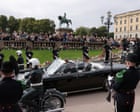
History is rarely polite. It arrives not with a polite knock, but with the heavy, unyielding iron of an oath spoken into the morning air.
Step into the grand hall of the Oslo legislature, the Storting, where the winter light cuts sharp through high windows and hits polished wood. The air smells faintly of wool, old paper, and the collective anxiety of a nation watching its own reflection. Outside, the fjord is a sheet of slate grey. Inside, the room is holding its breath.
A king is not born overnight, even when the bloodline demands it. The transition of power in a constitutional monarchy is a strange, delicate choreography. It balances centuries of divine-right theater against the modern, quiet reality of a parliamentary democracy. On this particular morning, Norway’s new monarch stood before the assembly. The crown was not yet resting on his head—in modern Scandinavia, the physical crown remains a relic of museums, replaced instead by the gravity of words.
Words matter. Especially the ones you promise to keep when millions of people are relying on you to stay steady while the world wobbles.
He raised his hand. The formula of the oath is old, carved into the constitutional architecture of 1814. It binds the sovereign to the constitution and the laws of the realm, a promise to govern in accordance with the collective will of the people rather than the whims of a throne. It is a contract. A handshake across generations.
Yet, something unprecedented shifted the geometry of the room.
Standing right beside him was his daughter.
Not relegated to a balcony far above, and not hidden behind velvet ropes as a distant prop for future pageantry. She was close enough to feel the slight tremor in his hand. She was young, bearing the surreal burden of an inheritance she never asked for, yet stepping into the light with a poise that felt both fragile and fierce.
Consider what happens next in the human mind when we witness power shared with vulnerability. We stop looking at the institution and start looking at the people.
Monarchy is an absurd idea on paper. In an age of algorithms, hyper-capitalism, and rapid democratic elections, the notion of hereditary head-of-state sounds like a historical typo. Why do we keep them? Why do Norwegians, famously egalitarian and allergic to ostentatious displays of hierarchy, continue to embrace their royal family with such steadfast warmth?
The answer is not political. It is emotional.
Governments change every four years. Prime ministers rise on waves of populist rhetoric, stumble through crises, and leave office exhausted, often deeply unpopular. Parliaments argue, deadlock, and fracture. In the messy machinery of modern governance, a country needs an anchor that does not shift with the political winds.
Enter the constitutional monarch. They are the living room rug of the nation. They don't make the laws, but they hold the house together. They are present at the disaster sites, the national tragedies, the Olympic podiums, and the quiet moments of grief. When terror struck Norway on July 22, 2011, King Harald V did not offer dry political spin; he cried with his people, saying simply that his worst fear was that Norway had lost its innocence, but his belief remained that they would find it again.
That is the currency of a modern crown. Empathy. Continuity. A human face on a bureaucratic state.
When the new king took his oath with his daughter at his side, he was signaling something profound about the future. He was acknowledging that the institution cannot survive on empty tradition alone. It must adapt, humanize, and anchor itself in the next generation.
Think about what it feels like to stand before a crowd of critical eyes, knowing that every inflection of your voice is being recorded, analyzed, and beamed into the pockets of millions of strangers. Now, imagine doing it while your child watches, learning what duty looks like in real time.
The weight is heavy.
In many ways, the modern royal upbringing is a gilded cage. From the moment they draw their first breath, these children are cast into a public play where the script is already written and the ending is fixed. They learn to smile through jet lag, to wave until their arms ache, to master the art of listening to endless speeches with absolute fascination. They are public property long before they are private individuals.
Yet, there is a distinct power in proximity. By having his daughter right there beside him during the solemnity of the oath, the king stripped away some of the cold distance that usually defines sovereign succession. It became less about a crown being passed from one invisible head to another, and more about a father showing his child the price of belonging to a country.
History is built by these micro-moments. The press corps outside scribbled furiously, noting the exact minute the oath concluded, the precise wording of the constitutional clause, the meteorological details of the Oslo morning. They captured the dry facts. The transition is legal. The quorum was met. The signature is dry.
But the story—the real story—lives in the space between the heartbeats.
It lives in the quiet glance a father throws to his daughter when the applause finally breaks out. It lives in the realization that while institutions are propped up by laws, they endure only because people choose to care about them.
As the ceremony drew to a close and the assembly filed out into the cold Scandinavian air, the immediate political landscape of Norway remained unchanged. The bills would still be debated. The fjords would still freeze and thaw. The coffee would still be brewed strong in kitchens from Bergen to Tromsø.
Nothing had fundamentally changed in the machinery of the state.
And yet, everything felt different. The crown had been handed down, not just as a symbol of power, but as an ongoing promise of shared humanity. In a world increasingly fragmented by digital noise and political fury, there is something quietly radical about a nation pausing to watch a father and a daughter step into the future together, hand in hand, bound by a vow they cannot break.


