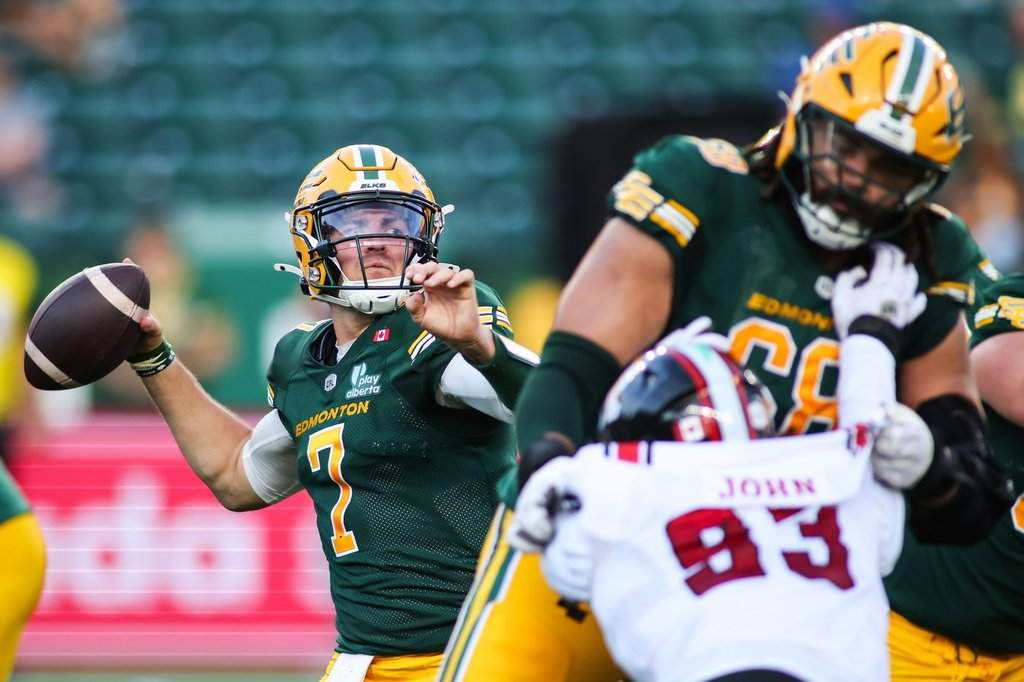
The grass at a professional football stadium feels different when the sun goes down. It’s slick with dew, smelling of crushed blades and the faint, metallic tang of an adrenaline-soaked field. For most, this is where the spectacle happens. For the men wearing the jerseys, it’s a crucible. It is where you find out who you are when the roar of forty thousand people is stripped away, leaving only the hum of your own heartbeat against the cold autumn air.
Cody Fajardo knows that sound. He has spent years choreographing chaos, directing traffic with his eyes while his body absorbs hits that would buckle a lesser man. Last week, the Canadian Football League looked back at the carnage and the glory of the season and decided that Fajardo—along with his peers, Logan McAllister and Adam Theis—had earned the recognition that separates a professional from a legend.
They received their honours. A plaque. A headline. A nod of respect from the league office. But that’s the public side of the story.
To understand why these specific men were elevated, you have to look at the invisible geography of the game. You have to look at the moments they didn't ask for.
Consider Cody Fajardo. Quarterbacks are often treated like CEOs of a volatile, high-stakes startup. They are expected to remain calm when the structural integrity of their protection collapses. When a three-hundred-pound defensive end is barreling toward his ribs, Fajardo has milliseconds to calculate the trajectory of a receiver’s route, the wind speed, and the closing window of opportunity. He has lived through the seasons where the narrative turned against him, where the press questioned his arm, his mind, and his future. He didn't answer with words. He answered by throwing the ball into windows that didn't exist until he forced them open.
This recognition isn't just a trophy. It is a validation of every silent practice session, every session in the film room where he stared at his own failures until his eyes burned. It is the league saying they noticed the poise he maintained when the rest of the stadium felt like it was tilting into the abyss.
Then there is the quiet work of men like Logan McAllister and Adam Theis.
Football fans love the quarterback. They love the wide receiver who performs a balletic leap in the end zone. But the game is held together by the connective tissue of players who operate in the shadows. They are the ones whose names appear in small font on the stat sheet, yet whose bodies are covered in the bruises that tell the true history of a game.
To excel in the CFL—a league that demands speed, versatility, and a level of grit that can’t be taught—you have to be a special kind of person. You have to be someone who thrives on the thankless tasks.
Imagine standing on a kickoff return. The ball is spiraling down from a gray sky. You are the wall. You are the obstacle. You know that if you miss your assignment, the game could swing on a single play. You don't have the luxury of the spotlight. You have the weight of the team’s momentum resting on your shoulders. You make the block. You hold the line. You vanish back into the scrum.
That is where McAllister and Theis have spent their time.
The league honours them because they are the ballast. Without the players who prioritize the team’s integrity over their own highlight reels, the entire enterprise would drift into irrelevance. They are the ones who understand that the most important play is the one that gets the least attention.
There is a visceral, almost primal satisfaction in watching these athletes navigate the demands of their craft. It reminds us that we are all, in our own ways, working in the shadows. We all have seasons where the pressure mounts, where the obstacles seem to have too much momentum, and where the only way out is to keep our feet moving.
We look to these athletes not just because they are fast or strong, but because they are mirrors. When we see Fajardo stand tall in the pocket, or see the discipline required for special teams mastery, we see the potential for our own resilience.
The awards ceremony, the press releases, the formal recognition—that is just the surface. Beneath it lies the real truth of the CFL. It is a league built on the backs of people who have learned that the only way to earn respect is to give everything you have, even when no one is watching, and especially when the world is telling you that you aren't enough.
These three men didn't just earn honours. They earned the right to be remembered as the versions of themselves that refused to break.
The stadium lights will eventually go out. The crowds will disperse into the night, their voices fading into the city's hum. The jerseys will be laundered, folded, and placed back in lockers. But the work stays. The discipline stays.
In the end, it’s never really about the trophy. It’s about the fact that when the clock hit zero and the pressure was at its absolute peak, they were the ones who were still standing, looking for the next play.
There is nothing quite as beautiful as that.