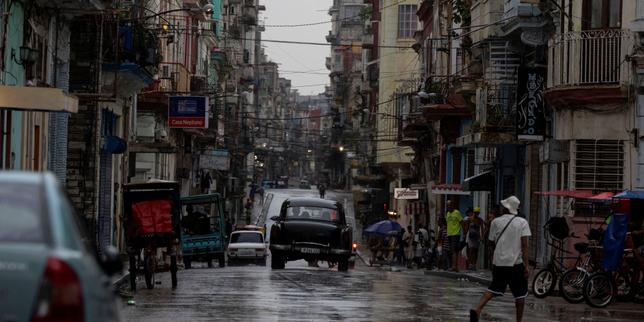
The sea does not care about geopolitics. It beats against the limestone seawall of the Malecón with a rhythmic, indifferent violence, sending up salt spray that coats windshields and rusts the iron balconies of once-grand mansions in Vedado. In Havana, the ocean is both a boundary and an exit. Right now, standing on that wall as the late afternoon sun turns the water the color of bruised copper, you can feel the squeeze.
It is the squeeze of a new round of American sanctions. Cold words on diplomatic paper, translated into empty pots and dark streets.
To understand what happens when a superpower tightens the economic screws on an island ninety miles off its coast, you have to stop looking at trade charts and start looking at a cup of coffee.
Consider Mateo. He is fictional only in his specific name, but he represents a million men and women waking up before dawn in Guanabacoa. Mateo owns a small paladar, a private restaurant tucked into the ground floor of a crumbling colonial building. Three years ago, his tables were full of curious tourists from Madrid, Montreal, and occasionally, Miami. He served fresh snapper, fried plantains, and strong, dark coffee that smelled of earth and ambition. He felt, briefly, like the architect of his own small destiny.
Then the screws turned again.
Financial corridors narrowed. Remittances—the lifeblood sent by relatives in Florida to keep families afloat—faced tighter caps, heavier fees, and bureaucratic gridlock. Shipping lanes grew more hostile as foreign insurers and vessel owners were penalized for docking in Cuban ports. Fuel imports, already strangled, choked to a trickle.
Mateo's story is not an abstract lesson in international trade policy. It is the story of a refrigerator that hums for two hours instead of twenty-four. It is the story of fish that spoils because the ice truck could not find diesel. It is the slow, grinding erosion of hope.
When Washington announces fresh economic penalties, the stated intent is always surgical. The policy papers speak of pressuring the state apparatus, of targeting military-run conglomerates that control tourism and retail, of forcing a transition toward political liberalization. The theory is clean. It fits neatly into PowerPoint presentations in air-conditioned conference rooms in Foggy Bottom.
Reality is messy. Reality bleeds.
Sanctions do not fall neatly like a laser-guided bomb. They fall like a persistent, freezing rain, soaking everything equally. When the state's foreign exchange earnings plummet because hotel occupancy drops or shipping restrictions bite, the first casualty is not the apparatus of power. The first casualty is the neighborhood bakery that cannot import wheat flour. The second is the hospital that runs out of basic antibiotics because transactions involving foreign banks trigger compliance alarms in New York and Frankfurt.
We have seen this script before. It is old, worn at the edges, and devastatingly predictable.
For decades, the embargo and its periodic tightenings have operated on a dark paradox. The architects of the policy argue that the Cuban government uses the blockade as a convenient scapegoat for its own internal economic failures—the bureaucratic inertia, the inefficient centralized planning, the missed opportunities of agricultural reform. And they are not entirely wrong. Central planning has long suffered from paralysis.
Yet, by tightening the tourniquet, Washington hands Havana the very excuse it needs. Every empty shelf, every blackouts-induced night of stifling heat, every cancelled bus route is neatly slotted into the official narrative of heroic resistance against an imperial Goliath. The ordinary citizen is caught in the middle of a sixty-year geopolitical staring contest, ground down by two stubborn forces that refuse to blink.
Walk through Central Havana after dark. The absence of light is startling. Because fuel supplies are rationed to keep the hospitals running on emergency generators, entire neighborhoods plunge into deep, obsidian shadows. People sit on their doorsteps in the humid night air, talking quietly, fanning themselves with cardboard or folded newspapers. The silence is heavy, punctuated only by the distant, rhythmic thrum of an overloaded diesel generator rattling in an alleyway.
In these dark streets, the human element crystallizes. You realize that sanctions are not just economic data points. They are a dampening field applied to human potential.
Young doctors, brilliant minds trained in some of the finest medical schools in the Caribbean, spend their evenings calculating how to trade their scrubs for a ticket through Nicaragua and a grueling overland journey to the southern border of the United States. Engineers drive dilapidated 1950s Chevrolets as informal taxis because fixing broken elevators in state-owned apartment blocks pays less in real value than a single afternoon of ferrying tourists.
The brain drain is catastrophic. It is the quiet bleeding out of a nation’s future. Every twenty-something who boards a raft or flies to Managua takes with them a piece of the island's capacity to heal, to build, to invent.
And why? Because the official policy assumes that if you starve a population long enough, they will rise up and overthrow their government.
History suggests the exact opposite.
When people are fighting simply to secure a loaf of bread, a carton of eggs, or a liter of cooking oil, they do not have the luxury of revolution. Survival consumes the entire horizon of human consciousness. Energy that might have been channeled into political organizing, artistic expression, or economic entrepreneurship is entirely absorbed by the daily, grinding scavenger hunt for basic necessities.
The new American sanctions add another layer to this architectural maze of despair. By further restricting financial transactions and tightening the noose on shipping, they signal a return to maximum pressure. The political calculus in Washington often shifts with the electoral calendar in Florida, where the politics of the Cuban exile community exert a powerful gravitational pull on both major parties. Foreign policy becomes domestic theater.
Meanwhile, back on the Malecón, the waves keep rolling in.
A teenager sits on the concrete wall, strumming an untuned acoustic guitar. He sings a melancholy trova song about a ship that never returned. Around him, the city breathes in its sleep, heavy with fatigue and an unyielding, stubborn grace.
Cubans are masters of resolver—the art of making something out of nothing, of turning a broken refrigerator compressor into a working fan, of stretching a pound of rice to feed six people. It is a testament to extraordinary resilience. But resilience should not be confused with consent, and survival should not be mistaken for stability.
When we look at Cuba through the lens of new sanctions, we must look past the dry language of export controls, banking restrictions, and geopolitical chess moves. We must look at the kitchen table. We must look at the empty medicine cabinet. We must acknowledge that foreign policy leaves fingerprints on real lives.
The tightening of the screws may satisfy a political objective thousands of miles away, but on the ground in Havana, Santiago, and Camagüey, it feels like another turn of the screw in a door that has been closing for generations.
The sea rises against the wall. The salt stings the eyes. And the quiet, relentless work of enduring continues in the dark.


