The grass at the center of the pitch does not care about national identity. It does not feel the suffocating pressure of forty million people holding their breath in unison, nor does it register the frantic, rhythmic beating of plastic drums echoing from the South American contingent in the upper decks. To the mud and the rye-grass, a boot is just a boot.
But to the man standing over the ball, the ground feels like shifting sand. Don't forget to check out our previous coverage on this related article.
Football regularly manufactures these moments of artificial trauma. We call them matches, but they are closer to public exorcisms. When France met Paraguay, the pre-game analysts spoke exclusively in the vocabulary of tactical systems. They drew neat lines on digital whiteboards, tracking overlapping full-backs and defensive pivots. They predicted a display of European fluid geometry breaking down a stubborn, low-block Guaraní defense.
They were entirely wrong. To read more about the history here, The Athletic offers an excellent breakdown.
What transpired over ninety minutes of brutal, agonizingly unglamorous sport was not a tactical masterclass. It was an ideological street fight. It was a ninety-minute reminder that under the bright lights of the World Cup, tactical sophistication is often the first luxury to burn away, leaving behind nothing but raw human desperation.
The Beautiful Game at Its Ugliest
There is a specific kind of dread that accompanies a favorite team playing poorly. It settles deep in the stomach, a cold realization that the script everyone agreed upon is being torn to shreds in real time. From the opening whistle, the French side looked heavy. Their passes, usually crisp and intuitive, lacked the necessary velocity. They were a split-second slow to every second ball.
Paraguay did not come to play beautiful football. They came to survive, and in surviving, to conquer.
Every touch by a French midfielder was met with a physical tax. A shoulder in the ribs here. A trailing boot across the Achilles there. It was a masterclass in defensive friction. The Paraguayan defenders moved as a single, multi-limbed organism, constricting space until the pitch felt the size of a tennis court.
Consider the psychological toll of this approach. For an elite attacker, frustration is a slow-acting poison. It begins with a misplaced pass. Then a referee’s ignored whistle. By the sixtieth minute, that frustration transforms into a frantic desire to do everything alone. The collective structure dissolves.
The stadium grew increasingly quiet, save for the pockets of red and white celebrating every clearance as if it were a trophy lift. The air grew thick with the distinct scent of an impending disaster. We have seen this cinematic trope before in international tournaments. The giant stumbles, grows frantic, and ultimately trips over its own ambition.
The Anatomy of an Isolation
To understand why this match felt so claustrophobic, one must look at the isolated figures on the pitch. Think of a young winger, isolated on the touchline. He has spent his entire life being faster than everyone else. Yet, every time he drops his shoulder to accelerate, two defenders appear, their bodies positioned with the clinical precision of morticians.
The crowd begins to murmur. It is not an angry sound yet, but rather a collective groan of anxiety. It is the sound of a collective realization that greatness is not self-executing.
The minutes did not merely pass; they evaporated. With fifteen minutes remaining, the scoreboard showed a stubborn, unyielding pair of zeros. The French bench looked less like a sports team and more like a waiting room in a hospital. Managers usually pace the technical area to project authority. Now, the movements were erratic, driven by adrenaline and the terrifying knowledge that a four-year cycle of preparation was ticking down to a whimper.
Then, the chaotic geometry of the penalty box intervened.
A loose ball, a desperate lunge, and a split-second miscalculation. The sound of the referee's whistle was sharp enough to slice through the humidity.
Twelve Yards of Solitude
A penalty kick is an unfair psychological experiment disguised as a sporting rule. In open play, instinct governs the athlete. You do not think; you react. But when the referee points to the spot, time stops. The frantic motion of twenty-two players suddenly freezes into a tableau of agonizing anticipation.
The stadium transformed into a pressure cooker.
The man selected to take the kick walked toward the spot with the deliberate, heavy steps of an astronaut walking on the moon. Every camera lens in the stadium zoomed in on his face, searching for a twitch of the jaw, a nervous blink, any sign of fracture.
Imagine the internal dialogue in that specific sequence of seconds. You are not thinking about your technique. You are thinking about your childhood pitch. You are thinking about the headlines already written in the printing presses back in Paris. You are thinking about the goalkeeper, who looks twice his actual size, bouncing on his line like a manic shadow.
The Paraguayan keeper understood the theater of the moment. He delayed. He walked over to water bottles. He kicked the posts. He did everything in his power to stretch those seconds into minutes, forcing the penalty taker to live inside his own head just a little longer.
Silence. Absolute, terrifying silence fell over the arena.
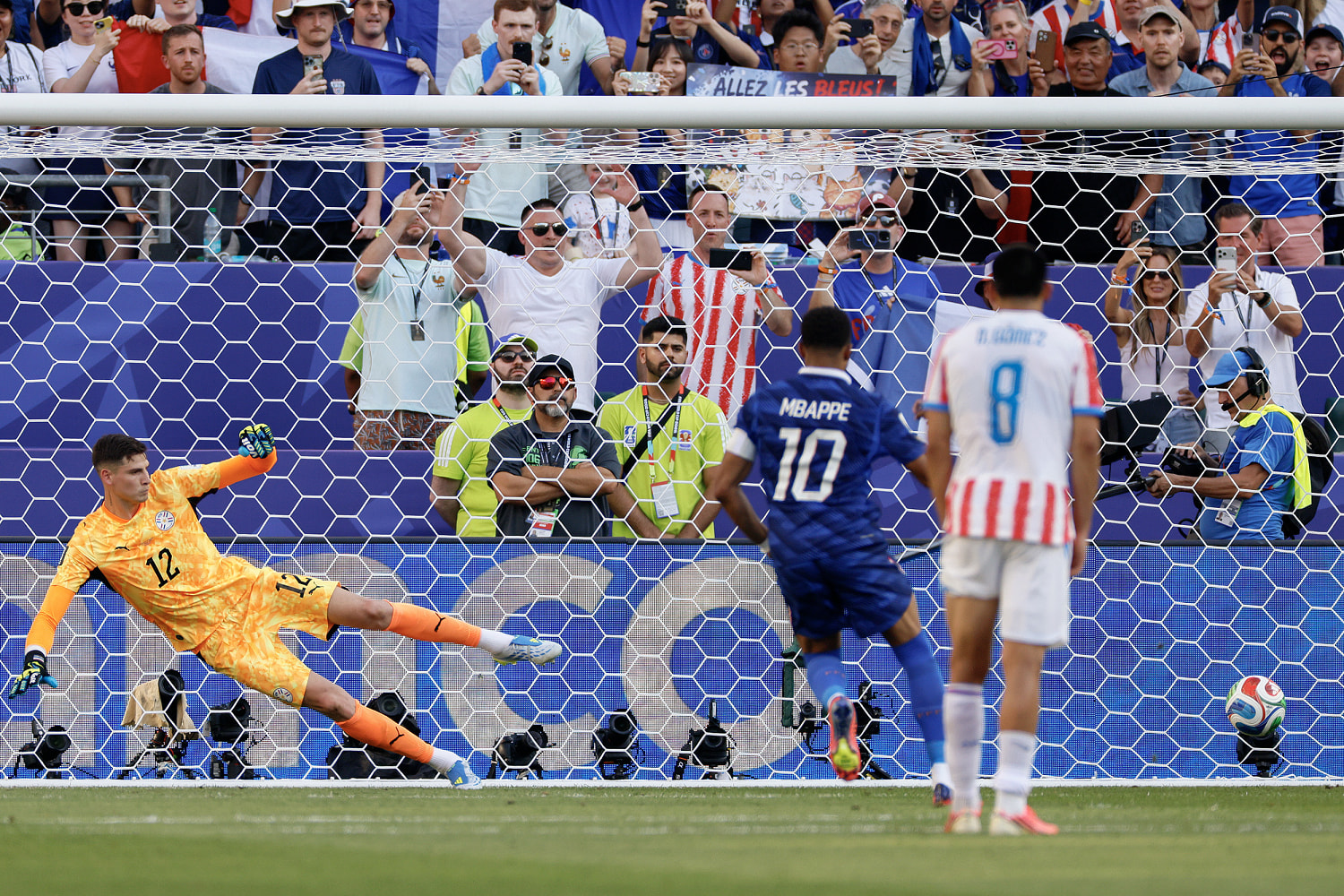
The whistle blew. Three steps forward. A hesitation that felt like an eternity. A strike of the boot.
The ball did not rip into the top corner with theatrical elegance. It was a struck with more relief than romance, staying low and hard, slipping past the outstretched fingers of the diving goalkeeper by a margin that could be measured in millimeters.
The net bulged.
The Release of Held Breath
The celebration was not one of triumph, but of profound survival. The players did not dance; they collapsed into one another, a heap of blue shirts defined by the sheer expiration of terror.
They had saved their tournament, but they had not conquered their doubts.
When the final whistle blew shortly after, the scoreboard confirmed the advancement of France. The record books will show a victory. They will show a step closer to the ultimate prize. But anyone who watched those ninety minutes knows the truth. It was a match stripped of all romance, a reminder that sometimes advancement is not about glory.
Sometimes, it is simply about refusing to die.
The stadium emptied slowly, leaving behind the discarded plastic cups, the crushed flags, and the trampled turf. The French team marched down the tunnel, their faces etched with exhaustion rather than elation. They had looked into the abyss of elimination and found a way to blink last. In the grand narrative of a World Cup, these are the games that truly define a champion—not the fluid, five-goal exhibitions, but the ugly, midnight brawls where survival is the only beautiful thing left on the pitch.