The rain in Frankfurt does not care about the weight of history. It falls in relentless, gray sheets, turning the immaculate pitch into a slick mirror and soaking through the heavy cotton of seventy thousand shirts in the stands. For eighty minutes, the stadium has been a pressure cooker of noise. On one side, a wall of tartan, beer-fueled defiance, and bagpipes that refuse to be drowned out. On the other, the desperate, rhythmic drumming of a nation that views anything less than absolute footballing dominance as a collective psychological crisis.
This is the World Cup group stage, but nobody on the pitch is playing like it is a preliminary.
To understand what happened in the dying embers of this match, you have to understand the invisible stakes. For Scotland, the calculus was simple: survival. A historic, gritty progression to the knockout rounds hung on a knife-edge. They played with the frantic, beautiful desperation of men defending a fortress, throwing bodies into tackles, suffocating space, turning a football match into a war of attrition.
For Brazil, the stakes were entirely different. They were internal. They were spiritual.
To wear the yellow shirt of Brazil is to carry a permanent debt to the ghosts of Pelé, Garrincha, and Ronaldo. It is not enough to win. You must win with joga bonito—the beautiful game. For seventy-five minutes, that beauty was nowhere to be found. The passing was static. The heavy German air seemed to clog the lungs of the South American masters. The scoreboard read a tense, fragile 1-0, courtesy of a scrappy, deflected first-half effort. The Scottish fans were singing, sensing that a single counter-attack, a single long ball into the box, could shatter the Brazilian group-stage dream.
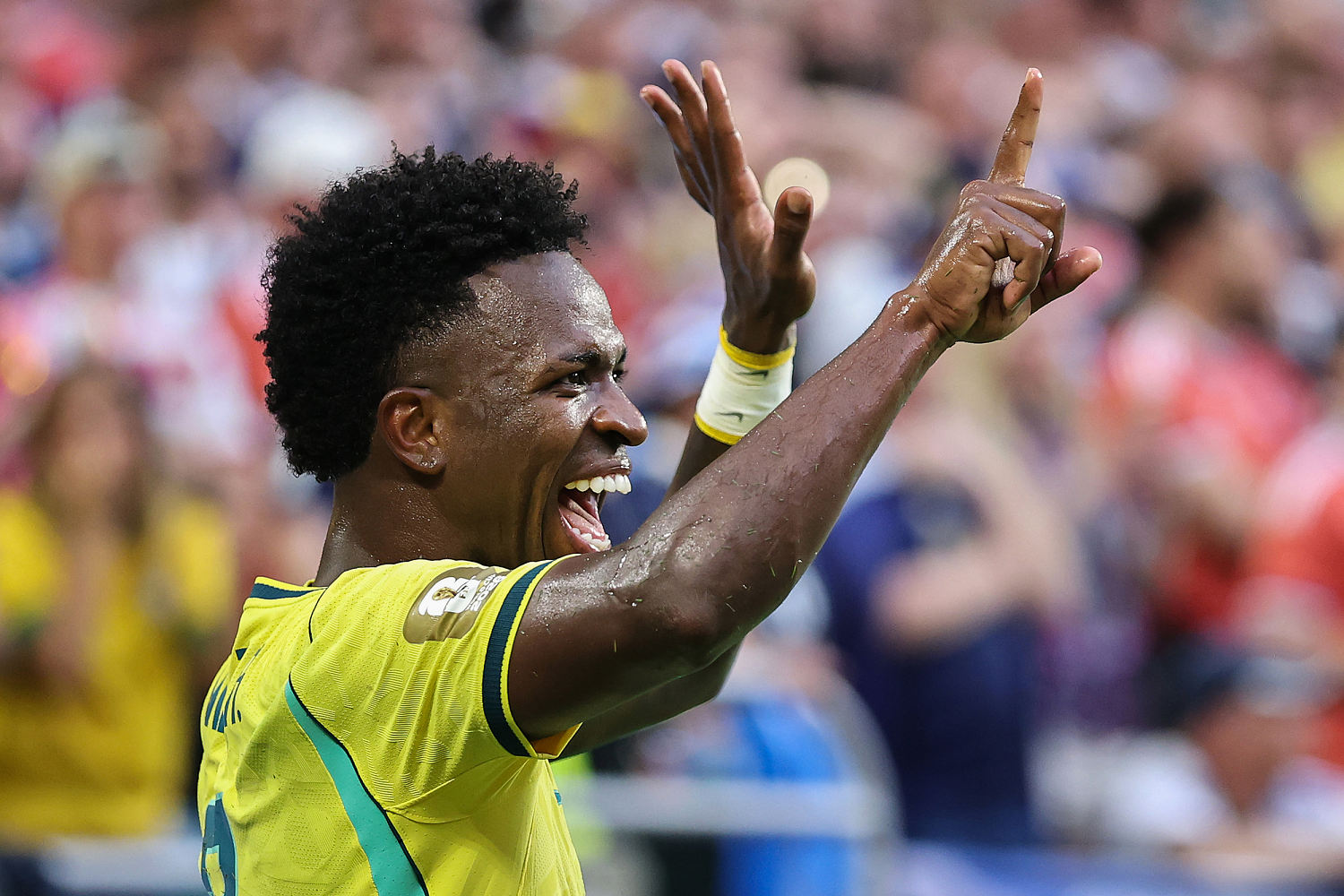
Then, Vinícius Júnior decided he had carried the weight long enough.
Consider the anatomy of a breakthrough. It rarely looks like a tactical masterstroke from the dugout. It looks like an individual refusing to accept the script written by the clock. In the seventy-eighth minute, Vinícius received the ball out wide on the left flank. In standard tactical manuals, the correct play is to retain possession, shield the ball, and recycle it through the midfield to bleed the clock.
He didn't.
Instead, he dropped his shoulder. A tiny, almost imperceptible shift of weight that forces a defender to make a choice. The Scottish right-back, exhausted from an evening of relentless tracking, committed a fraction of a second too early.
Explosion.
One touch with the outside of the boot, a burst of acceleration that looked entirely unfair against the backdrop of twenty tired men, and Vinícius was inside the penalty area. The finish was not a blast of power; it was a stroke of pure arrogance, a delicate curl that bypassed the outstretched fingertips of the goalkeeper and kissed the inside of the far post.
2-0.
The tartan wall fell entirely silent. The Brazilian drum line exploded. But the story of this night was not wrapped up in a two-goal cushion. The true narrative arc of a champion is found in the merciless pursuit of perfection.
Five minutes later, with Scotland completely broken and chasing shadows, it happened again. It was a mirror image of the first, but with the added cruelty of a man completely in the zone. A loose ball in midfield, a quick transition, and suddenly Vinícius was bearing down on the defensive line once more. This time, there was no hesitation from the defense—three men converged. It did not matter. A drop of the hip, a drag-back that belonged on the streets of Rio rather than a rain-slicked European stadium, and he slipped between them like a ghost. The second goal was struck with the laces, a violent, definitive punctuation mark to the evening.
3-0. Group won. Job done.
We often talk about sports in the language of data. We analyze expected goals, possession percentages, heatmap clusters, and defensive blocks. We treat the game like an algorithm that can be solved if we just crunch the numbers long enough. But algorithms do not feel the crushing anxiety of a nation watching through television screens three thousand miles away at three in the morning. Algorithms do not have to answer for the legacy of generational greatness every time they touch a leather ball.
When the final whistle blew, Vinícius did not slide on his knees or beat his chest in front of the cameras. He stood near the center circle, closed his eyes, and let the Frankfurt rain wash the sweat from his face.
The scoreboard will record a comfortable 3-0 victory for Brazil over a brave, defeated Scotland. The tournament brackets will be updated, and the pundits will begin analyzing the round of sixteen matchups. But those who watched the shift in the atmosphere during those crucial ten minutes know the truth. It was the moment a young man stopped carrying the weight of the yellow shirt, and started making it fly.