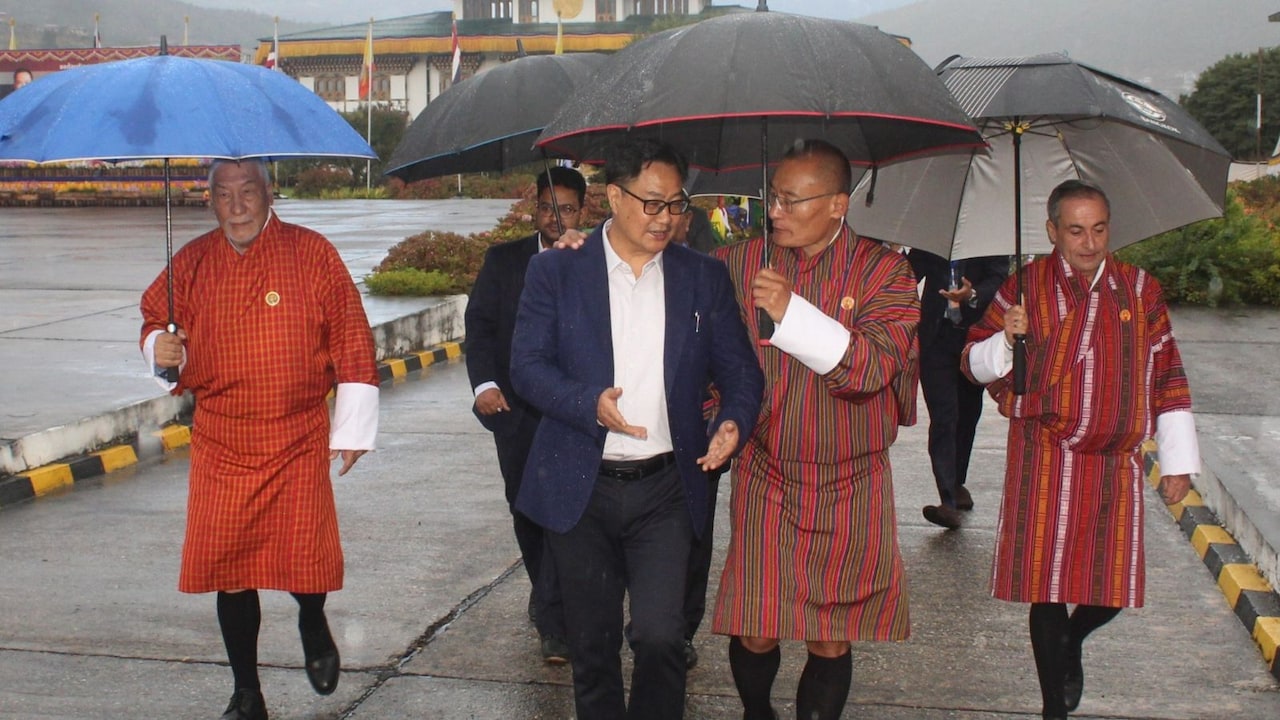
Indian Union Minister Kiren Rijiju and Bhutanese Prime Minister Tshering Tobgay rode together in the same vehicle to attend a stupa construction ceremony, signaling a deliberate, high-trust diplomatic alignment between New Delhi and Thimphu. On the surface, a shared car ride between a visiting cabinet minister and a head of government looks like a simple photo opportunity or a logistical convenience on winding mountain roads. In reality, diplomatic protocol in South Asia rarely leaves seating arrangements to chance, especially when sensitive regional borders and shared cultural heritage intersect.
Diplomacy in the Himalayas operates on a different frequency than the rigid, motorcade-heavy choreography seen in Western capitals. When two senior leaders ditch separate armored sedans for a single cabin, they are sending an unmistakable message to domestic audiences and regional rivals alike. The journey itself becomes the statement.
The Architecture of Informal Diplomacy
State visits are usually suffocating affairs. Every handshake is timed to the second, every press briefing is sanitized by layers of foreign ministry bureaucrats, and physical proximity between principals is strictly rationed. Breaking that script requires mutual confidence.
By riding together to the site of a Buddhist stupa construction ceremony, Rijiju and Tobgay bypassed the usual buffer of aides, translators, and security details. Those twenty or thirty minutes inside a moving vehicle represent unscripted diplomatic real estate. Conversations happen without note-takers hovering nearby. Leaders can test ideas, vent about bureaucratic bottlenecks, or gauge personal chemistry away from the glare of television cameras.
For India, Kiren Rijiju is not just another cabinet official dispatched on a routine foreign trip. As a prominent Buddhist leader from Arunachal Pradesh—a region bordering Bhutan and claimed in part by China—his presence carries layered geographic and cultural weight. He speaks the language of Himalayan Buddhism fluently, both culturally and politically. Putting him in the passenger seat next to Tshering Tobgay underscores a shared identity that predates modern nation-states and border fences.
Why the Stupa Matters
A stupa is never just a pile of stone and mortar. In Vajrayana Buddhism, which shapes the civic and spiritual backbone of Bhutan, a stupa is a physical anchor of legitimacy, spiritual merit, and territorial harmony.
Constructing a stupa requires exact geometric proportions, consecrated relics, and the blessing of high lamas. When political leaders attend a groundbreaking or construction ceremony, they are participating in an ancient ritual of statecraft. They are publicly aligning their temporal authority with spiritual continuity.
- Cultural Continuity: India is the historical birthplace of Buddhism, while Bhutan remains one of the few sovereign nations where Mahayana and Vajrayana traditions govern daily public life.
- Soft Power Projection: New Delhi has spent the past decade actively reclaiming its Buddhist heritage as a diplomatic bridge across Asia, countering regional competitors who attempt to co-opt Buddhist institutions for political influence.
- Local Resonance: For ordinary Bhutanese citizens, seeing an Indian minister participate respectfully in a sacred construction rite registers far deeper than a dry bilateral trade communiqué.
Navigating the Shadow to the North
You cannot analyze any high-level India-Bhutan interaction without looking at the map. Bhutan sits wedged between two Asian giants, acting as a vital geographic buffer. Over the past several years, Beijing has aggressively pushed boundary negotiations with Thimphu, constructing villages in disputed border zones and dangling economic incentives to pull Bhutan closer into its orbit.
Every road paved, every monastery restored, and every joint ceremony held between Indian and Bhutanese officials is watched closely in Beijing. New Delhi knows it cannot take Bhutan's loyalty for granted simply because of a 1949 treaty or decades of hydropower subsidies. Younger generations of Bhutanese citizens want economic diversification, digital connectivity, and global engagement.
India has had to adapt its diplomatic playbook accordingly. The old top-down approach—where New Delhi acted as an overbearing big brother—no longer works in Thimphu. Today, Indian officials have to show up as respectful partners who value Bhutanese sovereignty and cultural autonomy.
Shared car rides and joint religious ceremonies are part of this recalibrated strategy. They project warmth rather than dominance. They suggest a relationship built on equal footing, shared faith, and mutual respect rather than mere strategic dependency.
The Logistics and Optics of Mountain Statecraft
Anyone who has driven through Bhutan knows the terrain dictates the pace of life. The roads twist along steep ridges, hugging cliff faces above glacial rivers. Security protocols in these valleys are inherently intimate. Massive twenty-car motorcades simply do not fit easily through narrow mountain passes or small monastic courtyards.
Yet, leaders still routinely travel separately to maintain strict hierarchy. A Prime Minister rides in the lead vehicle; a visiting minister follows behind. Merging those two bubbles into one vehicle requires deliberate coordination between Bhutan's Royal Bodyguard and India's Special Protection Group or diplomatic security detail.
Security chiefs hate improvised proximity. Combining two high-value targets into a single vehicle doubles the risk profile on narrow mountain roads. The fact that security agencies signed off on the arrangement proves the political directive came straight from the top. Both leaders wanted the image of unity, and they wanted the private transit time.
What Happens When the Cameras Turn Off
Critics of public diplomacy often dismiss these moments as pure theater. They argue that a friendly car ride does not resolve trade deficits, speed up delayed hydropower projects, or settle complex border demarcations. That cynicism misses how power actually functions in small, relationship-driven states.
Bhutan's political establishment is remarkably compact. Decisions move quickly when trust exists at the top, and they stall indefinitely when friction develops between key personalities. Tshering Tobgay, returning to the prime minister's office after a stint out of power, understands the value of personal rapport with New Delhi's inner circle.
Rijiju, having held major portfolios ranging from Law and Justice to Earth Sciences and Parliamentary Affairs, is a trusted troubleshooter for Prime Minister Narendra Modi. When Rijiju travels to a neighboring country, he carries direct access to the top of the Indian government. A private conversation in a car with him is worth three formal summits with mid-level diplomats.
The Economics Behind the Warmth
Beneath the spiritual symbolism and warm optics lies hard economic necessity. Bhutan is currently navigating a delicate economic transition. The country graduated from the United Nations list of Least Developed Countries, a milestone that brings prestige alongside the loss of certain concessional trade benefits and aid packages.
Youth unemployment and outward migration—particularly young Bhutanese moving to Australia and the Middle East for work—have become pressing domestic concerns in Thimphu. To keep its workforce at home, Bhutan is betting heavily on ambitious infrastructure initiatives, most notably the Gelephu Mindfulness City project along the southern border with India.
This massive economic zone aims to attract international investment while adhering to Bhutan's Gross National Happiness principles. However, Gelephu cannot succeed without seamless road, rail, and energy links through neighboring Indian states like Assam and West Bengal.
- Cross-Border Rail Links: India has committed to building the first railway lines connecting Assam to Bhutanese border towns, transforming landlocked trade routes.
- Energy Diversification: Beyond traditional hydropower, both nations are exploring solar energy partnerships and regional power grid integration.
- Digital Infrastructure: Indian tech frameworks are increasingly supporting Bhutan's push toward digital governance and financial inclusion.
When Rijiju and Tobgay attend a stupa ceremony together, they are reinforcing the political goodwill required to push these billion-dollar infrastructure projects through sluggish bureaucracies on both sides of the border. Cultural diplomacy greases the wheels of physical connectivity.
The Counter-Argument A Fragile Balance
Not everyone views this tight embrace without skepticism. Within Bhutan's emerging civil society and online commentary spaces, there is constant debate over how closely Thimphu should align with New Delhi's regional posture.
Some analysts point out that overt displays of closeness with Indian cabinet ministers can complicate Bhutan's delicate border talks with China. Thimphu wants to finalize its northern boundary agreement to secure its territorial integrity without triggering alarm bells in New Delhi. Walking that tightrope requires immense diplomatic agility.
Furthermore, cultural diplomacy has limits. Building stupas and sharing rides generate positive headlines, yet ordinary citizens judge their governments on tangible economic outcomes. If cross-border infrastructure projects suffer from cost overruns or environmental pushback, warm photo opportunities will quickly lose their luster.
India also faces internal pressures along its Himalayan frontier. Managing border infrastructure in Arunachal Pradesh, Sikkim, and Assam requires balancing national security imperatives with local ecological fragility and indigenous land rights. Rijiju knows these pressures intimately from his own constituency.
Reading the Signals in Thimphu
In international relations, small gestures often reveal more than hundred-page policy papers. A formal joint statement tells you what diplomats agreed to publish; a shared car ride tells you how leaders actually feel about working together.
Kiren Rijiju and Tshering Tobgay chose to share space on the way to a sacred monument because both men understand the currency of Himalayan politics. Power here is personal, visual, and deeply rooted in spiritual geography. By stepping out of separate official vehicles and arriving together at the stupa site, they demonstrated that the road between New Delhi and Thimphu remains open, direct, and firmly anchored in shared tradition.