Behind double-gasketed steel doors in a climate-controlled room somewhere in the American Sunbelt, centrifuges spin in total darkness. They turn at speeds so blindingly fast that the outer edges of the carbon-fiber rotors move faster than the speed of sound. A whisper of unbalanced weight—a single speck of dust—would cause the entire assembly to shred itself into supersonic shrapnel.
Thousands of miles away, under a desert sun so fierce it bleaches the horizon into a blinding haze of white, engineers gaze across empty stretches of sand. Beneath those dunes lies a paradox. The region powered the world for a century by burning dark, ancient liquid pumped from deep underground. Now, it wants the power of the atom.
When diplomats sit at mahogany tables to sign document packets bound in thick leather, they rarely talk about the human beings who will feel the tremors of their signatures. They talk in technical acronyms. They debate uranium hexafluoride, non-proliferation frameworks, and megawatt capacities.
Yet, strip away the legalese, and this agreement between the United States and Saudi Arabia isn't about paperwork. It is about power, sovereignty, and the invisible lines that prevent—or cause—the next global flashpoint.
The Chemistry of Fear
To understand why a nuclear agreement makes world leaders sweat in air-conditioned briefing rooms, you have to look at a single element: Uranium-235.
In its natural state, pulled from dark mines in places like Kazakhstan or Canada, uranium is remarkably docile. You can hold a piece of raw ore in your hand. It is heavy, metallic, and cold. More than ninety-nine percent of that rock is Uranium-238, a stable isotope that refuses to split easily. The prize is the remaining fraction—less than one percent—which consists of Uranium-235.
Splitting U-235 releases energy. Splitting millions of them at once heats water, creates steam, spins turbines, and lights up cities.
Here is the trick that keeps intelligence analysts awake at night: the exact same machinery used to create fuel for a power plant can be adjusted to build the core of a weapon. To generate electricity, you need to enrich U-235 to roughly three to five percent. To make a bomb, you need to spin those centrifuges until that concentration climbs past ninety percent.
The technology is identical. Only the runtime changes.
For decades, American foreign policy operated on a simple, rigid principle known as the gold standard of nuclear cooperation agreements. Under Section 123 of the U.S. Atomic Energy Act, Washington offered countries access to American nuclear technology, reactors, and expertise. The catch? The recipient nation had to sign away its right to enrich uranium or reprocess spent fuel on its own soil forever.
They could buy the fuel. They just could not make it.
Saudi Arabia looked at that deal and balked.
For the leaders in Riyadh, accepting a permanent ban on domestic enrichment felt like handing the keys to their energy future over to a foreign power. If you own the reactor but must import the fuel, you remain a customer, vulnerable to sanctions, political whims, and distant blockades. If you enrich the fuel yourself, you are sovereign.
The Quiet Shift in the Desert
Imagine a young Saudi engineer named Tariq—a hypothetical composite of the bright, ambitious technologists currently filling the halls of King Abdullah City for Atomic and Renewable Energy.
Tariq studied thermal hydraulics in Texas. He knows that his nation’s oil reserves, while vast, are an expiring asset. He sees the desalination plants humming along the Red Sea coast, gulping down millions of barrels of crude oil every single day just to purify drinking water for growing cities like Riyadh and Jeddah.
To Tariq and his generation, burning precious oil to distill sea water is madness. It is like burning furniture to heat a mansion when you have an ocean of sunlight and the capability to master nuclear energy.
When Washington insisted on the gold standard, Riyadh began looking around the room. China stood in the corner, offering nuclear hardware with far fewer ideological strings attached. Russia was more than happy to build reactors across the Middle East, just as it had done in Iran.
American negotiators realized they faced a stark, unpleasant reality.
If the United States refused to compromise, Saudi Arabia wouldn't abandon its nuclear ambitions. It would simply buy its reactors from Beijing or Moscow. The United States would lose its leverage, its commercial footprint, and its ability to install high-grade monitoring systems on the ground.
So, the rules of the game began to bend.
The Deal on the Table
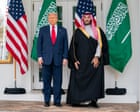
The agreement signed between Washington and Saudi Arabia represents a profound realignment of geopolitical strategy. Instead of demanding a total, non-negotiable ban on domestic enrichment, the U.S. opened a narrow, highly monitored doorway.
Under the framework, the United States agrees to help build the civil nuclear infrastructure that Saudi Arabia craves. In return, Saudi Arabia accepts a regime of inspection and verification so intrusive it makes traditional defense treaties look casual.
Consider what happens next: American firms secure multi-billion-dollar contracts to build state-of-the-art reactors. American inspectors, working alongside international monitors, gain real-time digital eyes inside the facilities.
But the central, throbbing nerve of the deal remains domestic enrichment.
Washington agreed to a path—a sequence of strict, conditional benchmarks—that could eventually allow Saudi Arabia to enrich uranium on its own soil. But there is a catch. The early stages of enrichment will be strictly managed under joint ownership or heavy U.S. technical oversight.
It is a diplomatic tightrope act suspended over a volcano.
If Washington holds the rope too tightly, Riyadh turns East. If Washington lets go of the rope entirely, it risks triggering an atomic arms race across a region already frayed by historical rivalries.
The Domino Effect
Walk through the corridors of power in neighboring capitals, and the anxiety is palpable.
In Tel Aviv, security officials watch every line of the accord. Israel has long maintained a strategic monopoly on nuclear capabilities in the Middle East, a policy of deliberate ambiguity that underpins its defense posture. A nuclear-capable Saudi Arabia—even one focused entirely on electricity—alters the equilibrium.
In Tehran, the reaction is equally sharp. Iran spent decades enduring crushing economic sanctions while spinning its own centrifuges in underground bunkers at Fordow and Natanz. Iranian leaders view any Western willingness to allow Saudi enrichment as a glaring double standard.
This is where the abstract world of diplomacy collides with cold, hard human emotion.
When a nation gains the technical capacity to enrich uranium, it acquires what defense analysts call nuclear latency. It becomes a turnkey state. It may not possess a weapon today, or tomorrow, or next year. But every citizen in the region knows that the distance between a civilian fuel cycle and a military program is measured not in decades, but in months.
Fear spreads faster than radiation. When one country builds a centrifuge facility, its neighbor starts asking for its own.
The Unspoken Risk
We like to believe that treaties are solid things, etched into stone by men in tailored suits. We trust that signatures on parchment can bind the actions of sovereign states decades into the future.
History tells a different story.
Treaties are only as durable as the political weather. Governments fall. Monarchies evolve. Geopolitical alliances that seem unbreakable today can shatter overnight when a new crisis erupts or a new leader takes power.
When you install nuclear infrastructure, you are placing hardware on the ground that will outlive the politicians who authorized it. A nuclear power plant operates for sixty, sometimes eighty years. Centrifuges, once calibrated and operational, do not care who holds office in Washington or who sits on the throne in Riyadh.
They simply spin.
If an international crisis erupts twenty years from now, a facility built for peace can be repurposed in the dark. The inspectors can be expelled. The cameras can be painted over. The joint protocols can be revoked with the stroke of a pen.
That is the invisible cost baked into every line of this landmark deal. It is the price of keeping an ally close, paid in the currency of future risk.
Light in the Dust
Late in the evening, after the press conferences end and the diplomats head to their hotels, the desert returns to quiet.
Out on the plains where the concrete foundations will soon be poured, the wind sweeps across the sand, carrying the smell of salt from the Gulf. Millions of households in the kingdom will eventually draw their light from the heat of splitting atoms. Air conditioners will hum through three-digit summer days. Desalination plants will pour billions of gallons of clean water into dry cities.
It is a vision of progress, clean energy, and modern technological mastery.
Yet, deep within those future containment structures, behind meters of high-density concrete and lead-lined glass, the centrifuges will turn. They will hum with a low, continuous vibration—a sound that carries both the promise of a powered world and the quiet, persistent whisper of catastrophe.
Washington signed the paper because it believed it had no better choice. Saudi Arabia accepted the terms because it refused to be left behind.
Now, the world waits to see whether this deal will be remembered as the triumph of pragmatic diplomacy, or as the moment the desert took its first step into an uncertain atomic dawn.