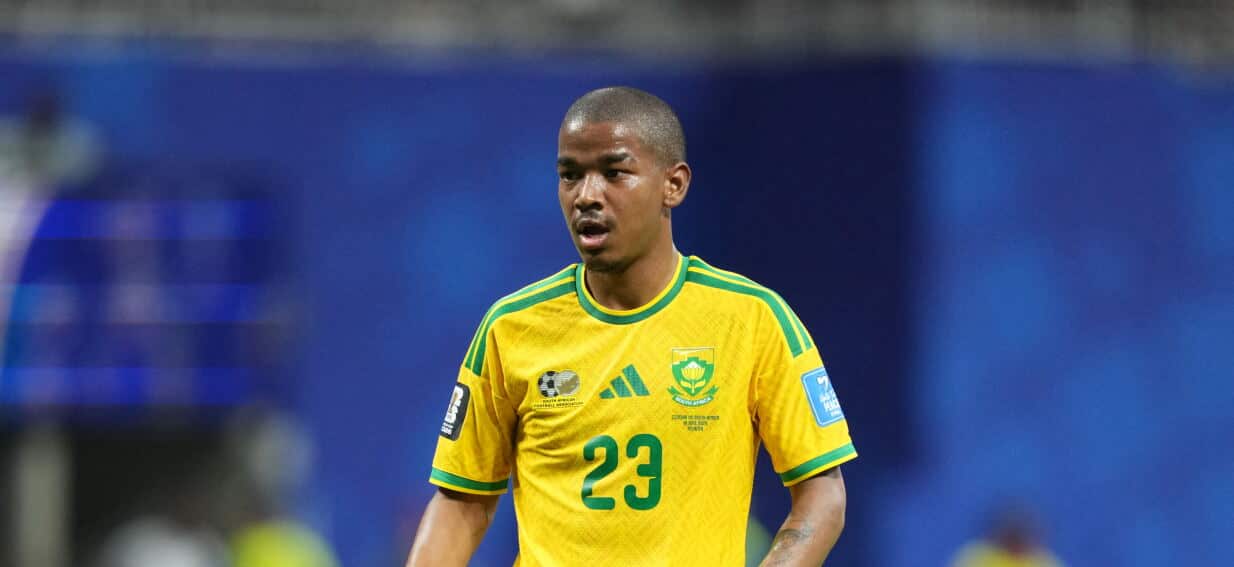
The stadium lights in Stellenbosch do not just illuminate a pitch. They cast long, heavy shadows across the red dust of the Western Cape, shadows that stretch all the way back to the cramped streets of Hanover Park. For a young boy kicking a deflated ball against a concrete wall, those floodlights are the sun. They represent the only warmth that matters.
Jayden Adams knew those shadows. He grew up running right through them.
When news broke that the 25-year-old Stellenbosch FC and Bafana Bafana midfielder had passed away, a sudden, suffocating silence fell over South African football. The dry wires of the news tickers hummed with the standard, sterile language of tragedy: South Africa World Cup midfielder Jayden Adams dies at the age of 25. The cold facts were stamped onto the internet, processed, and filed away.
But death at twenty-five is never just a fact. It is a theft.
To understand what was lost when Jayden stopped running, you have to understand the sheer weight of a football shirt in South Africa. It is not just polyester and sponsor logos. In communities bruised by generational hardship, a football kit is a suit of armor. When a local boy puts on the gold of the national team, he carries the heartbeat of an entire neighborhood on his shoulders. He becomes proof that the concrete walls do not have to be the end of the story.
Jayden was that proof. He was a midfielder who played the game with a rare, spatial intelligence, the kind of player who seemed to see the pitch from a bird's-eye view while moving at a sprint. He was the engine room for Stellenbosch FC, a club that defied the traditional giants of Johannesburg to carve out its own legacy. When he broke into the national squad, earning his place among the elite for the World Cup qualifiers, it felt like the natural trajectory of a rocket that had successfully broken orbit.
Then, the engine stopped.
Consider the anatomy of a midfield. It is the most unforgiving real estate on the grass. The strikers get the glory of the back-to-back backflips and the front-page photographs. The goalkeepers get the dramatic, diving rescues. But the midfielder lives in the mud and the traffic. They are the translators, turning a desperate defensive clearance into a soaring, elegant attack. Jayden was a master of this translation. He possessed a low center of gravity and a first touch that felt like velvet on a rainy Wednesday night.
Imagine standing in the tunnel before a massive fixture. The air is thick with the smell of wintergreen rub and deep heat. The stadium structure vibrates above you from the stamping feet of forty thousand partisan fans. In that tunnel, the professional facade drops away. You look at the man next to you. You see the pulse throbbing in his neck. You realize that beneath the bravado, everyone is just a kid from somewhere, terrified of letting down the people who bought a ticket with their last bit of grocery money.
Jayden carried that awareness into every tackle. He was not a flashy player who demanded the cameras follow his every step. Instead, he was the teammate who covered the extra three yards when the left-back was caught out of position. He was the one who took the tactical foul, absorbing the bruising impact so the team could reset its lines.
The grief that has rippled through the Premier Soccer League since his passing is not the performative sorrow of corporate press releases. It is the raw, unvarnished shock of young men who suddenly realize their own mortality. Footballers in their twenties feel immortal. Their bodies are finely tuned machines, calibrated for maximum output, monitored by GPS vests and heart-rate straps. They eat according to spreadsheets and sleep according to algorithms.
When the machine fails anyway, the illusion of control shatters.
The locker room at Stellenbosch FC sits empty now, the silence loud enough to make your ears ring. A jersey hangs from a peg, smelling faintly of detergent and old sweat, waiting for a man who will never walk through the double doors again. His teammates face the impossible task of laced boots and training cones, knowing that the loudest voice in the tactical huddle has been permanently muted.
The tragedy of a young athlete’s death leaves a unique scar on the public consciousness. We look at them and see the absolute peak of human capability. We project our own hopes of escape, of excellence, of triumph onto their young shoulders. When they fall, it feels as though a law of nature has been broken. The ball should keep rolling. The whistle should only blow after ninety minutes.
But the universe does not keep time with a referee's watch.
The streets of Hanover Park will remember him not as a statistic on a sports website, nor merely as a name printed on a squad sheet for a global tournament. They will remember the boy who kept his feet when the ground beneath him was shifting. They will remember the kid who made it out, not by forgetting where he came from, but by carrying every single soul from those streets out onto the grass with him.
The floodlights at the stadium will turn on again this weekend. The green expanse will be rolled out like a stage. The whistle will blow, the boots will crunch against the turf, and the game will demand its tribute of sweat and focus. The world moves on because it must, because the schedule dictates that the fixtures must be fulfilled.
But as the midfielders take their positions in the center circle, looking out over the white lines, there will be a patch of grass that feels just a little bit heavier, a little more sacred, where a boy from the Cape once showed the world how to fly.


