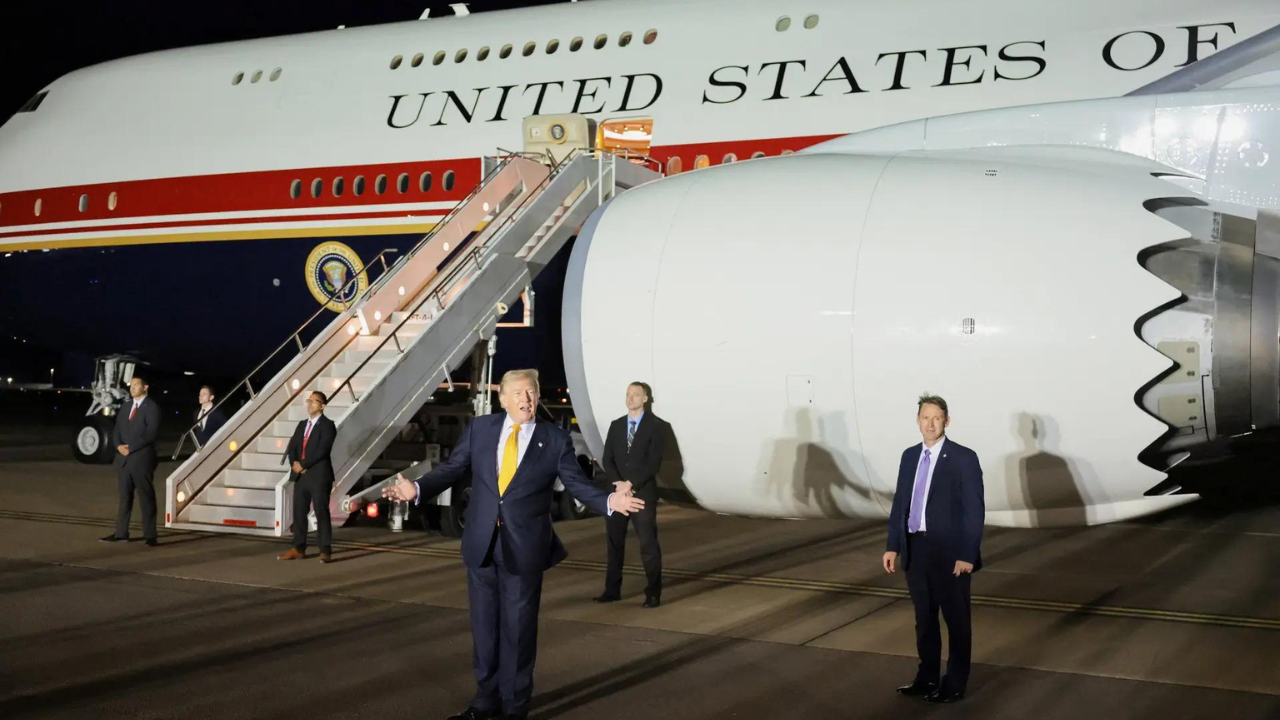
Steel has a voice before it ever leaves the hangar. It groans under its own immense weight, a low, metallic shifting that sounds less like engineering and more like the breath of a sleeping beast. When a wide-body aircraft sits on an apron, waiting, it commands space. It demands respect.
Now imagine a gift. Not a gold watch. Not a ceremonial dagger housed in velvet. A Boeing 747. Four engines. Double-decked. A palace carved out of aluminum and composite materials, offered by a foreign government to the United States. And more specifically, to Donald Trump.
Air travel at the highest level of statecraft is never just about transportation. It is a moving embassy. It is a sovereign bubble cutting through the stratosphere at six hundred miles per hour, insulated from the friction of foreign soil. Every bolt, every wire, every encrypted terminal inside that cabin tells a silent story about trust. Or the lack of it.
When the news broke that the former president intended to utilize a luxury Boeing 747 gifted by Qatar for international journeys, the immediate reaction in Washington was predictable. Eyebrows arched. Briefing papers were shuffled with nervous urgency. Telephones buzzed late into the night. Security analysts, people whose entire professional lives are spent worrying about invisible threats hiding in plain sight, felt a cold knot form in their stomachs.
Because you do not simply accept a jumbo jet from a foreign power and fly it across oceans.
Let us walk through what happens when an aircraft enters the possession of a head of state. Think of a hypothetical aerospace engineer named Marcus, a veteran of Air Force One maintenance programs who spent thirty years chasing ghosts inside wiring bundles. Marcus has retired now, but his phone still rings when the impossible is proposed. If you bring a foreign-built, foreign-owned aircraft into the American presidential fleet—or even use it in a private capacity that mimics state travel—you are inviting a Pandora's box of vulnerabilities.
Every inch of skin on that fuselage has to be stripped. Not metaphorically. Literally. Every seat torn out. Every bulkhead drilled into. Every inch of copper wire scanned for micro-transmitters, passive listening devices, and hidden routing paths that could broadcast the private thoughts, whispered conversations, and secure communications of an American leader to a receiver thousands of miles away.
Foreign intelligence services do not need to plant a bomb to win. They just need an ear pressed against the aluminum hull.
The security concerns are not born of paranoia. They are born of history. During the Cold War, embassies were built with listening devices baked into the bricks. Modern espionage has simply graduated to the skies. A Boeing 747 gifted by a Gulf nation carries immense diplomatic weight, but it also carries questions that money cannot answer. Who touched the flight control computers during assembly? What code was written into the navigation software before the ribbon was cut? Can you ever truly scour a machine clean of its origins?
The answer, whispered in the dim corridors of the Pentagon and the intelligence agencies, is unsettling. You can try. You can spend tens of millions of dollars and years of painstaking labor tearing the bird apart and putting it back together. But doubt remains. Doubt is a heavy passenger.
Yet, the allure of the 747 is intoxicating. There is a reason the Queen of the Skies has captured the human imagination for half a century. It is majestic. Its iconic hump gives it the silhouette of a bird of prey. To step onto a private 747 is to step into a realm of absolute detachment from the mundane world of crowded terminals and delayed commercial flights. For a figure like Trump, who has always equated scale with power, a massive wide-body jet is the ultimate architectural expression of influence. It is a floating billboard for personal brand and global reach.
The friction between the aesthetic of supreme power and the gritty reality of national security creates a fascinating tension. On one side stands the desire for unbridled luxury, speed, and the sheer audacity of flying in a gifted palace. On the other side stand the guardians of the state, the men and women who view every foreign object through the lens of worst-case scenarios.
Consider the logistical nightmare as well. The official presidential fleet, known as VC-25A and soon to be replaced by the heavily delayed VC-25B, is a marvel of defensive engineering. These planes are essentially flying nuclear bunkers, equipped with advanced countermeasures, electromagnetic pulse hardening, and communications suites that defy interception. A commercial-grade 747, even one outfitted with opulent staterooms and golden fixtures, lacks those invisible shields. To fly internationally in such a craft is to step outside the impenetrable armor that protects American leadership, trading sovereign security for custom upholstery.
And yet, the machine sits there, gleaming under the tarmac lights.
We live in an era where symbols often overpower substance. A handshake on television matters more than a treaty draft. A plane with the right silhouette projects dominance before it ever touches down on foreign soil. The Qatari gift represents that exact intersection of symbolism and pragmatism, wrapped in a diplomatic gray area that defies easy categorization.
When you look up at the sky and see a white streak trailing across the blue, you are seeing more than aluminum and jet fuel. You are seeing ambition. You are seeing the compromises nations make, and the risks individuals are willing to take for the sake of motion. Whether those wings carry a legacy of triumph or a quiet, unrecognized vulnerability is a question that time alone will answer. But as the engines spool up and the tarmac begins to blur, the rest of the world can only watch and wonder who is truly piloting the journey.


