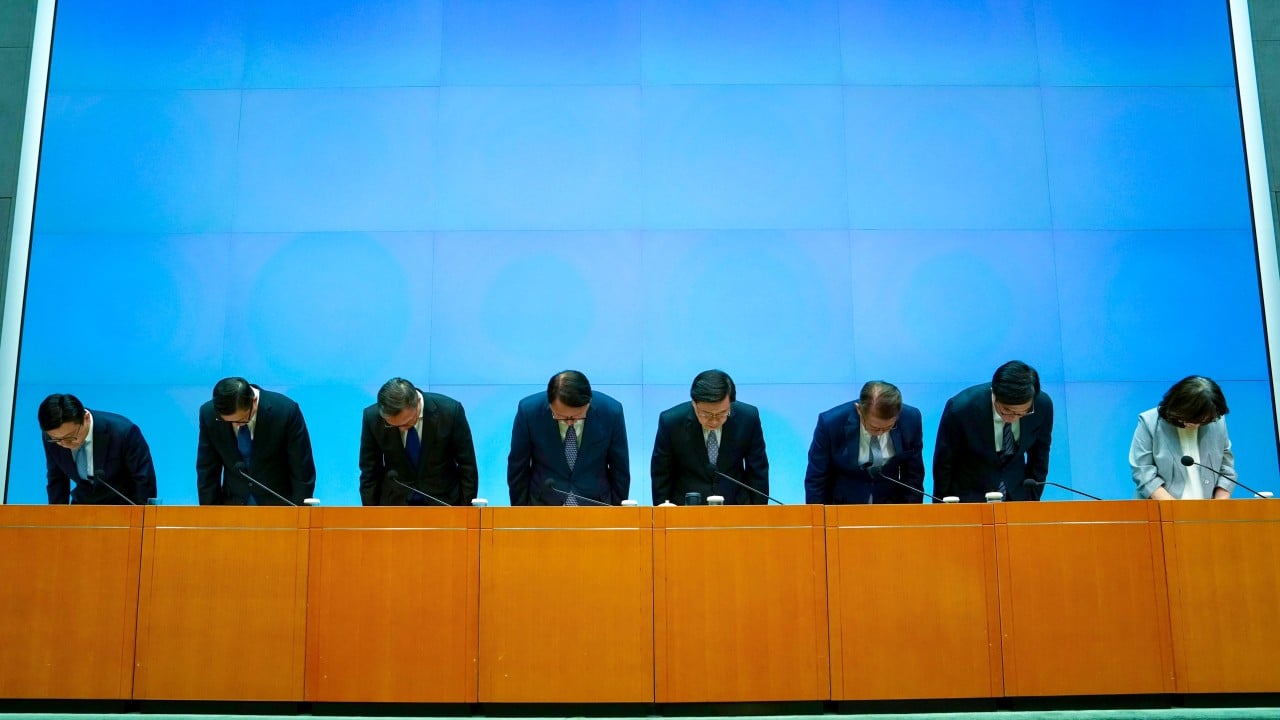
They want you to believe a resignation fixes a fire. They want you to think that when Secretary for Housing Winnie Ho steps down and a government spokesman utters the magic words—"decades of failure"—the slate is wiped clean.
It is not. That admission is the oldest trick in the bureaucratic playbook.
When an administration blames "decades of failure" for a fatal blaze in Tai Po, it is executing a calculated deflection. By spreading the guilt across thirty or forty years of unnamed predecessors, retired civil servants, and dead policymakers, the current leadership achieves total immunity. Nobody currently holding a pension or a corner office in Central has to answer for what happened last Tuesday. You cannot prosecute a decade. You cannot fire an era.
Mainstream coverage treats Ho’s exit as a rare moment of political conscience. That is a fairy tale for people who have never sat inside a municipal planning meeting or audited a public housing maintenance contract. In the world of urban governance and high-density real estate, a ministerial resignation after a tragedy is rarely an act of contrition. It is a pressure-release valve. The public gets a head on a platter, the media gets a clean narrative arc, and the underlying machinery that allowed the fire to happen remains completely untouched.
The Theatre of the Scapegoat
Look closely at the anatomy of a high-profile political exit in Hong Kong. The script never changes. First comes the shock. Then comes the carefully worded expression of deep sorrow. Finally, when the public anger threatens to spill over into structural scrutiny, a senior official falls on their sword.
I have spent fifteen years analyzing urban infrastructure policy and municipal risk management across East Asia. I have watched billion-dollar remediation budgets evaporate into administrative black holes while frontline inspectors are starved of basic enforcement authority. When a department head resigns, the immediate aftermath is always the same: paralysis.
Every ongoing safety audit stalls while the bureau awaits a new leader. Procurement approvals freeze. Mid-level directors spend six months rewriting briefing papers to bring the incoming secretary up to speed, rather than inspecting aging electrical risers or clearing obstructed fire escapes in the New Territories. By demanding—and celebrating—Winnie Ho’s resignation, critics have accidentally handed the Housing Bureau a six-month moratorium on actual work.
The lazy consensus says a leader must take responsibility for failures on their watch. Real accountability looks entirely different. Real accountability forces the person who oversaw the failure to stay at their desk, strip down the broken procurement rules, fire the negligent contractors, and fix the mess under brutal public scrutiny. Walking away is easy. Staying to dismantle a rotten bureaucracy is hard.
Why "Decades of Failure" Is a Lie
Let us dissect the phrase the government used to explain away the Tai Po tragedy: "decades of failure."
It sounds humble. It sounds honest. In reality, it is a sophisticated legal and political shield.
To understand why, you have to understand how public housing and aging private-public hybrid estates operate in districts like Tai Po. Built largely during the massive New Town expansion waves of the 1970s and 1980s, these estates were engineered for rapid population absorption, not fifty-year lifecycle durability. Every urban planner in the city has known since the late 1990s that the wiring, plumbing, and fire-suppression infrastructure of these first-generation New Town blocks were approaching terminal obsolescence.
Calling this "decades of failure" implies a passive, continuous drift—as if nobody noticed the buildings were getting older. That is false. The deterioration was documented in thousands of internal engineering assessments, Buildings Department circulars, and Legislative Council panel papers.
The failure was not passive. It was an active, recurring choice made in every single annual budget cycle.
Successive administrations chose to prioritize headline-grabbing mega-projects—artificial islands, cross-border rail links, gleaming cultural districts—over the unglamorous, vote-neutral grind of rewiring forty-year-old concrete towers. You do not get a ribbon-cutting ceremony for replacing corroded fire mains in a Tai Po housing estate. You do not get international investor applause for subsidizing fire-rated doors for low-income tenants.
So the money went elsewhere. The regulatory enforcement was softened to avoid triggering politically inconvenient eviction notices or massive special levies on elderly flat owners. When the inevitable happened in Tai Po, blaming "decades" allowed the current administration to pretend they inherited an unsolvable historical curse, rather than a budget line item they actively underfunded last year.
The Fatal Flaw in Public-Private Maintenance
If you want to understand why Tai Po burned, stop looking at the Secretary for Housing and start looking at the Tenants Purchase Scheme and the fragmentation of building ownership.
This is the nuance every surface-level news report misses.
In the late 1990s, the government decided to offload maintenance liabilities by selling public rental flats to sitting tenants at steep discounts. On paper, it was a wealth-building miracle. In practice, it created a governance nightmare that fire safety engineers have been screaming about for twenty years.
When a housing block is 100% government-owned, the Housing Authority has unilateral control over structural repairs, fire door replacements, and corridor clearance. The moment you sell 60% of those flats to individual owners while the government retains 40% for remaining rental tenants, you create a paralyzed hybrid.
Suddenly, every major fire-safety upgrade requires the consent of an Incorporated Owners committee. Many of these committees are dominated by elderly residents on fixed incomes who cannot afford a HK$50,000 per-unit levy for mandatory fire safety retrofits. Others are plagued by bid-rigging syndicates that inflate renovation costs by 300%, paralyzing the building in endless litigation while the fire alarms remain disconnected and the smoke vents stay rusted shut.
Imagine a scenario where a Buildings Department inspector issues a mandatory Fire Safety Direction to a mixed-ownership block in Tai Po. The Incorporated Owners cannot agree on a contractor. Two years pass. The inspector issues a fine of a few thousand dollars—less than the cost of hiring a scaffolding company. Another three years pass. The government refuses to step in and execute the works by default because the legal cost of recovering the money from hundreds of individual titleholders is too high.
That is not a leadership failure at the top of a ministry. That is a structural cancer embedded in property law and municipal finance. Winnie Ho could have been the most brilliant housing administrator in human history, and she still would have hit a brick wall every time she tried to force a cash-strapped owners' corporation to upgrade a 1982 sprinkler system.
Dismantling the Wrong Questions
Whenever a tragedy like this strikes, public discourse immediately defaults to predictable, useless questions. Let us look at what people are asking right now—and why those questions guarantee another fire within five years.
Did the Housing Bureau ignore warnings about Tai Po?
Yes, obviously. Every municipal department in every major metropolis sits on thousands of unaddressed hazard warnings. Asking if they knew is a waste of breath. The real question is why the statutory framework allows a known fire hazard to remain unresolved for seven years after an inspection notice is issued without triggering automatic state intervention.
Will the new housing chief prioritize building safety?
Every incoming official promises to prioritize safety during their first press conference. Six months later, they are judged by their KPIs: land supply, public housing completion targets, and waiting-list reductions. In Hong Kong, housing chiefs are promoted or fired based on how many new units they build, never on how many old units they keep from burning down. Until the performance metrics of the Housing Bureau penalize maintenance backlogs as harshly as construction delays, nothing changes.
Should the government simply pay for all fire upgrades in older estates?
Here is the uncomfortable truth nobody wants to say out loud: blanket subsidies destroy market discipline and reward negligence. If the state steps in with a blank check every time an owners' corporation refuses to maintain its property, responsible building owners who paid out of pocket for their own fire retrofits are penalized, while negligent committees are rewarded. Worse, state-funded renovation grants immediately attract predatory engineering consultancies that siphon off public money through inflated tender bids.
The Uncomfortable Fix Nobody Wants to Hear
If we actually care about preventing the next Tai Po, we need to abandon the comforting fantasy that a change in personnel equals a change in outcomes. Real reform requires brutal, unpopular interventions that will anger property owners, contractors, and civil servants alike.
First, abolish the consent threshold for life-safety retrofits in hybrid estates. If a building fails a statutory fire inspection, the government must have the unilateral legal authority to enter the premises, execute the repairs using pre-vetted, salaried municipal engineering teams—not third-party tender contractors—and slap a non-negotiable statutory charge onto the property deeds. If an owner cannot pay, the debt sits against the title until the flat is sold or transferred. No committees. No years-long tender disputes. No bid-rigging.
Second, decouple building safety enforcement from the Housing Bureau entirely. Having the same ministry responsible for both building new public housing and policing the safety of existing stock creates an inherent conflict of interest. You cannot ask the developer to be the building inspector. Enforcement needs to sit inside an independent statutory body with the power to fine government departments just as aggressively as private landlords.
Third, accept the political cost of condemnation. Some of the first-generation New Town blocks built in the 1970s are beyond economical repair. Their floor plates are too narrow for modern smoke extraction, their concrete is suffering from advanced carbonation, and their electrical conduits cannot handle modern appliance loads. Pouring tens of millions into patching them up is throwing good money after bad. They need to be systematically condemned, cleared, and rebuilt—even if that temporarily disrupts housing supply statistics.
There is a massive downside to this approach, and anyone pretending otherwise is lying to you. Stripping owners' corporations of control over safety repairs will trigger massive political pushback from property rights advocates and elderly resident groups. Condemning aging blocks will temporarily lengthen the public housing waiting list—a metric that politicians treat as sacred. It is messy, expensive, and guaranteed to make whoever implements it deeply unpopular.
Which is precisely why it will not happen.
Instead, we get a polite resignation letter, a solemn press conference admitting "decades of failure," and a fresh face at the podium promising a comprehensive review. The media will move on to the next news cycle by next month. The Buildings Department will print a few thousand new safety pamphlets. And somewhere in the New Territories tonight, an overloaded electrical riser behind a locked corridor door is quietly overheating.