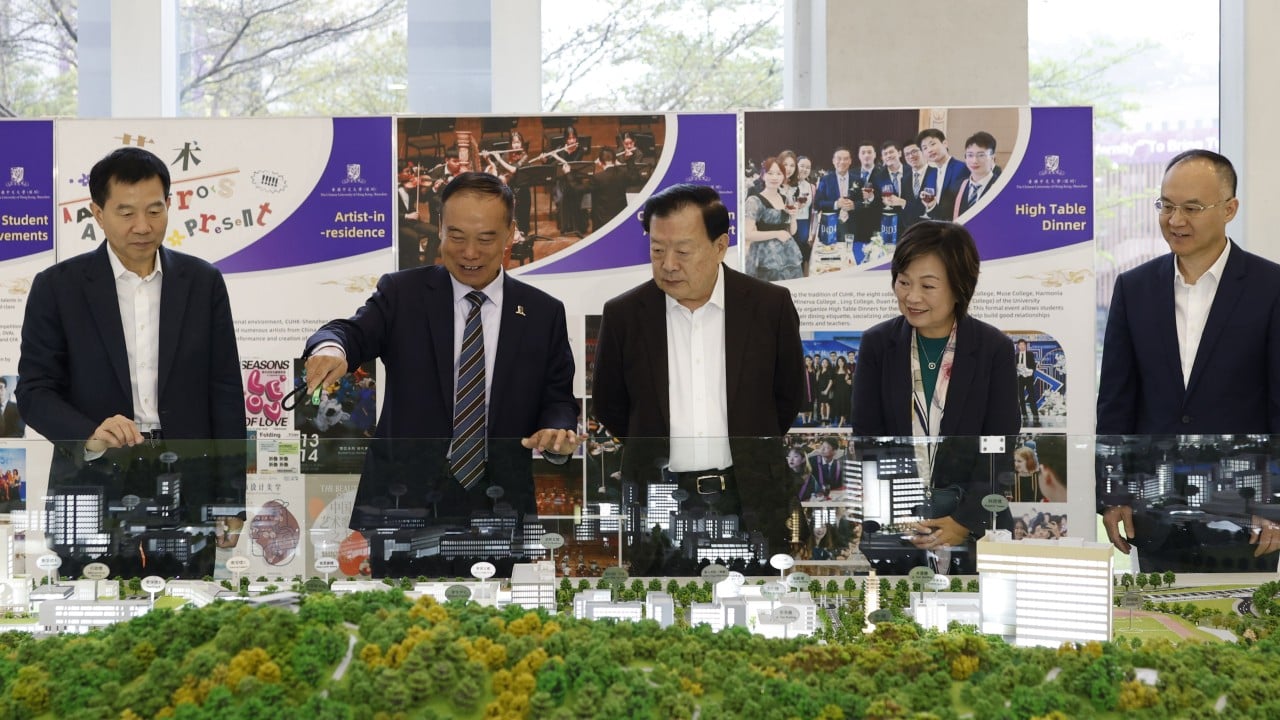
When Beijing’s top official for Hong Kong affairs shows up on a university campus in Shenzhen, you shouldn't treat it as a routine photo op. On November 20, 2026, Xia Baolong—director of both the Hong Kong and Macau Affairs Office (HKMAO) and the Central Hong Kong and Macau Work Office—walked the grounds of the Chinese University of Hong Kong, Shenzhen (CUHK-Shenzhen).
He didn't go alone. Beside him were HKMAO deputy directors Xu Qifang and Nong Rong, along with Hong Kong’s Secretary for Education, Christine Choi Yuk-lin. After listening to a briefing from founding president Xu Yangsheng, Xia endorsed the university’s direction and urged it to use its "unique strengths" to better serve the Guangdong-Hong Kong-Macao Greater Bay Area (GBA). Don't miss our recent article on this related article.
Most news briefs summarize this in three sentences and move on. That's a mistake. If you want to understand where higher education, cross-border research, and regional industrial policy are heading in southern China, this specific inspection tells you almost everything you need to know.
What Actually Happened During the November 2026 Inspection
Official readouts from the HKMAO are famously economical with words, so you have to read the lineup in the room to see the real intent. To read more about the background here, The Washington Post provides an informative breakdown.
Bringing Hong Kong’s Education Secretary across the border to a Shenzhen campus signals that Beijing views Hong Kong’s universities not as isolated local institutions, but as regional economic engines. Xia’s message to Xu Yangsheng was clear. Keep doing what makes this joint-venture campus distinct, and plug that capacity directly into the GBA's broader development push.
Look at the timing, too. The visit landed right after major regional economic gatherings in Shenzhen and Hong Kong, and while Hong Kong is rolling out its own Northern Metropolis University Town across the border. CUHK-Shenzhen isn't an experiment anymore. Approved by China’s Ministry of Education in March 2014 as a partnership between CUHK and Shenzhen University, it has had twelve years to prove whether a Hong Kong academic model can survive—and scale—on mainland soil.
Xia’s presence confirms Beijing thinks the model works. More importantly, it tells other Hong Kong universities building branch campuses in Guangzhou, Dongguan, and Zhuhai what the central government expects back for the land and capital it's pouring into them.
The "Unique Strengths" Behind the CUHK-Shenzhen Model
Politicians love vague phrases like "unique strengths". In CUHK-Shenzhen’s case, though, the phrase points to concrete structural differences that separate it from standard mainland universities.
One Brand, Two Campuses, Global Standards
CUHK-Shenzhen operates under what the institution calls a "one brand, two campuses" framework. Students enrolled in Longgang District don't just get a mainland graduation certificate. When they meet degree requirements, they receive an actual degree awarded by the Chinese University of Hong Kong, with "Shenzhen" noted on the parchment.
Why does that matter for GBA growth? Because talent follows credentials that travel well.
- English-medium instruction: Aside from physical education and Chinese language classes, courses are taught in English. That lowers friction for international faculty and prepares graduates to work across global supply chains.
- Global faculty recruitment: Instead of relying solely on domestic hiring pipelines, the university recruits professors internationally, bringing overseas lab experience directly into Guangdong’s manufacturing belt.
- Residential college system: Following the tradition of its Sha Tin parent campus, CUHK-Shenzhen organizes student life around eight residential colleges—including Shaw, Muse, Diligentia, Harmonia, Ling, Minerva, Duan Family, and the Eighth College—blending general education with specialized technical training.
As of April 2026, more than 12,000 undergraduate and postgraduate students study on the roughly two-million-square-meter campus. That scale gives Shenzhen something it historically lacked despite its breakneck economic rise—a deep, internationally connected academic anchor.
Solving Guangdong’s Higher Education Bottleneck
Here is a fact people outside the region often miss. Guangdong is China’s manufacturing powerhouse and largest provincial economy, yet for decades it lagged behind Beijing, Shanghai, Jiangsu, and Zhejiang in top-ranked universities.
According to analysis from Times Higher Education, the Greater Bay Area packs a population larger than Germany's into a compact cluster of 11 cities, yet historically had almost no universities inside major global top-100 rankings on the mainland side. Meanwhile, just across the Shenzhen River, Hong Kong boasts five universities ranked in the global top 100.
The GBA's core challenge has always been a mismatch. Hong Kong has world-class basic research and global academic networks, but tiny local markets and high operating costs. Shenzhen and the Pearl River Delta have massive industrial capacity, venture capital, and hardware supply chains, but needed top-tier research universities to move up the value chain.
CUHK-Shenzhen sits right on that fault line. It acts as a translation layer between Hong Kong’s academic governance and Shenzhen’s industrial speed.
Where the Rubber Meets the Road in 2026
You can't build a regional economy on undergraduate lectures alone. What makes Xia Baolong’s 2026 visit notable is how aggressively CUHK-Shenzhen has expanded into applied, high-priority sectors over the past two years.
Look at three recent moves that explain why Beijing is paying close attention:
- The School of Artificial Intelligence: Launched in February 2025, this became the university's eighth academic school, joining Management and Economics, Science and Engineering, Humanities and Social Science, Data Science, Music, Medicine, and Public Policy. By September 2026, the school was welcoming new cohorts focused on intelligent computing, embodied intelligence, generative AI, and cognitive science. In a city home to major tech hardware and software giants, training AI researchers under an international curriculum feeds directly into local R&D labs.
- A 3,000-Bed Academic Medical Center: Healthcare and biotech sit near the top of GBA policy priorities. CUHK-Shenzhen opened its School of Medicine in 2021, adapting Hong Kong’s clinical curriculum for the mainland while weaving AI education across all six years of training. Right alongside it, the 3,000-bed Grade 3A CUHK-Shenzhen Medical Centre began its soft opening in late 2025 and moved toward full completion by the end of 2026.
- Clinical Scale That Hong Kong Can't Match: Why build a massive hospital in Shenzhen when Hong Kong already has elite medical schools? Numbers tell the story. Hong Kong records roughly 30,000 births a year, compared with nearly 10 million across the Chinese mainland. As CUHK researchers have pointed out regarding breakthroughs like non-invasive prenatal testing (NIPT), mainland clinical scale provides vastly richer data and faster real-world validation for medical technologies invented in Hong Kong labs.
What Most Coverage Gets Wrong About Cross-Border Campuses
If you read standard press releases, cross-border education sounds effortless. Everything is win-win. Every collaboration produces instant breakthroughs.
Anyone who has actually worked across the Hong Kong-Shenzhen boundary knows better. Friction is real, and ignoring it leads to bad strategy.
First, regulatory systems still don't align neatly. Because China’s Ministry of Education treats Hong Kong as a separate jurisdiction for higher education administration, Hong Kong universities can't simply open solo branches on the mainland. They require mainland partner institutions. Research funding, cross-border data flows, biological sample transfers, and intellectual property ownership still run into complex compliance hurdles between Hong Kong’s common-law environment and mainland regulatory frameworks.
Second, there's a real debate inside Hong Kong about brain drain versus brain gain. Critics in Hong Kong occasionally worry that pouring top faculty and leadership bandwidth into Shenzhen, Guangzhou (HKUST-GZ), or Dongguan (CityU-Dongguan) could dilute the academic focus of the home campuses. Defenders counter that without mainland space, clinical volume, and manufacturing partners, Hong Kong’s professors hit a ceiling where great papers never become commercial products.
Third, money and physical bottlenecks haven't vanished. Even with municipal governments in Guangdong subsidizing land and construction, sustaining English-medium, internationally competitive faculty salaries requires relentless fundraising and tuition management. Meanwhile, on the Hong Kong side, the government’s push to build its own 300-hectare Northern Metropolis University Town across San Tin, Hung Shui Kiu, and Ta Kwu Ling faces sharp questions over student housing shortages and slow land development timelines.
Xia Baolong’s inspection doesn't magically erase those administrative headaches. What it does is give university leaders political backing when they negotiate with local bureaus to clear red tape. When the director of the HKMAO publicly affirms a school's direction, provincial and municipal officials take notice.
How This Connects to Hong Kong’s Northern Metropolis Push
You shouldn't view CUHK-Shenzhen in isolation from what's happening a few kilometers south in Hong Kong’s New Territories.
Under the Hong Kong 2026 Policy Address, the Northern Metropolis—which accounts for roughly one-third of Hong Kong’s land area and projected population—is shifting from blueprint to active execution. A centerpiece of that plan is the Northern Metropolis University Town, with initial campus site applications opening in Hung Shui Kiu in late 2026.
Look at the symmetry here. For twelve years, Hong Kong exported its university governance north into Shenzhen to help Guangdong build research capacity. Now, Hong Kong is building dedicated university towns near the Shenzhen border—right next to the Hetao Shenzhen-Hong Kong Science and Technology Innovation Co-operation Zone—to pull industry, applied research, and international talent back into its own northern districts.
CUHK-Shenzhen effectively served as the prototype. It proved that joint governance, bilingual campus culture, and industry-linked research institutes could operate without losing international academic credibility. As Hong Kong universities bid for sites in Hung Shui Kiu and San Tin, they're borrowing directly from the playbook CUHK-Shenzhen wrote in Longgang.
Practical Takeaways for Researchers, Students, and Businesses
If you're tracking the Greater Bay Area for academic partnerships, talent recruitment, or R&D expansion, Xia Baolong’s visit is a clear signal to adjust how you look at the region.
- For tech and biotech companies: Stop treating Hong Kong universities and mainland manufacturing hubs as separate sourcing tracks. Look at joint translational platforms—like CUHK-Shenzhen’s AI and medical ecosystems or the Hetao co-operation zone—where early-stage IP developed under Hong Kong governance can access mainland clinical trials and hardware prototyping.
- For prospective students and academics: Pay close attention to joint-venture campuses that award home-campus degrees while embedding students in mainland industry clusters. With Beijing actively backing these institutions, funding for postgraduate labs in AI, robotics, public policy, and biomedical engineering is concentrating heavily in these cross-border hubs.
- For policy watchers: Watch the follow-through over the next six months. High-level HKMAO inspections in Shenzhen typically precede specific policy tweaks around cross-border data sharing, research grant portability, or talent visa facilitation.
Beijing isn't asking CUHK-Shenzhen to become just another mainland university. The entire point of Xia Baolong’s message is that the campus is valuable precisely because it stays hybrid, international, and wired into Hong Kong—and that’s the exact blueprint now shaping higher education across the Greater Bay Area.