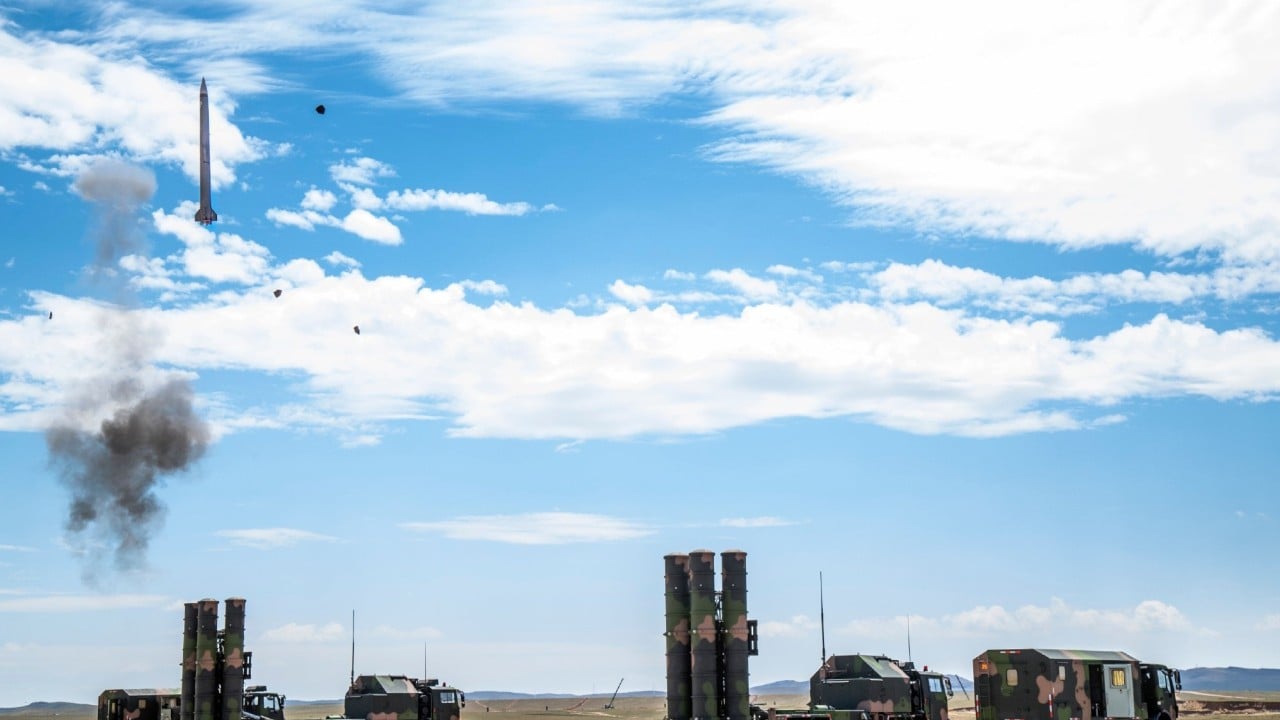
Most defense coverage treats Chinese military drills like routine parades, missing the actual engineering shifts happening under the hood. When reports surfaced that China's HQ series air defense systems intercepted two new missile types during People's Liberation Army live-fire exercises, the headlines barely scratched the surface.
Look closer at those tests. You aren't just seeing another generic target practice in the Gobi Desert or over the Bohai Sea. You're watching the PLA stress-test a layered shield designed specifically to neutralize modern Western standoff munitions and hypersonic threats. If you found value in this piece, you should check out: this related article.
Why These Two New Intercepts Matter Right Now
Air defense isn't static. For decades, China's Red Banner—or Hong Qi (HQ)—family relied heavily on Soviet-era DNA, starting with reverse-engineered SA-2 Guideline designs in the 1960s and later incorporating Russian S-300 and S-400 architectures. That era is over.
When PLA Air Force and Rocket Force units test HQ batteries against two previously unannounced target profiles, they're validating seeker software and kinetic kill vehicles against low-observable cruise missiles and high-speed tactical ballistic threats. Modern warfare doesn't give radar operators ten minutes to think. You get seconds. For another angle on this event, refer to the latest coverage from The New York Times.
Honestly, the hardware itself is only half the story. Anyone can build a fast rocket motor if they throw enough money at solid propellants. The real breakthrough lies in sensor fusion—getting long-range early warning radars to hand off targeting data seamlessly to terminal interceptors without human bottlenecks.
Breaking Down the HQ Family Layers
If you want to understand what just happened on that test range, you have to stop thinking of the "HQ series" as a single weapon. It's an overlapping web of distinct systems, each covering a specific altitude and range bracket.
- HQ-9 and HQ-9B: This is China's heavyweight long-range workhorse, roughly analogous to the American Patriot PAC-3 or Russian S-400. With active radar homing and ranges pushing past 250 kilometers on newer variants, it's built to swat down high-altitude aircraft and incoming ballistic warheads.
- HQ-16 and HQ-16FE: The medium-range brawler. Mounted on tracked or wheeled chassis, these systems travel with ground forces to knock out low-flying cruise missiles, helicopters, and precision-guided bombs.
- HQ-19 and HQ-29: The exo-atmospheric and high-altitude specialists. Defense analysts at organizations like the Center for Strategic and International Studies (CSIS) closely track the HQ-19 as China's direct answer to the U.S. THAAD system, built specifically for mid-course and high-terminal ballistic missile defense.
- HQ-17A: Short-range point defense. Tracked, fast, and heavily automated, it protects high-value assets from saturation drone swarms and incoming artillery rockets.
Testing against two new target types means the PLA is forcing these different tiers to talk to each other under simulated electronic warfare conditions. If a stealthy sea-skimming cruise missile slips past an HQ-9's radar horizon, an HQ-16 battery needs that track file instantly.
The Shift From Single Batteries to Networked Kill Webs
Here's what I've noticed tracking PLA modernization over the last decade: Western commentators obsess over range numbers, while Chinese military planners obsess over kill-chain resilience.
A single radar site is a giant magnet for anti-radiation missiles. If your HQ-9 battery turns on its fire-control radar, every electronic intelligence aircraft within four hundred miles sees it light up like a Christmas tree.
To survive, the PLA has spent years practicing distributed engagement. An airborne early warning aircraft like the KJ-500 or an over-the-horizon ground radar detects the incoming target. It beams the coordinates via encrypted data links to a silent HQ launcher sitting miles away. The missile launches cold, flies toward the predicted intercept box, and only activates its onboard seeker during the final seconds of flight.
That's why intercepting two new missile types is such a big deal. Different target profiles require wildly different terminal guidance algorithms. A maneuvering supersonic cruise missile behaves nothing like a plunging ballistic warhead. Updating the onboard seeker software to recognize, classify, and hit two unfamiliar threat signatures proves China's defense industrial base is iterating software at a rapid clip.
What the PLA Is Actually Practicing Against
Let's be direct about the geopolitical reality driving these tests. The PLA isn't burning expensive solid-fuel interceptors in the desert just for state television footage. Every target drone launched on those ranges represents a specific threat they expect to face in a regional conflict.
Low-Observable Cruise Missiles
Think about the U.S. AGM-158 JASSM-ER or the naval LRASM. These weapons fly low, hug terrain, and feature radar-absorbent shaping that shrinks their radar cross-section to the size of a small bird.
Hitting something like that requires high-frequency X-band radars and dual-mode seekers that combine active radar with infrared imaging. When PLA reports highlight successful intercepts against "new" low-altitude or high-speed targets, they're signaling to Washington and neighboring capitals that stealthy standoff munitions can no longer count on a free ride to their targets.
Tactical Ballistic and Hypersonic Gliders
Ballistic missiles follow predictable arcs. Hypersonic glide vehicles don't. They skip across the upper atmosphere, pulling high-G turns that throw off traditional trajectory prediction software.
While the HQ-19 is specifically tailored for upper-tier intercepts, newer variants of the HQ-9B have been modified to handle steep-diving tactical ballistic targets. Testing against two distinct new missile profiles strongly points toward validating hit-to-kill kinetic interceptors—missiles that don't carry an explosive fragmentation warhead, because they rely on sheer kinetic energy to pulverize the incoming threat on direct impact.
Common Misconceptions About Chinese Air Defense
Whenever CCTV broadcasts footage of an HQ battery firing into a clear blue sky, two predictable reactions flood defense forums. Both are wrong.
First, skeptics dismiss every PLA test as staged propaganda against slow, cooperative target drones. Yes, state media edits out failures. Every military on earth does that—you don't see the Pentagon publishing raw footage of failed intercept tests unless Congress forces them to. Dismissing the technical capability entirely, however, ignores the massive investments China has poured into phased-array radar gallium nitride (GaN) semiconductors and solid-rocket propulsion.
Second, alarmists treat these systems as impenetrable domes. They aren't. Physics still applies.
Earth's curvature still limits ground-based radar horizons against sea-skimming missiles. Saturation attacks—firing fifty cheap decoys and cruise missiles simultaneously—still overwhelm finite magazine depths. Even the most advanced HQ-9B battery only carries four missiles per transporter-erector-launcher (TEL). Once those tubes are empty, reloading takes precious minutes under fire.
How to Read Future PLA Weapons Testing Reports
If you follow defense news, business intelligence, or geopolitical risk, you don't need a security clearance to separate real military breakthroughs from routine saber-rattling. Next time an announcement drops about an HQ series test or a new PLA weapons trial, look for three specific indicators:
- Multi-branch participation: Did the test involve only the Air Force, or were Navy destroyers and Rocket Force units linked into the same exercise? Joint-service integration is the hardest problem in modern warfare, and it's where true combat readiness lives.
- Night and adverse weather execution: Firing missiles at noon in clear desert air proves the rocket motor works. Firing at 2:00 AM during active GPS jamming proves the crew and software actually work.
- Mention of "unscripted" or "back-to-back" profiles: When official dispatches emphasize that operators didn't know the target's flight path in advance, it means the PLA is moving away from rigid, choreographed drills toward realistic combat conditions.
Watch how the PLA pairs these land-based HQ batteries with its naval cousins—specifically the HHQ-9B aboard Type 055 cruisers—over the coming months. That land-sea sensor integration is the true benchmark of whether China's air defense network can hold up under real pressure.