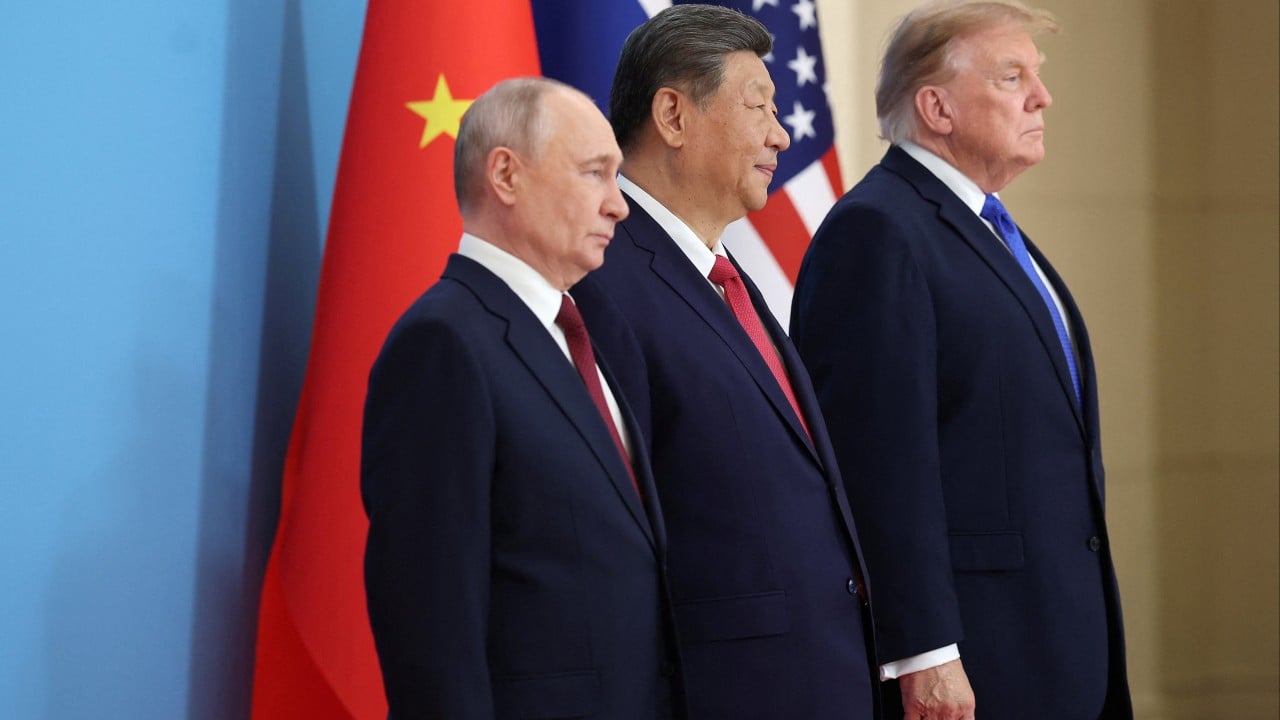
Diplomacy rarely sounds simple. When Russian President Vladimir Putin stated that cooperation among the United States, China, and Russia can strengthen global stability, most Western commentators rolled their eyes and dismissed it as routine Kremlin messaging. That reaction misses the real story.
Think about the numbers for a second. Together, Washington, Beijing, and Moscow hold roughly 90 percent of the world's nuclear warheads, control three permanent seats with veto power on the United Nations Security Council, and shape global energy, trade, and security flows. Ignoring how these three powers interact isn't realism. It's wishful thinking.
Putin's remarks about a US-China-Russia framework touch on a raw nerve in modern geopolitics. Can three rivals with clashing political systems, competing alliances, and deep mutual distrust actually stabilize anything? The answer depends entirely on what you mean by stability—and which issues you put on the table.
Why Putin's US-China-Russia Stability Pitch Keeps Coming Back
Moscow has floated variations of trilateral or great-power coordination for years, particularly at forums like the Valdai Discussion Club, the Shanghai Cooperation Organisation, and BRICS summits. The core argument from the Kremlin is consistent. Russian officials argue that the post-Cold War era of unipolar American dominance is over, and global order now rests on a multipolar balance among major centers of power.
In Putin's framing, when Washington, Beijing, and Moscow maintain open channels and respect each other's core security interests, smaller regional conflicts stay contained. When they don't, crises spiral.
From the Kremlin's perspective, this pitch serves several immediate strategic goals:
- It places Russia on equal diplomatic footing with the United States and China, pushing back against Western efforts to isolate Moscow economically and diplomatically over the war in Ukraine.
- It signals to Washington that global challenges—from nuclear arms control to Middle East escalation—can't be solved without Russian participation.
- It reinforces Moscow's alignment with Beijing while leaving room for Russia to act as an independent power broker rather than a junior partner.
Critics in Washington and Brussels view this very differently. Many foreign policy analysts at institutions like the Carnegie Endowment for International Peace and Chatham House point out that "stability" in Moscow's vocabulary often translates to spheres of influence—an arrangement where major powers divide regions among themselves while smaller nations lose sovereignty.
The Nuclear Reality Nobody Can Ignore
Strip away the diplomatic spin, and one hard fact remains. Strategic nuclear stability is impossible without all three capitals in the room.
For decades, nuclear arms control was a bilateral affair between Washington and Moscow. Treaties like the Anti-Ballistic Missile Treaty, the Intermediate-Range Nuclear Forces Treaty, and New START created guardrails, inspections, and data exchanges that kept miscalculation at bay.
Most of that architecture is now gone or suspended.
At the same time, China's nuclear arsenal has grown rapidly. According to Pentagon assessments, Beijing has expanded its operational nuclear warhead stockpile past 600 warheads and is projected to exceed 1,000 by 2030. That puts China on track to become a peer nuclear competitor alongside the United States and Russia for the first time in history.
Try solving a three-body nuclear equation with two-party rules. It doesn't work.
Washington has repeatedly argued that future strategic arms control agreements must include China alongside Russia. Beijing has historically resisted trilateral caps, noting that its arsenal remains smaller than those of the US and Russia. Moscow, meanwhile, insists that British and French nuclear forces must also be factored into any broader negotiation.
Yet despite these roadblocks, experts across all three countries acknowledge a shared interest in preventing accidental nuclear escalation, cyber interference in command-and-control systems, and the weaponization of outer space. Even during the height of the Cold War, Washington and Moscow maintained hotlines and basic risk-reduction protocols. Rebuilding trilateral crisis communication channels isn't a concession to Putin. It's basic survival math.
Where Washington, Beijing, and Moscow Actually Overlap
If you only watch cable news, it looks like the US, China, and Russia disagree on every single issue on Earth. Look closer at UN Security Council voting records and diplomatic backchannels, and a more complicated picture emerges.
There are concrete areas where interests align—or at least where uncontrolled chaos hurts everyone equally:
- Counterterrorism and transnational extremism. None of the three capitals wants militant networks operating freely across Central Asia, the Middle East, or South Asia. Following attacks like the March 2024 Crocus City Hall assault near Moscow, intelligence warnings from the US to Russia demonstrated that basic threat-sharing still happens even amid severe political hostility.
- Nuclear non-proliferation. Keeping nuclear weapons from spreading to additional states has long been a shared priority for the permanent five members of the UN Security Council. While disagreements over sanctions enforcement on North Korea and Iran have widened, none of the three powers benefits from a regional nuclear arms race in East Asia or the Middle East.
- Arctic shipping and maritime rules. Climate shifts are opening northern sea routes faster than governance frameworks can keep up. Russia controls the longest Arctic coastline, the US is an Arctic nation through Alaska, and China has declared itself a "near-Arctic state" investing heavily in polar infrastructure. Clear rules on navigation, search-and-rescue, and environmental protection prevent costly friction.
- Artificial intelligence in military systems. Both Washington and Beijing have held preliminary bilateral talks on AI safety and keeping humans in control of nuclear launch decisions. Bringing Russia into those guardrails is a logical next step if autonomous weapons systems proliferate.
None of this erases deep conflicts over Ukraine, Taiwan, NATO expansion, or trade tariffs. Cooperation on specific risks doesn't mean friendship. It means compartmentalization.
The Structural Roadblocks That Keep Derailing Trilateral Cooperation
Understanding why Putin's vision sounds appealing on paper is easy. Seeing why it stalls in practice requires looking at the structural friction among the three powers.
First, there's an acute trust deficit. Washington views Moscow's military actions in Ukraine as a direct violation of the UN Charter and European security norms. At the same time, US national security strategies identify China as America's primary long-term geopolitical competitor. From Beijing's and Moscow's viewpoints, US-led alliances like NATO, AUKUS, and bilateral defense pacts in the Indo-Pacific are designed to contain their rise and limit their regional influence.
Second, domestic politics in each capital constrains compromise. In the United States, bipartisan skepticism toward both Beijing and Moscow makes sweeping diplomatic bargains politically costly. In Russia, the state narrative frames confrontation with the West as an existential struggle, leaving limited room for sudden public reversals. In China, leadership prioritizes sovereignty, economic resilience, and avoiding any arrangement that looks like bowing to external pressure.
Third, the three countries define "global stability" in fundamentally different ways:
- The United States defines stability around a rules-based international order, open maritime commons, alliance commitments, and democratic governance norms.
- China emphasizes state sovereignty, non-interference in internal affairs, economic connectivity, and stable trade routes.
- Russia focuses on great-power parity, multipolarity, security buffers along its borders, and resistance to unilateral Western sanctions.
When three countries use the same word to describe three competing visions of world order, diplomatic statements alone won't bridge the gap.
What History Tells Us About Great-Power Concert Models
Putin's emphasis on major powers managing global stability echoes an older diplomatic concept—the 19th-century Concert of Europe, or Franklin D. Roosevelt's World War II vision of the "Four Policemen" keeping peace after 1945.
History offers a clear lesson about how those arrangements work and why they break down.
Great-power coordination succeeds when the leading states share a basic consensus on territorial legitimacy and focus on narrow, verifiable mechanisms—like border commissions, naval incident agreements, or arms ceilings. The 1972 US-Soviet Incidents at Sea Agreement is a classic example. It didn't end the Cold War, and it didn't solve ideological rivalry. It simply established clear rules so warships and aircraft wouldn't collide and trigger an unintended war.
On the flip side, great-power deals fail whenever they try to dictate the political fate of smaller countries without their consent, or when one power uses diplomatic forums purely to buy time while shifting facts on the ground. European allies, Indo-Pacific partners like Japan and South Korea, and nations across the Global South are deeply wary of any US-China-Russia arrangement that sidelines their voices.
How to Read Future Statements on US-China-Russia Relations
When headlines flash about Putin, Xi Jinping, or US leaders referencing trilateral stability, don't get distracted by broad rhetoric. Watch the concrete indicators instead.
Look for technical working groups on nuclear risk reduction and hotline upgrades—those signal genuine crisis management rather than public relations. Track UN Security Council resolutions where all three abstain rather than veto, which often reveals quiet diplomatic bargaining behind closed doors. Pay attention to whether bilateral talks between Washington and Beijing or Washington and Moscow include agenda items that explicitly require the third capital's participation.
If you want to follow how this triangular dynamic actually shapes global markets, energy prices, and security policy, focus on verifiable actions rather than speeches—track arms control compliance reports from the Stockholm International Peace Research Institute, monitor official UN Security Council voting records, and compare readouts from all three foreign ministries side by side whenever major summits happen.