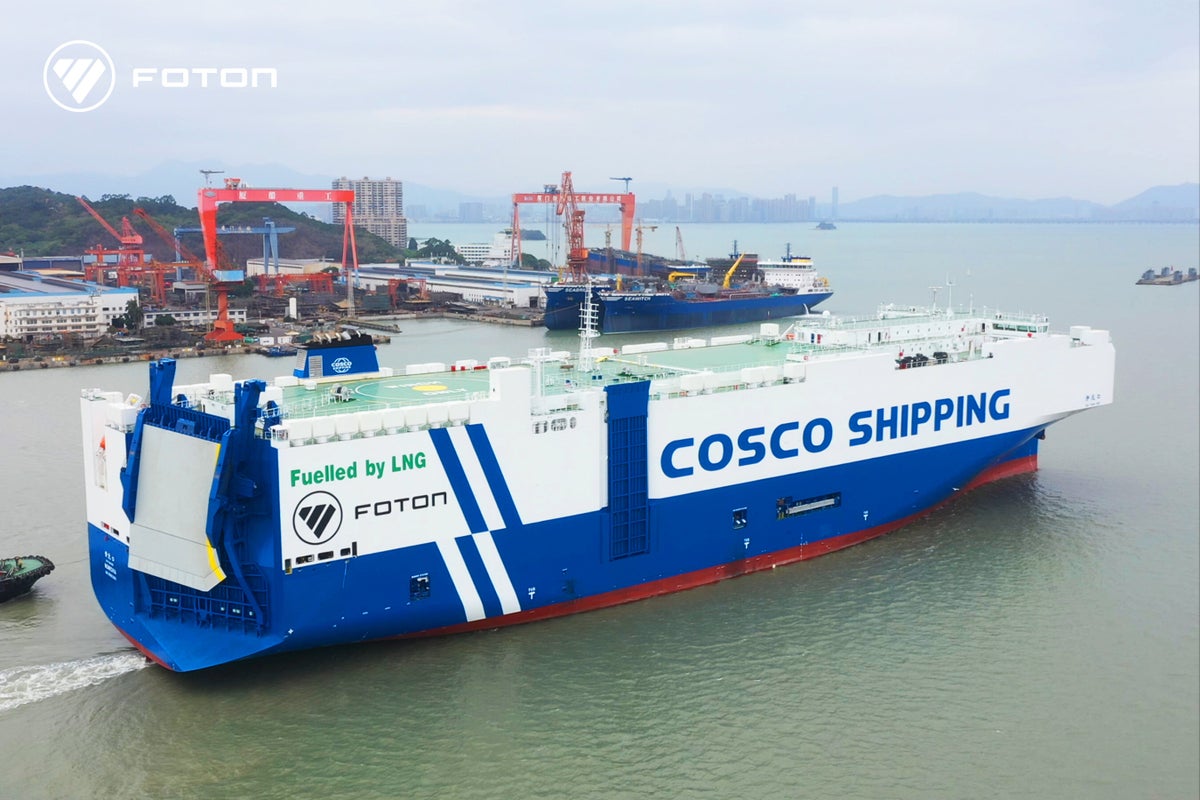
Modern statecraft relies on an invisible friction between commercial globalization and sovereign defense. When intelligence assessments indicate that state-owned merchant vessels operate clandestine signals intelligence collection nodes near foreign territorial waters, the discussion usually devolves into predictable geopolitical theater. Beneath the diplomatic friction lies a structural reality of modern supply chain design: commercial efficiency mandates open access, while national security demands absolute perimeter control. The integration of state-directed collection hardware onto commercial container carriers turns standard maritime logistics into a decentralized intelligence apparatus, exposing the severe friction points where global trade networks double as military surveillance platforms.
The Dual-Use Logistics Vector
The operational mechanics of commercial maritime espionage rely on the doctrine of civil-military fusion. State-owned enterprises do not operate as isolated commercial entities maximizing shareholder value within a vacuum. Under statutory mandates, domestic corporations must provide technical support, data access, and physical infrastructure cooperation to state intelligence agencies. For another look, read: this related article.
This creates a structural asymmetry in maritime security enforcement. A dedicated naval intelligence vessel presents a clear tactical profile, allowing defense networks to track, shadow, and neutralize its operational utility. Conversely, a container mega-ship operating under standard commercial flags blends into normal port traffic schedules.
The logistics footprint offers several distinct advantages for signals interception: Further analysis on this trend has been published by USA Today.
- Constant proximity to major littoral chokepoints, naval stations, and submarine transit lanes.
- Access to shore-side power, container terminals, and heavy logistical support without triggering counter-intelligence alerts.
- Cover for hardware installation and maintenance under the guise of routine electronic servicing or container retrofitting.
- Shielding by commercial contract law, making unilateral interdiction or boarding operations legally and economically disruptive.
These variables explain why administrative designations, such as Pentagon procurement bans, exert minimal operational friction on the underlying collection mechanism. A procurement restriction prevents direct defense contracting, but it does nothing to stop a vessel from docking at commercial container terminals to offload consumer goods while simultaneously recording electromagnetic emissions from nearby military installations.
The Signal Collection Matrix
To understand what intelligence analysts monitor aboard these vessels, one must examine the specific mechanics of maritime signals intelligence. Coastlines facing major commercial sea routes are saturated with high-frequency military communications, tactical data links, radar calibrations, and electronic warfare testing transmissions.
Commercial hulls operating at slow speeds or idling in designated anchorages off major naval hubs function as stationary collection posts. The hardware suite required to capture these transmissions does not look like traditional military radar. Instead, modular electronic arrays can be housed inside standard intermodal shipping containers or integrated directly into onboard telecommunication masts.
The collection targets fall into three distinct analytical categories. First, electronic signatures and radar parameters help military planners map coastal defense layouts and active response times. Second, communication telemetry yields insight into encryption protocols, frequency hopping routines, and cryptographic evolution over time. Third, tracking routine naval movements establishes baseline operational tempos for carrier strike groups and submarine deployments.
This creates an acute vulnerability loop for defense planners. Standard military communications rely on predictable frequencies and satellite uplinks to coordinate fleet movements near home ports. Every transmission from a shore-based facility or a departing surface combatant represents an electromagnetic footprint that nearby commercial receivers can capture, digitize, and backhaul via routine digital logs.
The Economic Deterrence Trap
Countering this form of asymmetric surveillance requires more than rhetorical condemnation or targeted procurement bans. Policymakers face a high-stakes trade-off governed by systemic economic dependency. Container shipping networks operate on razor-thin margins and massive economies of scale. Removing major state-linked shipping operators from domestic ports introduces catastrophic supply chain friction.
The cost function of wholesale exclusion involves several cascading economic penalties:
- Immediate spikes in transpacific freight rates due to reduced vessel capacity and terminal congestion.
- Severe capital losses for terminal joint ventures and port authorities heavily reliant on continuous container throughput.
- Supply chain contraction affecting manufacturing inputs, retail inventories, and downstream distribution logistics.
- Retaliatory port restrictions targeting domestic carriers operating within foreign jurisdictions.
Because total decoupling carries prohibitive economic costs, governments frequently resort to cyclical policy pauses. Trade negotiations, diplomatic summits, and temporary tariff truces consistently override long-term counter-intelligence imperatives. This dynamic locks national security agencies into a reactive posture where intelligence assessments are published, diplomatic protests are filed, and commercial operations continue unabated.
Strategic Realignment Protocols
Mitigating the risks posed by dual-use commercial espionage requires shifting the security paradigm away from blunt trade bans toward strict port-side technical verification. Defense strategies must transition from asking whether a suspicious fleet can be banned to questioning how maritime infrastructure can be insulated against compromise.
Mandatory electronic auditing for all vessels entering strategic maritime zones represents a necessary structural upgrade. Port authorities must implement continuous spectrum monitoring within territorial waters to detect unauthorized local electromagnetic emissions originating from commercial hulls. Furthermore, customs enforcement frameworks should treat non-standard communication wiring and unlisted electronic enclosures inside commercial cargo spaces as direct violations of port entry protocols.
The long-term resolution depends on rebuilding domestic commercial shipbuilding capacity and reducing reliance on state-subsidized foreign transport monopolies. Until domestic maritime logistics achieve structural independence, commercial trade routes will remain an open vector for strategic intelligence extraction.